
Top Things to Know
Kydex holster prices rose in 2026 due to higher material costs and increased manufacturing demand. While premium rigs can exceed $100, most CCW carriers find maximum value in the $30 to $65 range. Safety is determined by a four-point check, including full trigger-guard coverage and an audible retention click, rather than by price.
Related: AIWB Appendix Carry Holster Setup: The 2026 Guide to Comfort, Speed, and Safety
If you have shopped for a Kydex holster recently, you have probably had the same thought as a forum carrier who said it plainly in early 2026: “I’ve got a drawer full of Kydex and wasted money as proof.” Prices have moved upward across most major brands since 2024, and the gap between a budget shell and a premium rig now feels wider than the actual functional difference.
The honest answer for the CCW carrier asking whether they are being smart or cheaping out is that you can do either at any price point, because the variable that decides which is happening is not the price tag but whether the holster passes a small set of non-negotiable checks. This guide walks through what is driving Kydex holster prices upward, the four-point check that determines adequacy at any tier, and the sub-$50 picks that earn a place in daily carry rotation.
Why Have Kydex Holster Prices Gone Up in 2026?
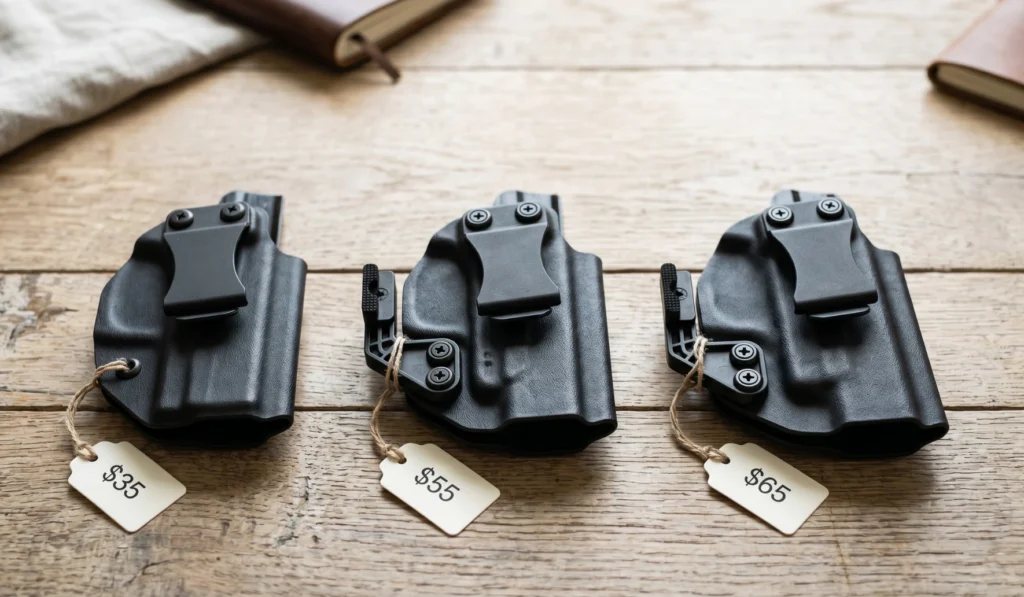
Several real cost pressures have stacked up since 2024. Kydex sheet stock has gotten more expensive. Hardware (clips, screws, threadlockers) has gotten more expensive. Small-shop labor has gotten more expensive. Demand from new permit holders has stayed elevated, and the holster market has absorbed price increases that consumers were willing to pay.
Not all of the increase is cost-driven. Some of it is brand premium expansion, where a name that built equity a decade ago now charges $130 to $180 for a shell that costs the same to make as a $50 competitor. Both are true at the same time, and the rising tide of Kydex holster prices reflects both forces.
What that means for you: the question is not whether prices are too high. The question is what you are actually paying for at each tier, and whether you need it.
What Actually Matters in a Kydex Holster, At Any Price?
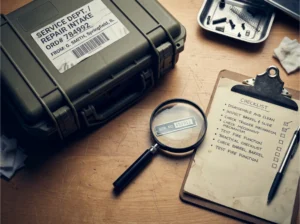
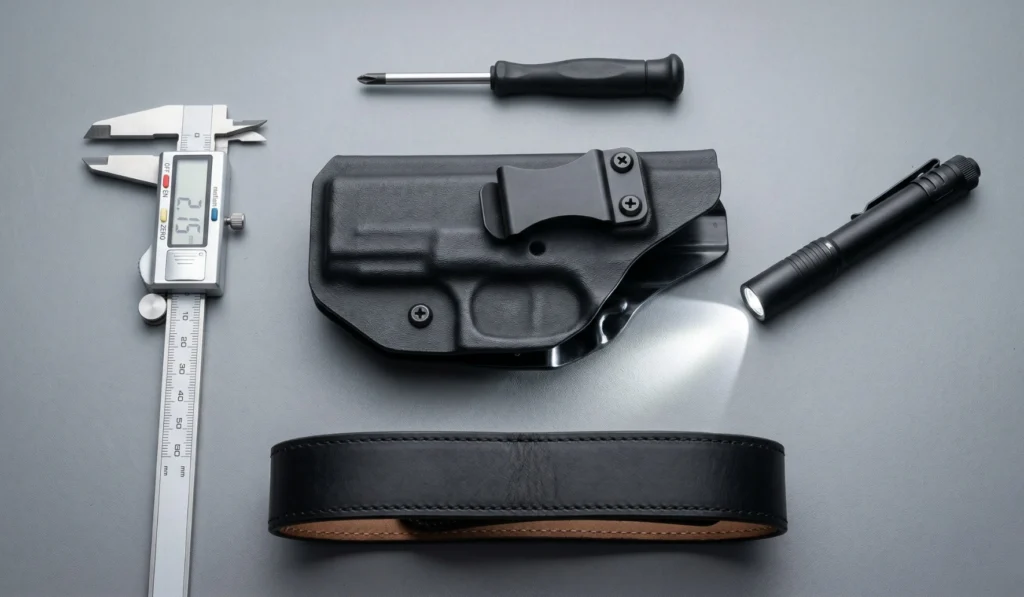
Most of what separates an adequate holster from an inadequate one is verifiable in five minutes with the holster in your hand. We call it the Four-Point Check, and it applies whether you are looking at a $35 shell or a $175 custom rig.
- Point 1: Full trigger guard shell coverage. The Kydex must completely cover the trigger guard with no gaps. This is the safety variable. A holster that exposes any portion of the trigger is not a concealed carry holster, regardless of what it costs.
- Point 2: Audible retention click on re-holster. When you re-holster (with an unloaded firearm, in a safe direction), you should hear and feel a positive click. A holster that lets the gun slide in without that confirmation has retention slop, and retention slop becomes a problem in real-world movement.
- Point 3: Model-specific molding. The shell should be molded for your exact firearm. “Fits multiple guns” or “compatible with X, Y, Z” is a red flag. Generic-fit shells leave gaps, allow movement, and produce inconsistent draws.
- Point 4: Belt clip rated for your belt width. A 1.5-inch clip on a 1.75-inch gun belt rotates and rides up. Match the clip to the belt you actually wear daily.
A holster that passes all four points at $40 is functionally adequate. A holster that fails any one of them at $140 is functionally inadequate. The persona dossier captures this in plain terms: “Half of it was junk or didn’t fit me.” That is the four-point check, in reverse.
What Are the Best Kydex Holsters Under $50 for Daily Carry?
Two sub-$50 options pass the four-point check on the firearms most CCW carriers actually own. These are not aspirational picks. They are workhorses.
- Concealment Express IWB AIWB Kydex ($28 to $50): This is the budget entry point, and it earns its place: rigid Kydex shell, basic adjustable retention, model-specific molding for over 200 firearm fitments. Inspect on arrival for edge finishing and retention click. If both pass, this holster is a legitimate daily carry option for the next 12 to 18 months. It is not the holster you keep forever, but it is a real holster, not a compromise.
- Rounded by Concealment Express IWB ($45 to $65): A small step up from the entry tier, with the same 100% USA-made Kydex construction and the Posi-Click retention system. Made-to-order in Jacksonville, Florida, with free shipping on orders over $50. This is the value-tier sweet spot for a carrier that wants made-to-order fitment without crossing into premium pricing.
Both options are sold on Amazon and direct from the manufacturer. Direct from the manufacturer typically gets you the most current shell molds and a lifetime warranty. Before you carry either holster live, run the four-point check yourself. Edge finishing varies between production runs on every brand at every price point, and a five-minute inspection on arrival is the difference between a safe rig and a risky one.
When Is It Worth Paying More for a Premium Kydex Holster?
Here is where buyers get into trouble. The community is split on whether premium Kydex is worth the price for an average CCW carrier, and both sides are partly right. The answer depends on where you are as a carrier.
- If you are a new daily carrier without a benchmarked drawstroke baseline: Buy the budget tier. Pass the four-point check. Carry it for six months. Then re-evaluate. The budget tier is the right floor for the new carrier because you do not yet know which holster characteristics matter to you. Spending $150 before you have measured anything is buying refinements you cannot detect.
- If you are a benchmarked carrier with documented draw times, and you can attribute variance to your holster, this is the case for upgrading. Poor grip indexing, retention slop you cannot dial out, belt slap that costs you a tenth of a second, and ride height that does not work for your body. Spending buys solutions to specific measured problems.
- If you have not measured your draw and you are buying premium Kydex on reputation alone: Stop. Run the benchmark first. Most carriers who do this discover their floor was fine all along.
For carriers who have done the work and want a mid-premium upgrade, the Vedder ComfortTuck IWB Hybrid ($69.99) is the recommended pick. Hand-made in the USA, premium leather backing, formed Kydex shell, lifetime warranty, 30-day return window. The leather backing changes the carry feel for back-hip 3-to-5 o’clock carry in a way Kydex-only shells do not. It is the right purchase for the carrier who has measured the gap they are trying to close. Carriers shopping warm-weather concealment specifically should also review our IWB summer carry guide before committing to a hybrid versus an all-Kydex shell.
Are Cheap or DIY Kydex Holsters Safe for Concealed Carry?
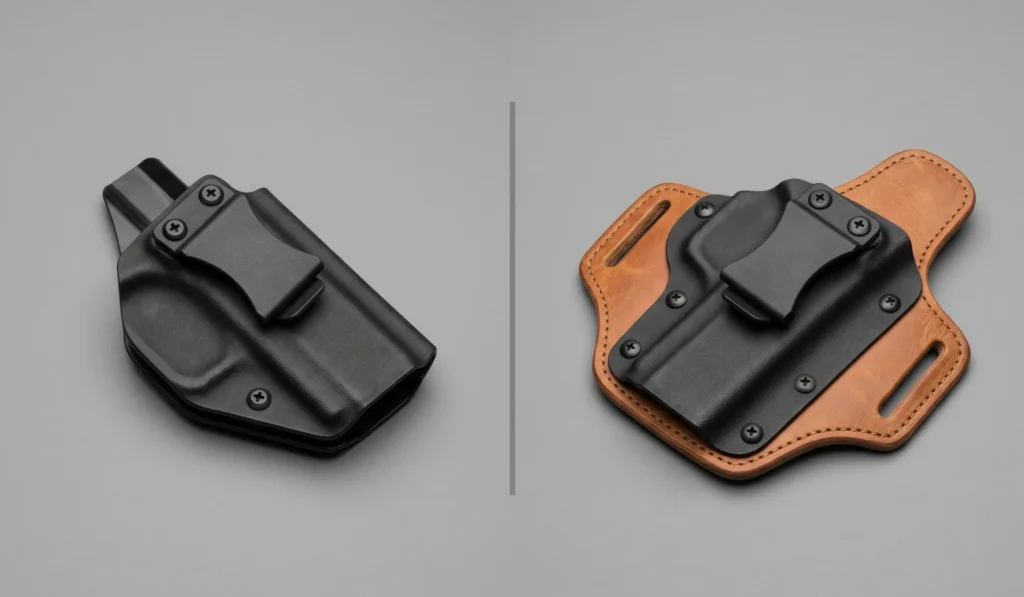
Cheap is not the same as inadequate. Inadequate is inadequate at any price. A $35 holster that passes the four-point check is safe to carry. A $200 holster that fails at any point is not.
DIY Kydex is legal in most states for personal use, but the four-point check still applies and is harder to verify on a first build. Heat warpage, inconsistent retention, and incomplete trigger guard coverage are common failure modes on home-formed shells. New carriers should not start with DIY. Carriers who have carried for years and want to learn the craft can build their own, but the safety floor does not move.
How Do I Buy a Kydex Holster Without Wasting Money?
Kydex holster prices are higher in 2026 than they were two years ago, and they are likely to stay that way. The carriers who navigate the price increases without wasting money are the ones who treat the holster as a function, not a brand. The four-point check determines safety. Carry consistency determines effectiveness. Refinement is what you pay for above the floor, and refinement is worth paying for only when you can name the specific problem you are solving.
Run the four-point check on the holster you carry today. If it fails at any point, replace it this week, regardless of what you paid for it. If it passes, ask the next question: Are you actually drawing from it consistently, or has it been sitting in a drawer for a month? A budget holster you wear every day is functionally worth more than a premium holster you take off.
Shop the picks:


Last update on 2026-09-24 / Affiliate links / Images from Amazon Product Advertising API
(As an Amazon Associate, we earn from qualifying purchases.)
Check out HuntingGearsPro‘s Top 6 Best Gun Holsters for Concealed Carry 2026!
Frequently Asked Questions
-
Why are Kydex holsters so expensive now?
Prices have risen since 2024 due to higher costs for Kydex sheet stock, hardware, and small-shop labor. Demand from new permit holders has also let manufacturers raise prices the market will accept. Some increases reflect real costs, and some reflect brand premium expansion that the holster market has been willing to pay.
-
What is a good quality Kydex holster under $50?
Concealment Express IWB and the Rounded by Concealment Express line are widely-carried sub-$50 options that pass the core safety checks. They provide full trigger guard coverage, model-specific molding, and reliable retention. Inspect any sub-$50 holster on arrival for edge finishing, retention click, and full shell coverage before carrying it live.
-
Is a cheap Kydex holster safe for concealed carry?
A cheap Kydex holster is safe if it passes four checks. Those checks are full trigger guard shell coverage, audible retention click on re-holster, model-specific molding for your exact firearm, and a belt clip rated for your belt width. Price is not the safety variable. Fit and coverage are.
-
What is the difference between a $50 and a $150 Kydex holster?
At $50, you are buying the function: trigger guard coverage, retention, model-specific fit, and daily-wear durability. At $150, you are typically buying refinement: adjustable cant and ride height, sweat shields, premium hardware, and brand reputation. Refinement matters for measured problems but does not change the safety floor.
-
Are DIY Kydex holsters safe and legal for concealed carry?
DIY Kydex holsters are legal in most states for personal use, but they must still pass the four-point check. Verifying full trigger guard coverage, reliable retention, model-specific fit, and proper belt attachment is harder on a first build. New carriers should not start with DIY. Experienced carriers can build their own once they know what they are checking.
-
How do I know if my Kydex holster fits my gun correctly?
Check three things with an unloaded firearm in a safe direction. The trigger guard must be fully covered with no gaps, the holster must produce an audible click when you re-holster, and the gun must not move or rattle when the holster is shaken upside down. If any check fails, the holster does not fit your gun.
-
How long does a Kydex holster last with daily carry?
A properly made Kydex holster used for daily concealed carry typically lasts two to five years. After that, expect noticeable retention loss, edge wear, or hardware fatigue. Inspect monthly for cracks, loose hardware, and retention changes. Replace at the first sign of any safety-relevant degradation, regardless of how recently you bought it.
-
Should I buy a Kydex holster online or in-store?
Both work if you verify the holster on arrival or in hand. Online buying gives access to model-specific fit and better pricing, often with manufacturer-direct lifetime warranties. In-store lets you check the trigger guard coverage and retention click before paying. Either way, do not carry the holster live until it passes the four-point check.
-
Is the Vedder ComfortTuck worth the price over a sub-$50 Kydex holster?
The Vedder ComfortTuck at $64.99 is worth the upgrade for carriers who have measured a specific problem with their current rig. Ride height, cant, retention slop, or back-hip comfort during long-day wear all qualify. For new carriers who have not benchmarked their draw, a sub-$50 holster is the smarter starting point.
Why did that setup get your vote? We want to hear the technical specs.👇