
Quick Look
Building a reliable daily carry habit fails when your gear fights your lifestyle. Consistency is achieved through a three-part system: performing a wardrobe audit to match your holster to real clothing, choosing a firearm sized for all-day wear, and resolving chamber-carry hesitation through deliberate dry-fire practice rather than unchambered carry.
Table of Contents
- Why Do Most CCW Holders Struggle to Build a Real Daily Carry Habit?
- How Do You Choose a Carry Gun You Will Actually Wear Every Day?
- What Holster Setup Makes All-Day Carry Comfortable Enough to Be Automatic?
- Should You Carry One in the Chamber for Your Daily Carry Habit?
- How Do You Turn Your Daily Carry Habit Into an Automatic Morning Routine?
- What Do You Need to Know About Carrying Legally Every Day?
- What Are the Three Daily Carry Mistakes That Break Consistency Before It Starts?
- Frequently Asked Questions
Browse r/CCW on any given day, and the same admission surfaces in thread after thread: “I have the permit, I have the gun. I don’t carry every single day.” That is the commitment plateau. Most CCW holders hit it between years two and five. The permit is paid for. The gear is in the drawer. The daily carry habit never quite formed.
Here is the reframe: this is not a motivation problem. It is a system problem. Three specific friction points break the daily carry habit for most permit holders: the wrong gun for the real wardrobe, a holster that was never tested in actual everyday clothing, and chamber-carry hesitation that never got resolved through deliberate practice. Every one of those friction points is fixable without buying a new gun.
Why Do Most CCW Holders Struggle to Build a Real Daily Carry Habit?
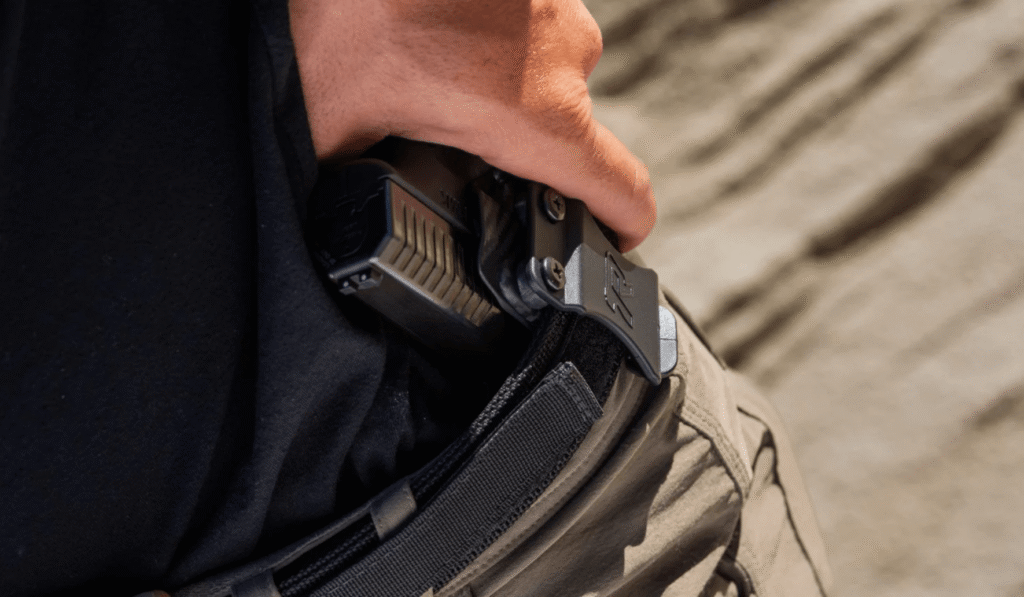
The commitment plateau follows a pattern. The permit clears, the first carry gun gets purchased, and the carrier wears it consistently for a few months. Then summer arrives, or a new job requires different clothing, or the holster starts printing through a lighter shirt, and the exceptions begin. One day off becomes three days a week. The gun moves from the hip to the nightstand to the safe, and the daily carry habit never becomes the default it needs to be.
The gun that stays home because it is uncomfortable has already failed its one job.
Three friction categories account for the majority of daily carry habit failures. The first is physical discomfort: the holster digs, the gun shifts during a full day of sitting and standing, and the weight reads wrong against everyday clothing. The second is wardrobe mismatch: the system that worked in November fails the moment shorts season arrives. The third is chamber-carry hesitation: the carrier who is not fully confident in the loaded configuration defaults to an unchambered setup that quietly erodes carry confidence over time.
Each one is a system problem. Each one has a specific fix. None of them requires a personality change or a new level of commitment.
How Do You Choose a Carry Gun You Will Actually Wear Every Day?
The full-size versus compact debate runs through every daily carry habit discussion on r/CCW, and both sides make a legitimate point applied to the wrong timeline.
The full-size argument is sound: a larger platform is easier to train with under stress, holds more rounds, and often runs more reliably over extended use. The compact argument is equally sound: “Just get something you are comfortable with. Gun sitting in the safe defeats the purpose.” That line has become the most-repeated truth in these threads because it holds up under scrutiny.
Here is how to reconcile both positions using a phase approach.
In the first 90 days of working toward a consistent daily carry habit, the priority is friction removal. A compact or subcompact that produces zero discomfort and gets worn 28 or more days out of every 30 is outperforming the full-size left in the center console. Carry frequency is the only metric that matters at this stage.
After 90 days of established daily carry, the question shifts from comfort to competency. Can you draw from concealment and place a first round on a five-inch circle at five yards in under three seconds? If yes, the carry system is functioning on both fronts. If the gun is too small to train with reliably under stress, the next step is scaling toward the largest platform that still clears the wardrobe and comfort threshold.
The best carry gun is not the one that shoots best at 15 yards. It is the one that is on your hip at 3 p.m. on a Tuesday.
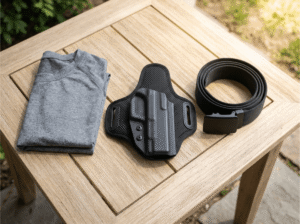
Before selecting any holster or committing to a carry position, run a wardrobe audit. List every outfit you realistically wear at least three times a week. The holster and carry position must produce a clean drawstroke across the majority of those outfits, not your range clothes or one preferred pair of jeans. This single step eliminates most of the holster friction that breaks the daily carry habit in the first 60 days.
What Holster Setup Makes All-Day Carry Comfortable Enough to Be Automatic?
Most daily carry habit failures are holster failures dressed up as motivation failures. “I wasted a lot of money on cheap nylon holsters” is not a beginner’s complaint. It is the standard experience of permit holders who skipped the wardrobe audit and bought based on online ratings. “Expect plenty of trial and error and a closet shelf of rejects” is not a rite of passage. It is a preventable outcome.
A holster built to support a daily carry habit passes three tests. First, it holds the gun securely through a full day of movement, including sitting, driving, and walking without shifting or rotating. Second, it stays comfortable across all three of those positions, not just one. Third, it conceals under your actual everyday clothing without requiring a cover garment heavier than you would normally wear.
If your holster only works with one specific outfit, you do not have a carry system. You have a range accessory.
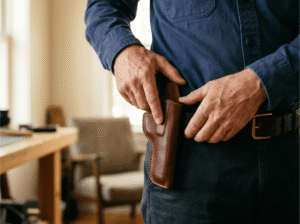
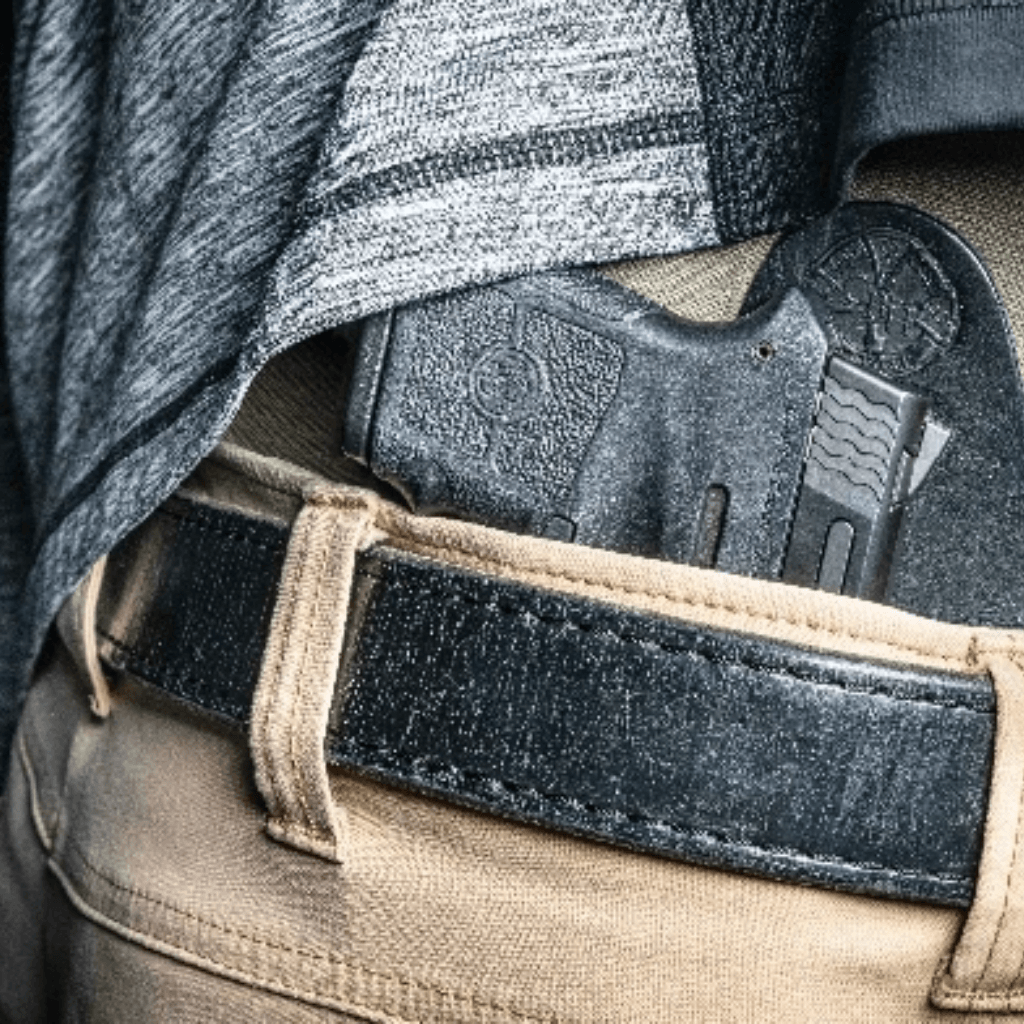
IWB carry is the default daily carry position for most CCW holders because it places the gun inside the waistband, where a standard shirt provides concealment without a dedicated cover garment. The tradeoff is that fit matters more with IWB than with any other carry position. A holster built specifically for your firearm model, tested in your actual wardrobe, will feel substantially different from a universal-fit option within the first two hours of wearing it.
The Vedder LightTuck IWB ($69.99) and Alien Gear Cloak Tuck 3.5 ($64.88) are two of the most consistently recommended options in this category for all-day wear. The Crossbreed SuperTuck Deluxe ($74.95) adds a padded backing for carriers who prioritize all-day comfort over minimal profile.
Should You Carry One in the Chamber for Your Daily Carry Habit?
Chamber-carry hesitation is real and understandable, particularly in the first one to two years of building a daily carry habit. Addressing it without condescension is the starting point. Here is the direct answer.
A modern striker-fired pistol paired with a quality holster that fully covers the trigger guard is engineered for chamber-loaded carry. The firearm does not fire without trigger contact. The holster prevents unintended trigger contact. Those two facts together are the complete safety case. The holster is the safety system. Any holster that exposes the trigger guard is not an acceptable option for daily carry, regardless of its other features.
The readiness case is separate from the safety case. A defensive encounter does not provide time to rack the slide after the draw. The draw from concealment to a ready position is the window a real situation allows. A carrier operating with an empty chamber cannot act within that window.
An unloaded chamber is a comfort decision dressed up as a safety decision. The actual safety decision is a holster that fully covers the trigger guard.
If chamber carry still creates uncertainty after understanding both cases, the correct answer is more dry-fire practice with the holstered gun, not an empty chamber. Draw from the holster. Build the sequence through repetition. The hesitation resolves through familiarity, not through a workaround that undermines the entire purpose of the daily carry habit.
How Do You Turn Your Daily Carry Habit Into an Automatic Morning Routine?
The daily carry habit does not form through motivation. It forms through a sequence. Motivation requires a fresh decision every morning. A sequence does not.
Attach carry to an existing anchor behavior: getting dressed, lacing shoes, picking up keys. When the sequence becomes keys, wallet, phone, gun, carry stops being a separate decision. It becomes the fourth step in a routine that already runs without conscious input.
Thirty consecutive days of full-duration carry establish the pattern. The first week involves deliberate decision-making each morning. By week four, most carriers report that leaving home without the gun creates a physical awareness that something is missing. That awareness is the daily carry habit, confirming it has moved from conscious effort to automatic routine.
Daily carry is not a mindset shift. It is a morning routine with a firearm in it.
The carry system must function without modification across your three primary daily environments: vehicle, workplace, and home. If the holster or carry position requires any adjustment to work across all three, the anchor breaks every time you cross one of those thresholds. Build the system to clear all three environments before committing to the 30-day sequence.
Five to ten minutes of drawstroke practice three times per week maintains the physical skill that supports the daily carry habit. The gun goes off every morning. The drawstroke gets practiced three times a week. The loop is complete.
For carriers who want structured training resources and legal coverage in a single membership, USCCA Gold ($29/month) addresses both before a defensive situation requires either one.
What Do You Need to Know About Carrying Legally Every Day?
Building a daily carry habit means carrying in more environments, on more days, than most permit holders are accustomed to. That consistency exposes legal gaps that occasional carriers rarely encounter. Three areas require specific attention before the daily carry habit becomes a full-time routine.
- Vehicle storage requirements vary by state. Most states permit lawful concealed carry in a personal vehicle for permit holders. The requirements for when you exit the vehicle differ significantly across jurisdictions. Some states require the firearm to be in a locked container when the carrier leaves the vehicle. Others impose no such requirement for permit holders. A carrier building a daily carry habit transitions in and out of vehicles multiple times per day. Know your specific state’s vehicle storage law before treating your car as a secondary holster position.
- Workplace carry policies are not the same as state law. Most private employers in most states can legally prohibit concealed carry on their premises. A workplace carry prohibition, in most states, does not automatically extend to the parking lot. Several states, including Florida, Texas, and Louisiana, have enacted parking lot protection laws that prohibit employers from restricting lawful firearm storage in employees’ locked vehicles. If your employer prohibits carrying inside the building, verify whether your state’s parking lot law applies before assuming the prohibition covers your vehicle.
- State reciprocity affects any daily carry habit that crosses a state line. If your regular commute, work travel, or routine errands cross a state line, your home state permit may not be recognized in every state you enter. A non-resident permit from a state with broad reciprocity fills most of those gaps for regular interstate travelers. Verify reciprocity for every state you travel through consistently, not just states you visit occasionally.
Consult your state’s current carry laws before relying on any general summary, including this one. Firearms law changes, and reciprocity agreements change with it.
Check out Gun Laws by State: 2025 Edition (Updated 2026).
Legal disclaimer: This section is for general informational purposes only and does not constitute legal advice. State and local firearms laws vary. Consult a licensed attorney in your jurisdiction for guidance specific to your situation.
What Are the Three Daily Carry Mistakes That Break Consistency Before It Starts?
Mistake 1: Choosing a carry gun based on range performance rather than all-day wearability. The gun that shoots best in a two-hour range session is not automatically the one that disappears on your hip for ten hours. Run the wardrobe audit before purchasing. Not after three uncomfortable outings that ended with the gun going back in the drawer.
Mistake 2: Carrying with an empty chamber. This does not make the daily carry habit safer. It makes it slower and less reliable at the precise moment the habit exists to address. The carrier who does not trust themselves to carry chambered has not resolved the safety question. They have deferred it to the worst possible moment.
Mistake 3: Treating carry as an event rather than a baseline. Date nights only. Long road trips only. Neighborhoods that feel risky. Every exception teaches the nervous system that the daily carry habit is negotiable. A habit that is negotiable is not a habit. It is an occasional preference.
Every exception you allow teaches your nervous system that carrying is optional.
Ready to Build a Daily Carry Habit That Lasts? Start With Your Morning.
Three friction points break the daily carry habit for most permit holders: the wrong gun for the real wardrobe, a holster that was never tested in actual everyday clothing, and chamber-carry hesitation that never got resolved through deliberate practice. All three are system problems. None of them requires a new level of commitment. They require a better-engineered system.
Run the wardrobe audit this week. Test your current holster in the clothes you actually wear tomorrow morning. Attach carry to your existing morning sequence and commit to 30 consecutive days. If the holster is the friction point, the Vedder LightTuck IWB and Alien Gear Cloak Tuck 3.5 are the two starting points worth evaluating before spending more.
Your permit is the license. Your daily carry habit is the commitment. Build the system, and the commitment takes care of itself.
Check out 7 Things To Do Before Carrying A Gun from Colion Noir.
Frequently Asked Questions
-
How do I build a consistent daily carry habit if I keep forgetting to put my gun on?
Attach carry to an existing morning anchor behavior rather than treating it as a separate decision. Keys, wallet, phone, gun. When all four are steps in the same morning sequence, none gets left behind. The daily carry habit forms through sequence repetition, not motivation. Thirty consecutive days of full-duration carry is the threshold where the routine becomes automatic.
-
Is it better to carry a smaller gun every day or a full-size gun sometimes?
The gun that is with you when an incident occurs is the only gun that matters in that moment. A compact carried every day outperforms a full-size carried three days a week. Once the daily carry habit is established at 28 or more carry days per month, evaluate whether the carry gun can be trained to a documented competency standard. If not, scale up.
-
How do I carry concealed all day without it being uncomfortable?
Holster quality and carry position are the two highest-impact variables. An IWB holster built for your specific firearm model, positioned correctly for your body type, and tested in the clothes you actually wear will feel substantially different from a universal-fit option within the first two hours. Most daily carry discomfort is a holster problem, not a body type problem.
-
Should I carry one in the chamber for concealed carry?
Yes. A quality holster with full trigger guard coverage is the safety system for a modern striker-fired pistol. The firearm requires trigger contact to fire, and the holster prevents unintended trigger contact. An empty chamber removes the ability to respond within the narrow window that a real defensive encounter allows. Chamber-loaded carry within that holster setup is the correct configuration.
-
What is the best IWB holster for all-day concealed carry?
The best IWB holster for a daily carry habit is the one that fits your specific firearm, passes a drawstroke test in your actual everyday clothing, and stays comfortable across sitting, driving, and standing. The Vedder LightTuck IWB, Alien Gear Cloak Tuck 3.5, and Crossbreed SuperTuck Deluxe are the three most consistently recommended options in this category for all-day carry.
-
How do I know if my carry setup is right for my body type?
Run the wardrobe audit before buying anything. List the five outfits you wear most often during the week. Test your holster and carry position in each one. If the drawstroke clears comfortably in at least four of the five, the system passes. If it fails two or more, the carry position, holster, or both need adjustment before the daily carry habit can form reliably.
-
How long does it take to build a daily carry habit?
Thirty consecutive days of full-duration carry is the threshold most carriers report as the turning point. The first week requires deliberate decision-making each morning. By week four, most carriers notice a physical awareness of something missing when they leave home without the gun. That sensation signals that the daily carry habit has shifted from conscious effort to automatic routine
-
What do I do if my workplace does not allow concealed carry?
Know your state law and your employer’s written policy. Many workplaces prohibit carrying inside the building but permit secure storage in your locked vehicle, particularly in states with parking lot protection laws. The daily carry habit still applies: carry to the vehicle, secure legally during work hours, and carry home. The routine does not break because the building does.
-
Do I need formal training before building a daily carry habit?
A verified competency baseline matters before committing to daily carry. A basic defensive pistol course and a timed drawstroke benchmark, run and documented, establish the floor. Recurring dry-fire practice three times per week maintains it. The daily carry habit and the skill that supports it are most effective when they develop in parallel rather than in sequence.
-
How does warm weather affect the daily carry habit, and how do I adjust?
Summer carry reduces clothing options and increases printing risk, which is why many carriers abandon their daily carry habit seasonally rather than adapting it. The solution is matching your carry position and gun size to lighter clothing before summer starts, not during it. An appendix carry with a compact platform addresses most warm-weather wardrobe constraints without requiring a new firearm.