Quick Look at Appendix Carry Holster
Appendix Inside-the-Waistband (AIWB) carry positions the firearm at the body’s centerline for the fastest drawstroke and best concealment of any carry position. A workable appendix carry holster setup requires three things: a rigid Kydex shell with full trigger guard coverage, a dedicated gun belt, and dialed-in ride height and cant.
Related: Which Holster Problems Show Up in Week One?
If you have a drawer full of holsters that did not work out, you are not alone. Appendix inside-the-waistband (AIWB) carry is the fastest-growing carry position in the CCW community, and also one of the most misunderstood. When the appendix carry holster setup is correct, AIWB gives you the fastest drawstroke of any carry position, solid concealment under a t-shirt, and reliable access whether you are standing, seated, or driving. When the setup is wrong, it is uncomfortable, unsafe to re-holster, and likely to end up in that same drawer.
What Is the Difference Between AIWB and Standard IWB Carry?

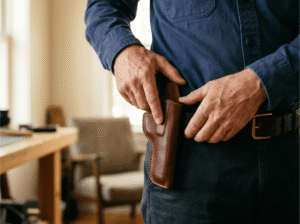
Standard IWB holsters sit between the 3 o’clock and 5 o’clock positions, near or behind the strong-side hip. AIWB positions the firearm at or near the 12 o’clock position, at the body’s centerline, just inside or beside the hip bone, depending on your build.
That position change affects nearly every aspect of how the carry system performs.
Drawstroke mechanics. The AIWB draw follows a shorter, more direct arc for most shooters. The hand drives straight down to the grip instead of reaching behind or across the body. This matters in seated positions, under stress, and when time is short. Most civilian defensive shootings happen at three to seven yards with minimal warning time, and the drawstroke from concealment is typically the slowest element in the response chain. A holster that enables a fast, consistent, repeatable draw is not a comfort preference. It is a functional requirement of a system intended for real-world use.
Concealment. At the 12 o’clock position, the grip is flanked by fabric from both sides. A quality holster with a claw or wing attachment presses the grip into the body, reducing or eliminating printing under a fitted shirt.
Safety requirements. AIWB positions the muzzle toward the femoral artery. This is not a reason to avoid appendix carry. It is a reason to take re-holstering discipline seriously. A rigid Kydex holster with complete trigger guard coverage is the baseline requirement, not an optional upgrade.
Comfort and adjustment. Sitting with an AIWB holster requires attention to ride height and cant. This is solvable with configuration work, but it does require testing before committing to a daily setup.
Why Is Kydex the Only Material Recommended for Appendix Carry?

- Custom Precision Fit: Expertly handcrafted and molded specifically for the Ruger LCP .380 providing a secure 'click...
- Slim, Lightweight IWB Holster for Everyday Carry Comfort: Made from durable .080" KYDEX Sheet, this concealed carry...
- Fully Adjustable Retention, Cant & Ride Height: Customize your carry with adjustable retention, adjustable ride height...
Last update on 2026-10-09 / Affiliate links / Images from Amazon Product Advertising API
Quality AIWB holsters are built from Kydex, a rigid thermoplastic that retains its shape through thousands of draw-and-reholster cycles. Kydex resists sweat, allows adjustable retention, and provides consistent trigger guard coverage.
Soft holsters (neoprene, generic nylon, leather-front hybrid designs) collapse when the gun is drawn. A collapsed holster requires two hands or awkward body contortions to re-holster. For appendix carry, with the muzzle pointed at the femoral artery during re-holstering, that is a safety problem, not a comfort problem.
Safety Rule #1: Stick with rigid Kydex for any AIWB setup. No soft-sided holster, no fashion holster, no hybrid with a collapsing leather face is appropriate for appendix carry under any circumstances.
How Do Ride Height and Cant Change the Way Your Setup Performs?
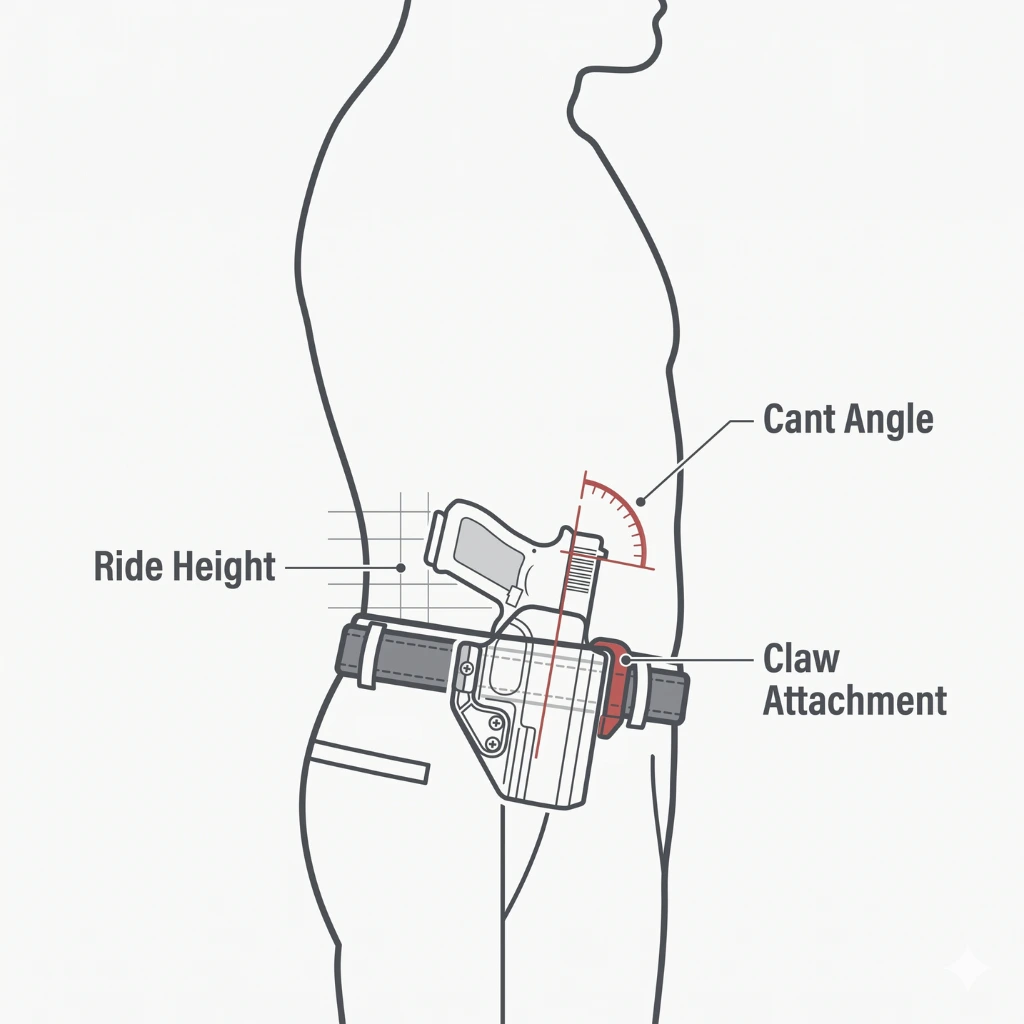
Ride height controls how far the grip extends above your waistband.
- Lower ride height conceals better, but lengthens the draw because the hand has further to travel before clearing the holster.
- Higher ride height speeds the draw but may print under shorter shirts.
Cant is the angle of the holster relative to vertical. Most AIWB carriers find that a slight forward cant, with the grip angled toward the strong side, provides the most consistent draw and the most comfortable seated carry. A neutral (zero-degree) cant works for some body types, but can dig into the abdomen when seated.
Both settings should be dialed in through dry fire over multiple sessions, not guessed at on day one. Most holsters ship at a neutral position that may not suit your body. Spend 15 minutes with the adjustment screws before concluding the holster is wrong for you.
How Do Holster Claws and Wedges Improve Concealment?
Claw or wing attachments press against the inside of the waistband to rotate the grip toward the body, reducing printing. Wedge attachments at the muzzle end angle the firearm away from the body, improving seated comfort by tilting the grip away from your ribs.
Many experienced AIWB carriers use both. If you have tried appendix carry and found it uncomfortable or prone to printing, these additions resolve both problems in most cases without requiring a new holster. Many holsters ship with these components included or available as add-ons, sometimes in the box but uninstalled. Carriers who skip this step and then report the holster prints too much have not finished the setup.

- ULTRA COMFORTABLE ALL DAY CARRY at just 3 ounces. TUCKABLE INSIDE THE WAISTBAND KYDEX HOLSTER fits: Sig P365 w/Lima...
- EXCLUSIVE HOLSTER FEATURES: Undercut Trigger Guard keeps the KYDEX from interfering with your draw. Over-Cut Open-Face...
- ADJUSTABLE ‘POSI-CLICK’ RETENTION, RIDE HEIGHT, & CANT: When you holster your Sig P365 w/Lima Laser, you'll hear a...
Last update on 2026-10-09 / Affiliate links / Images from Amazon Product Advertising API
Does AIWB Carry Work for Women and Different Body Types?
AIWB fit is anatomy-dependent, and generic holster recommendations built around male body geometry miss the mark for a large portion of carriers. Wider hip structure and different torso curvature change where the holster sits and how the draw arc moves.
Female carriers and carriers with shorter torsos often find that a softer wedge and a holster with multiple mounting positions outperform whatever holster is topping the latest forum recommendation thread. Full-size pistols in AIWB setups are feasible for most body types given proper ride height configuration, but compact and subcompact frames offer more flexibility for carriers who wear fitted clothing regularly.
The capability frame matters here: appendix carry is not “men’s carry.” It is a position that demands fit testing, and the carriers who get the best results, regardless of body type, are the ones who treat fit as a configuration problem to solve, not a yes-or-no verdict to render.
Which AIWB Holsters Are Worth Considering in 2026?
The market for purpose-built AIWB holsters has matured significantly. The five options below cover the practical price and use-case range. None of these is a sponsored placement. Pricing reflects current MSRP at time of writing.
- Tenicor Velo5 — $85 to $120
Best for experienced AIWB carriers wanting a refined daily system. Integrated claw, adjustable retention, multiple cant options, and a long track record of community endorsement. The Velo5 is the holster that other AIWB holsters get compared to. If you are upgrading from a budget option and you know what you want, this is the safe pick. - Slim Fit Carnex AIWB — $70 to $100
Best for carriers comparing 2026 new-generation AIWB options. Slim Kydex profile, gaining serious community traction in early 2026 comparison threads. Worth considering if you want a current-generation design rather than a five-year-old standard. - Vedder LightTuck — $50 to $75
Best as a first Kydex AIWB holster for carriers who want wide pistol compatibility. Adjustable cant and ride height, solid retention, and one of the broadest gun fitment lists on the market. This is the holster most often recommended as a “first real AIWB rig.” - Concealment Express AIWB — $28 to $50
Best as a budget entry point or backup holster. Rigid Kydex shell, basic retention adjustment, limited configuration options. Not the holster you will keep forever, but a legitimate way to test whether AIWB works for you without spending $100 to find out. - Tulster Profile — $65 to $90
Best for compact and subcompact pistols, and for carriers prioritising the lowest possible profile. Slim design, well-suited to smaller frames, and adjustable retention. A strong choice if your daily carry is a Glock 43X, P365, or similar.
For a broader look at holster options across carry positions and body types, see the full roundup of the best concealed carry holsters on Gun Carrier.

- ULTIMATE EDC GUN BELT. Kore makes the best fitting, most durable tactical belt you’ll ever wear. Precise, secure fit...
- PERFECT MICRO FIT. NO more Belt Holes. Instead our Kore concealed carry belts use a hidden track with 40+ sizing points...
- POWER-CORE REINFORCED STRAP. Nylon webbing outer layer (rated to 500 lbs.), our proprietary Reinforced Power-Core center...
Last update on 2026-10-09 / Affiliate links / Images from Amazon Product Advertising API
Why Does the Belt Matter More Than Most Carriers Expect?
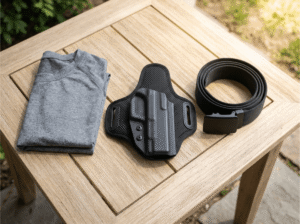
A quality AIWB holster on a flimsy belt produces an unstable system. The belt is the foundation. Without stiffness, the holster shifts during a full day of carry, the draw becomes inconsistent, and comfort deteriorates by afternoon. This is one of the most common reasons carriers conclude that AIWB does not work for them, when the actual culprit is the belt, not the holster or the position.
A dedicated gun belt differs from a standard dress belt in construction and rigidity. There are three main categories.
- Leather gun belts are stiff, dressy, and traditional. Brands like Galco and Crossbreed produce solid options in the $50 to $90 range. Expect a break-in period of one to two weeks before the belt reaches full rigidity.
- Nylon and reinforced belts are often built with internal polymer stiffeners. Faster adjustment, more casual appearance. Kore Essentials and Nexbelt are commonly recommended in the $50 to $80 range.
- Hybrid and inner-outer belt systems like the Ares Gear Aegis pair a stiff inner belt with a more comfortable outer layer. Higher cost in the $70 to $120 range, but preferred by carriers who wear the setup all day.
The practical test: With the holster on your body, try to push it sideways with your finger. If it moves, the belt is not stiff enough. The holster should feel anchored, not floating.
Is Appendix Carry Safe for Daily Use?
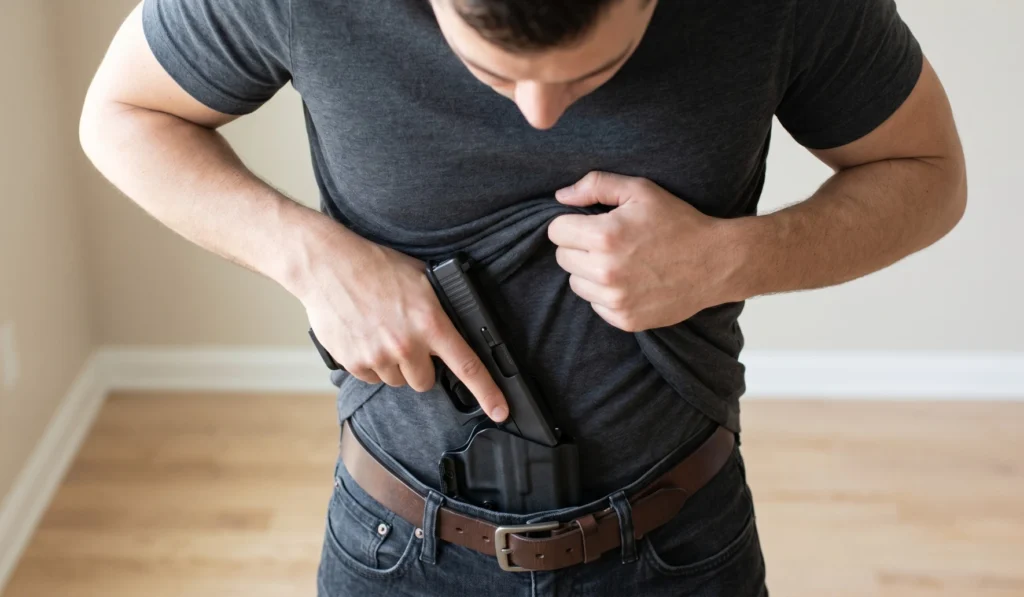
Appendix carry is safe when done correctly, and the requirements for doing it correctly are specific. This is not a carry position that tolerates shortcuts on holster selection or re-holstering habits. The non-negotiable safety requirements are listed below.
- Safety Rule #1: Rigid Kydex holster with full trigger guard coverage. The trigger must be completely shielded at all times. Soft holsters, partial coverage designs, and fashion holsters are not appropriate for appendix carry under any circumstances.
- Safety Rule #2: Deliberate, eyes-on re-holstering. Re-holster slowly, with your finger indexed along the frame, while looking at the holster. Never holster by feel under a garment. Rushed re-holstering is the primary mechanism of AIWB-related negligent discharges. Slow down every time, not just when you feel like it.
- Safety Rule #3: Consistent trigger finger discipline. Finger off the trigger until the sights are on a confirmed target. This applies in dry fire, at the range, and on every draw without exception.
- Safety Rule #4: Verified skill before daily carry. Most CCW holders cannot reliably draw and engage a target at five yards in under three seconds. Beginners should build verified dry fire reps and complete a structured training course before carrying the appendix daily.
For guidance on finding qualified instruction, see the Gun Carrier resource on concealed carry training.
Appendix carry is not inherently more dangerous than strong-side IWB when these practices are in place. The incidents that occur happen when re-holstering becomes a routine mechanical act rather than a deliberate safety procedure.
What Are the Most Common AIWB Setup Mistakes?
Judging ride height before adjusting it. Most holsters ship at a neutral position that may not suit your body. Before concluding that AIWB is uncomfortable, spend 15 minutes adjusting ride height and cant. Many carriers who returned holsters as “not working” were one adjustment screw away from a setup that worked fine.
Skipping the dedicated gun belt. An AIWB holster on a standard dress belt or casual nylon belt is an unstable platform. Buy the belt before the holster if budget forces a choice. The belt has more effect on daily comfort and draw consistency than most holster upgrades.
Choosing a soft or collapsible holster. Any holster that does not hold its shape without the gun in it is not safe for appendix carry. This eliminates most neoprene, generic nylon, and leather-front hybrid designs from AIWB consideration.
Ignoring the claw and wedge hardware. Many holsters include claw attachments and foam wedges that ship detached or uninstalled. Install the components and test before deciding the holster does not work.
Re-holstering in a hurry. There is no scenario where faster re-holstering matters enough to skip the deliberate process. Draw fast. Re-holster slowly. Every time.Buying by reputation rather than fit. A holster with a strong community following may not fit your gun, suit your body type, or work with your wardrobe. Check the return policy before ordering, and test fit with an unloaded firearm before committing to it as your daily carry setup.

- CARRY WITH OUTSIDE: Please feel free to choose our KYDEX Holster to protect for Glock 19 Holster. This is our...
- US .08" KYDEX - LIGHTWEIGHT - STRONG - DURABLE: The Glock 19 holster is hand-crafted from sturdy KYDEX alloy plastic...
- SAFETY LOCK BELT CLIP: Belt clip with switch and safety lock for 1.5-2 Inch belt, adjustable width, height and angle...
Last update on 2026-10-09 / Affiliate links / Images from Amazon Product Advertising API
How Do You Build Your First AIWB Setup?
A functional appendix carry holster setup has three components: a rigid Kydex holster with adjustable retention and claw or wedge capability, a dedicated gun belt, and consistent dry fire practice from concealment. The gear matters. The reps matter more. Both are required.
If you are building your first AIWB setup, start with a mid-range Kydex holster from Vedder or Concealment Express, pair it with a gun belt, and spend two weeks doing dry fire draw strokes before carrying live. Once the draw is smooth and consistent, decide whether to upgrade based on real experience rather than forum speculation.
If you are upgrading an existing setup, the Tenicor Velo5 and Slim Fit Carnex AIWB represent the current state of the purpose-built AIWB market. Both are generating serious community discussion in 2026 for real reasons. Neither one fixes a training deficit.
Why Does the System Matter More Than the Holster?
The carriers who succeed with AIWB are not the ones who bought the most expensive holster. They are the ones who treated the appendix carry holster setup as a system. Rigid Kydex holster, dedicated belt, dialed-in ride height and cant, claw and wedge installed, eyes-on re-holstering every single time. Once those pieces are in place, AIWB delivers what it promises: the fastest draw, the best concealment, and the most reliable access of any carry position available to civilians.
The drawer of failed holsters is not a personal failing. It is the predictable result of buying gear before understanding the system. Get the system right, and the gear decisions get a lot smaller.
Check out this video from Alston Trainings: You’ve Been Appendix Carrying Wrong… Here’s How to Do It Right!
Frequently Asked Questions
-
Is the appendix carry safe?
Appendix carry is safe when paired with a rigid Kydex holster that fully covers the trigger guard, a deliberate eyes-on re-holstering process, and consistent trigger finger discipline. The position points the muzzle near the femoral artery, so safety depends entirely on holster choice and re-holstering technique. Skip either one and the risk is real.
-
Do I need a special belt for appendix carry?
Yes. A standard dress belt or casual nylon belt is too flimsy to support the holster, which causes the gun to shift during the day and makes the draw inconsistent. A reinforced leather, polymer-stiffened nylon, or hybrid inner-outer gun belt in the $50 to $120 range is the minimum acceptable foundation for daily AIWB carry.
-
What does a holster claw do?
A claw is a small attachment that presses against the inside of the waistband, leveraging belt tension to rotate the pistol grip toward your body. This rotation tucks the grip closer to your torso, which dramatically reduces printing under a fitted shirt. Most modern AIWB holsters include a claw in the box, sometimes uninstalled.
-
Can I carry a full-size pistol in AIWB?
Yes, full-size pistols are feasible in AIWB for most body types when ride height and cant are properly adjusted. However, compact and subcompact frames offer more flexibility for carriers who wear fitted clothing or sit for long periods. Test with the gun unloaded in a variety of seated positions before committing to a full-size daily carry setup.
-
Is AIWB safe for women?
Yes, with the same safety requirements as any other carrier and with attention to fit. Wider hip structure and shorter torso length affect where the holster sits and how the draw arc works. Women carriers often benefit from a softer wedge, multiple mounting positions, and a holster purpose-designed for AIWB rather than one repurposed from strong-side IWB.
-
How long does it take to get used to appendix carry?
Most carriers need one to two weeks of daily wear and configuration adjustments before the setup feels natural. Spend the first two weeks doing dry fire draw strokes from concealment before carrying a loaded firearm. If discomfort persists past two weeks, the issue is usually ride height, cant, or belt stiffness, not the position itself.
-
What is the difference between a claw and a wedge?
A claw is mounted near the trigger guard and uses belt pressure to rotate the grip toward your body, reducing printing. A wedge is a foam or rubber piece mounted at the muzzle end of the holster that angles the firearm away from the body, improving seated comfort. Most experienced AIWB carriers use both together.
-
How fast should my AIWB drawstroke be?
A reasonable benchmark is drawing from concealment and placing an accurate hit at five yards in under three seconds. This is achievable with consistent dry fire practice. Most CCW holders cannot meet this standard, which is why verified dry fire reps and a structured training course should come before daily appendix carry, not after.
-
Is the Tenicor Velo5 worth the price?
For experienced carriers who already know they want AIWB as their daily system, yes. The integrated claw, adjustable retention, and proven track record justify the $85 to $120 cost. For first-time AIWB carriers, a $50 to $75 Vedder LightTuck is a smarter starting point because it lets you confirm AIWB works for you before upgrading.
-
Can I carry an appendix while seated for long periods?
Yes, with the correct configuration. The keys are a slight forward cant, a wedge attachment to angle the muzzle away from the body, and a holster with sufficient ride height that the grip does not dig into your ribs when you sit. Test seated comfort during the configuration phase, not after committing to a setup.
Make the case. Let us know in the comments below.👇