
Quick Answer
The best handguns for home defense in 2026 are the Glock 17 Gen 5 for reliability, the Walther PDP Full Size for trigger quality, and the S&W M&P9 M2.0 for ergonomics. For limited-grip users, the S&W Shield EZ is the top choice. Prioritize 9mm chambering, 15-plus round capacity, a weapon light rail, and a factory optics cut. A home defense handgun does not need to be hidden. It needs to perform.
Related: The Ultimate Guide to Handguns for Senior Women (2026 Edition): 7 Easiest-to-Use Models
Jump to Section
- What Makes a Handgun Good for Home Defense?
- What Are the Best Handguns for Home Defense in 2026?
- Does 9mm Caliber Provide Enough Stopping Power for Home Protection?
- Do You Really Need a Weapon Light and Red Dot on a Home Defense Gun?
- How Should You Safely Store a Home Defense Handgun with Children in the House?
- Is It Legal to Use a Handgun for Home Defense Under Castle Doctrine?
- Which Home Defense Handgun Is Right for You?
- Frequently Asked Questions
What Makes a Handgun Good for Home Defense?

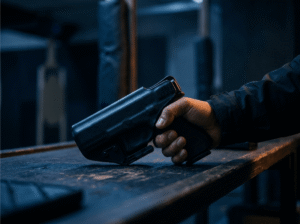
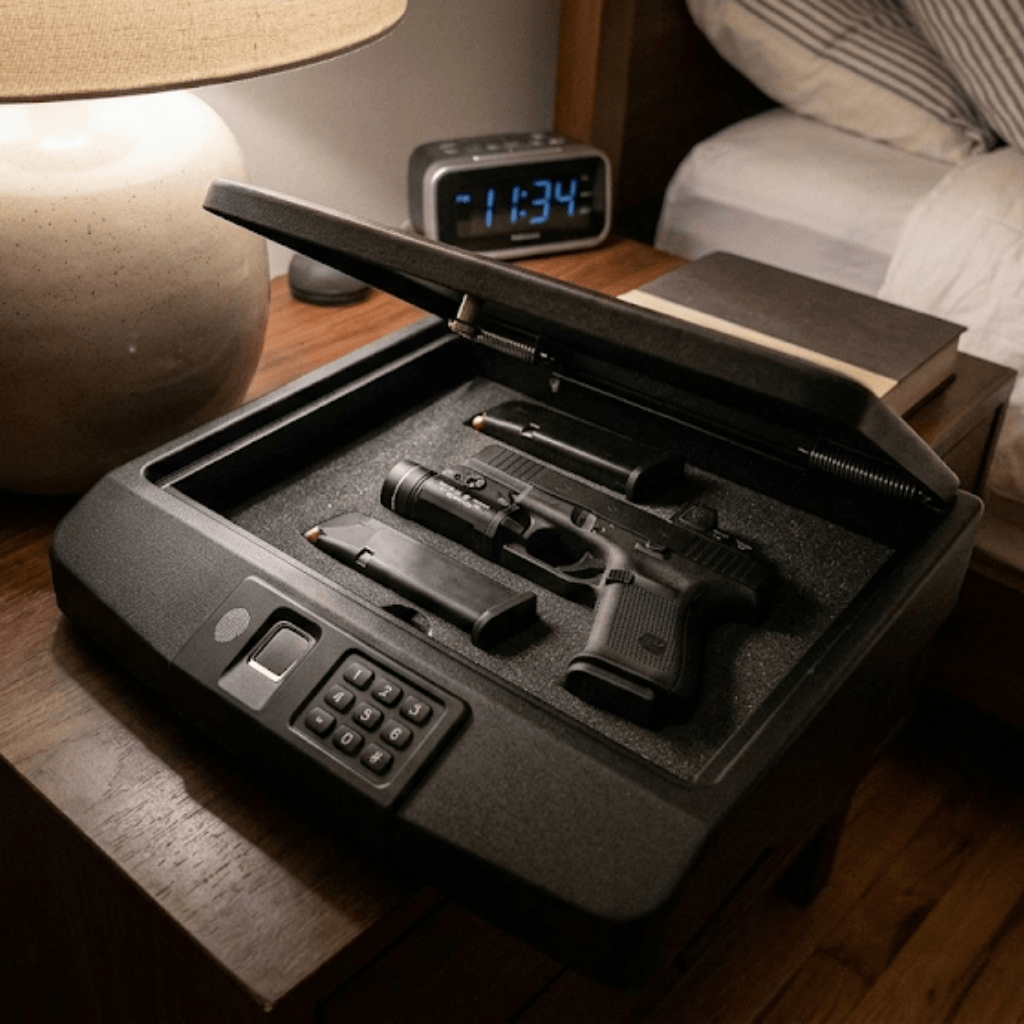
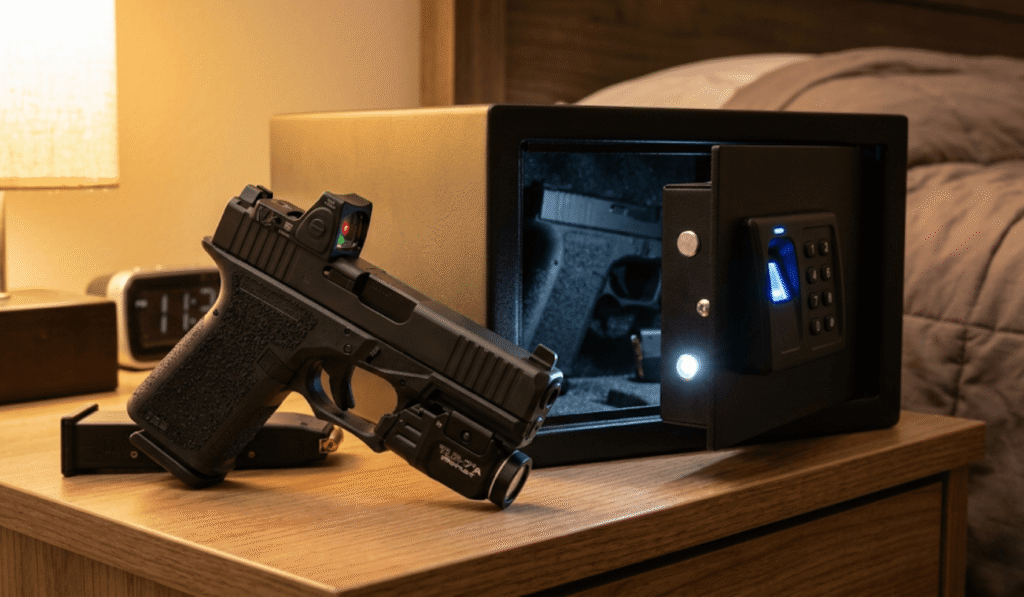
The image above does not contain the actual items mentioned in this article.
“Have you thought through the ‘wake up at 3 am’ scenario?” That question from a recent forum thread cuts straight to what most buyers skip. They compare spec sheets. They do not rehearse the conditions.
Handguns for home defense operate under different constraints than carry guns. Concealment is not the problem. Reliability, accessibility, and accurate target identification in low light are the problems. Understanding that distinction changes the selection criteria entirely.
Here is what matters, ranked in order of priority.
- Reliability with your actual defensive load. Not range ammo. Your hollow-point. Any handgun for home defense should be test-fired with at least 200 rounds of your chosen defensive ammunition before it earns nightstand duty. One documented failure-to-feed means more testing, not assumption.
- Weapon light compatibility. Positively identifying your target before you fire is a legal obligation in most jurisdictions. In a dark hallway, a weapon-mounted light is the difference between a defensible decision and one you spend years explaining. It is not an optional upgrade on any home defense handgun.
- Capacity. The home environment removes the concealment constraint entirely. A 17-round platform costs roughly the same as a 10-round platform. Choose the 17-round platform.
- Ergonomic access for every adult in the household. The person who selected the home defense handgun may not be the person who reaches for it first. One forum contributor stated it plainly: “My wife is a dedicated revolver shooter. If she has to use the weapon on my side, it needs to be one she uses well.” Every adult who might need that firearm should dry-fire it from the storage position at least once before the platform is finalized.
- Optics readiness. A factory optics cut is not a luxury on handguns for home defense. A quality red dot improves target acquisition in low light in ways iron sights cannot replicate, especially when you are woken from sleep, and your fine motor skills are compromised.
- Dry-fire practice before anything else. Before spending money on a new home defense handgun, confirm you can access your current one and present it accurately from your storage position in complete darkness. Run this drill once a month. Time it. If the time is not improving, the issue is practice cadence or storage solution, not the firearm.
What Are the Best Handguns for Home Defense in 2026?
These five home defense handguns meet every criterion above. Prices reflect approximate MSRP.
1. Glock 17 Gen 5 ($599)
The Gen 5 corrected the finger-groove grip from prior generations and added a flared magwell, ambidextrous magazine release, and Marksman Barrel for tighter accuracy. The MOS variant ships with a factory optics cut. Capacity is 17+1 rounds of 9mm. No other striker-fired handgun carries a more extensively documented reliability record, which is the single most important qualification for a home defense handgun.
Pros: Unmatched reliability documentation; universal weapon light compatibility; extensive aftermarket support.
Cons: Grip angle polarizes users; stock trigger is functional but not exceptional; trigger modifications on any defensive home defense handgun require careful legal review before implementation.

2. S&W M&P9 M2.0 Full Size ($569)
The M2.0 leads the category on grip ergonomics at this price point. Four interchangeable palm swell inserts, aggressive texturing, and a flat-faced trigger option address the fit problem that disqualifies many home defense handguns in multi-user households. The manual safety variant is available for households where it is operationally required. The no-safety version is appropriate for trained users who have confirmed their safe-storage solution prevents unauthorized access.
Pros: Best-in-class grip ergonomics; four grip inserts for multi-user household fit; 17+1 capacity; available with or without manual safety.
Cons: Optics-ready requires the CORE variant; stock trigger trails the PDP.
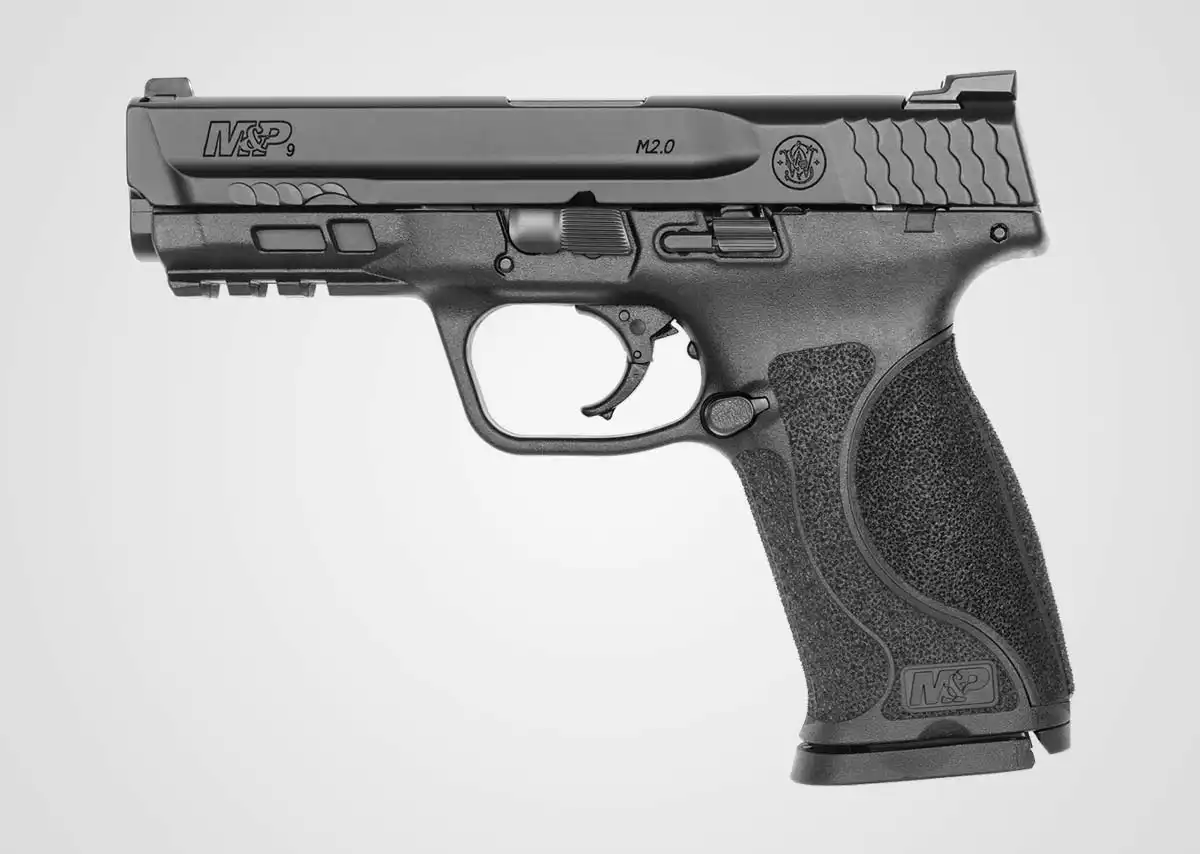
3. Sig Sauer P320 X-Full ($679)
The X-Full ships with the X-series trigger, which is the best factory striker trigger in this comparison of handguns for home defense. The modular chassis allows the serialized component to move between frame sizes, which matters for carriers who want one registered lower across a full-size home platform and a compact carry. Note: confirm any used P320 has completed the voluntary drop safety upgrade. All production units from 2017 onward are compliant, but verify before purchase.
Pros: Best factory trigger; full optics footprint; modular chassis for carry and home dual use; wide accessory ecosystem.
Cons: Highest price in this group; drop safety upgrade verification required on any used unit.
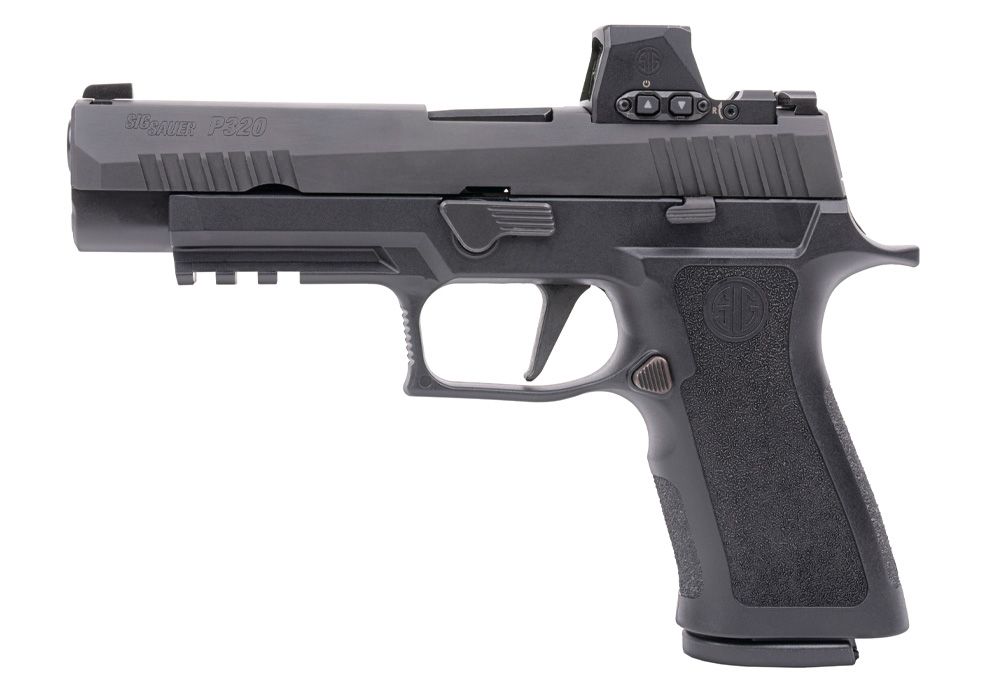
4. Walther PDP Full Size ($649)
The PDP ships optics-ready with a wide-format factory cut that accepts most major red dot footprints without an adapter plate. The grip texture was specifically designed for wet and stressful conditions. At 18+1 rounds, it edges the Glock 17 by one round. The stock trigger is the best of any pistol in this comparison and makes it the top pick for shooters who want the best out-of-the-box performance on a home defense handgun without any modifications.
Pros: Best stock trigger in the striker-fired segment; factory optics cut; 18+1 capacity; purpose-built for defensive use.
Cons: Smaller dealer footprint than Glock or S&W; less aftermarket depth.

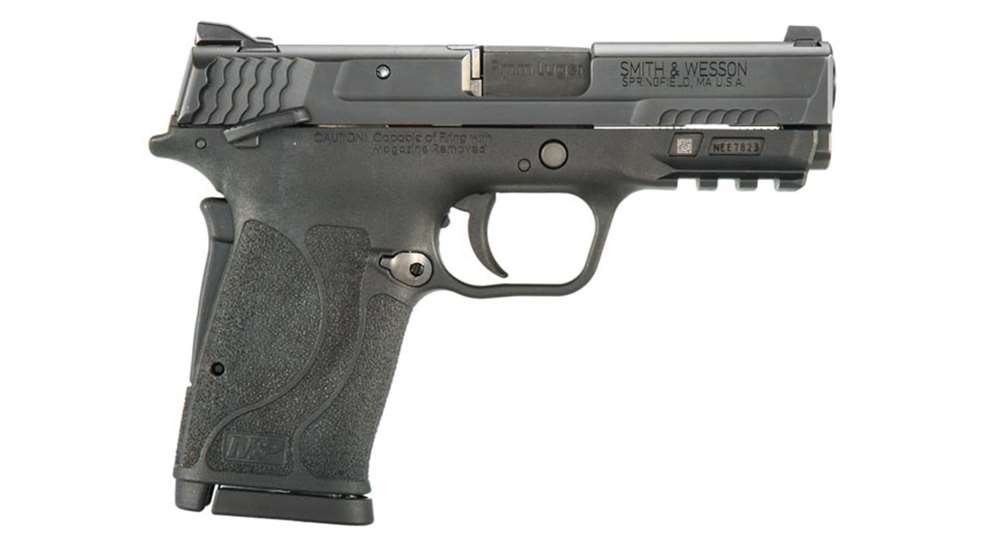
5. S&W M&P Shield EZ 9mm ($499)
The Shield EZ was designed for users who cannot reliably rack a standard semi-auto slide. The rack-assist design, grip safety, and reduced felt recoil make it the practical home defense handgun choice for senior household members or any user for whom the full-size platforms above are not ergonomically accessible. Capacity is 8+1, which is below the recommended standard for a primary home defense handgun. If this is your platform, pair it with a quick-access safe that stages a reload within reach.
Pros: Easy-rack slide; grip safety; reduced felt recoil; optics-ready variant available.
Cons: 8+1 capacity is a genuine limitation for a primary platform; best suited as a dedicated secondary or single-user solution.
Best Handguns for Home Defense 2026
| Handgun | Caliber | Capacity | Light Rail | Optics-Ready | Approx. MSRP | Best For |
| Glock 17 Gen 5 | 9mm | 17+1 | Yes | MOS variant | $599 | Reliability-first buyers |
| S&W M&P9 M2.0 Full Size | 9mm | 17+1 | Yes | CORE variant | $569 | Multi-user households |
| Sig P320 X-Full | 9mm | 17+1 | Yes | Factory cut | $679 | Trigger quality, dual-use |
| Walther PDP Full Size | 9mm | 18+1 | Yes | Factory cut | $649 | Best stock trigger |
| S&W Shield EZ 9mm | 9mm | 8+1 | Yes | Shield PC variant | $499 | Limited-grip users |
Does 9mm Caliber Provide Enough Stopping Power for Home Protection?
More than enough in the majority of documented scenarios. Modern 9mm hollow-point loads meet the FBI’s ballistic standard of 12 to 18 inches of penetration in calibrated gelatin after expansion. That standard was established following the 1986 Miami shootout and remains the most referenced benchmark in published defensive ammunition testing. The FBI returned to 9mm after its own research showed that modern 9mm loads matched or exceeded the terminal performance of .40 S&W while producing less felt recoil and allowing higher capacity in home defense handguns.
“Bullet construction matters more than caliber selection.” Available testing data support that principle. A quality 9mm hollow-point outperforms a budget .45 ACP FMJ in every metric that matters for handguns for home defense: controlled expansion, terminal performance, and overpenetration management. “FMJ punches clean holes and keeps going through drywall, studs, and into rooms you did not intend to shoot into.” That is the overpenetration risk in plain language.
For 9mm home defense handguns, Federal HST 124gr or 147gr and Speer Gold Dot 124gr +P are the most consistently documented performers across available published ballistic testing. Load your chosen hollow-point, run 200 rounds for reliability confirmation, and do not substitute range ammo for defensive use.
“Accuracy is more important than stopping power.” A well-placed 9mm round from a home defense handgun you can operate under stress outperforms any larger caliber you cannot.
Check GunCarrier’s 9mm vs .45 ACP in 2026: Skip the Forum Fight and Pick for Your Use Case.
Do You Really Need a Weapon Light and Red Dot on a Home Defense Gun?
Yes on both, and the reasoning is straightforward.
Weapon light. “Muzzle blast in a dark hallway” is an outcome no one wants. More critically, you cannot legally or safely fire at a target you have not positively identified. A weapon-mounted light solves the identification problem without requiring you to manage a handheld flashlight and a home defense handgun at the same time. For most home defense handguns in this comparison, the Streamlight TLR-7A is the standard-setting option at the sub-$100 price point. The SureFire X300U is the premium choice for the Walther PDP or Sig X-Full.

- 500-Lumens; 140 Meter beam; Runs 1.5 Hours
- Engineered optic produces a concentrated beam with optimum peripheral illumination
- Durable, anodized machined aluminum construction; IPX7; Waterproof to 1 Meter for 30 Minutes

Last update on 2026-10-08 / Affiliate links / Images from Amazon Product Advertising API
Red dot optic. A quality red dot improves target acquisition speed in low-light conditions, particularly for shooters woken from sleep with degraded fine motor skills. Every home defense handgun in this comparison ships with or supports a factory optics cut for the most common red dot footprints. If you have not shot a red dot before, invest in one dry-fire session before you need to use it under stress. The learning curve is short, and the performance difference under low-light conditions is real.
Cleaning and maintenance. Ammunition reliability and accessory function depend on a clean, properly lubricated firearm. A basic cleaning kit is the lowest-cost preventive maintenance investment in a home defense system.
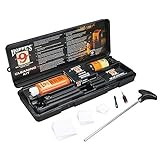
- Plastic storage box
- Hoppe's No. 9 cleaning kit with aluminum rod
- Includes one 2 ounce bottle cleaning solvent and one 2.25 ounce lubricating oil
Last update on 2026-10-08 / Affiliate links / Images from Amazon Product Advertising API
How Should You Safely Store a Home Defense Handgun with Children in the House?
“I’m not risking my kids or their friends’ lives to save me 30 seconds when accessing a firearm.” That is not only a values statement. In several states, it is now a legal requirement.
Defensive readiness and responsible storage are not competing priorities. A quality biometric quick-access safe resolves both at the same time. The Hornady Rapid Safe Night Guard provides RFID entry, keypad backup, and 14-gauge steel construction with a sub-3-second open time. Mount it within arm’s reach of your sleeping position. Test the open time monthly in the dark, one-handed, and confirm that every adult who might need the home defense handgun can open it under simulated stress conditions.

- Discreet, Secure, Touch-Free Entry - the Hornady Rapid Safe Night Guard, 98215 keeps your handgun safes for pistols as...
- Quick Access Gun Safe - This Hornady gun safe uses the patented RFID technology to unlocks safes faster than keypads and...
- Heavy Duty and Tamper Proof – This nightstand safe is made from 14 gauge steel. Comes with a heavy duty 1500 lb. steel...
Last update on 2026-10-09 / Affiliate links / Images from Amazon Product Advertising API
State storage law changes in effect for 2026:
| State | Requirement | Effective Date |
| Illinois | Mandatory locked-container storage; penalties up to $10,000 where unauthorized access causes injury | January 1, 2026 |
| Colorado | Mandatory secure storage when minors are present | 2025 |
| Washington | Mandatory secure storage; civil liability applies for unsecured firearms | 2025 |
This table reflects published information available as of early 2026. State law changes frequently. Verify current requirements for your state at HandgunLaw.us before finalizing your storage solution for your home defense handgun.
Note: Civil liability for an improperly stored firearm does not require a storage statute to exist in your state. If an unsecured home defense handgun is accessed and used to cause harm, civil exposure is substantial regardless of whether your state has enacted a criminal storage law.
See GunCarrier’s Gun Safe Storage Laws 2026: What Owners Must Know Now.
Is It Legal to Use a Handgun for Home Defense Under Castle Doctrine?
Castle doctrine and defense of dwelling standards vary significantly by state. Being inside your own home does not automatically satisfy the legal threshold for lethal force in every jurisdiction.
As a general framework applied across most self-defense laws, the threat must present the ability to cause serious bodily harm or death, the opportunity to carry it out immediately, and demonstrated intent to do so. All three elements must typically be present before lethal force with a home defense handgun is legally and morally justified. Changing any one of those elements changes the legal analysis entirely.
Some states maintain a duty to retreat even within the home. Others impose no duty to retreat but still require an objectively reasonable belief of imminent serious harm. “Castle doctrine” is not a uniform national standard. Know your state’s specific statute before you rely on it.
Legal Disclaimer: The information in this section is general educational content, not legal advice. Firearms law varies by state, is subject to change, and depends on facts specific to each situation. Consult a licensed attorney in your jurisdiction before relying on any information here for legal decisions.
After any defensive use of force involving a home defense handgun, say as little as possible before speaking with your attorney. Self-defense legal insurance is worth treating as a gear purchase in the same category as the firearm itself.
Which Home Defense Handgun Is Right for You?
The right choice comes down to three scenarios.
- If you carry daily and have a compact tested to 200 rounds of defensive hollow-point reliability, that gun can serve both roles. Documented familiarity with a home defense handgun consistently outperforms an unfamiliar platform with a better spec sheet.
- If home defense is your primary application with no concealment requirement, go full-size. The Glock 17 Gen 5 and Walther PDP Full Size are the clearest choices at their respective price points among handguns for home defense in 2026.
- If limited grip strength or a multi-user household is the binding constraint, the Shield EZ earns that role, with its capacity limitation planned around through accessible staging of a reload.
Whatever you choose: test it with 200 rounds of your defensive hollow-point before it earns nightstand duty. A home defense handgun that has never fired your actual ammunition is a range gun with a nightstand address.
Check out the Top 12 Best 9mm Guns For Home Defense in 2026 from Gun Addicts.
Frequently Asked Questions
-
What is the best caliber for a handgun for home defense?
9mm is the most practical choice. Modern 9mm hollow-point loads meet the FBI’s 12 to 18 inch penetration standard after expansion, deliver high capacity, produce manageable recoil, and cost less to train with than .40 S&W or .45 ACP. Caliber matters less than ammunition construction and documented reliability in your specific home defense handgun.
-
Do I need a weapon light on a home defense handgun?
Yes. Positive target identification before firing is a legal requirement in most jurisdictions. In a low-light intrusion, a weapon-mounted light is the only reliable way to confirm your target before engaging. A handheld flashlight is a backup, not a substitute for a light-mounted home defense handgun in a genuine low-light scenario.
-
Should my home defense handgun be different from my carry gun?
Not necessarily. A carry gun tested with 200 rounds of defensive ammunition can outperform an unfamiliar full-size at the bedside. The home environment removes the concealment constraint, so a full-size platform earns its place among handguns for home defense if you train with it at the same level you train with your carry gun.
-
How should I store a home defense handgun with children in the house?
A quick-access biometric or RFID safe mounted within arm’s reach of your sleeping position is the correct solution. Look for minimum 14-gauge steel, sub-3-second open time, and a keypad backup for when biometrics fail under stress. In a household with children, your storage solution is the first decision you make, before selecting any home defense handgun.
-
What is the best home defense handgun for someone with limited grip strength?
The S&W M&P Shield EZ 9mm was designed for this use case. Its rack-assist slide, grip safety, and reduced felt recoil make it accessible to users who cannot reliably cycle a standard semi-auto. A compact revolver in .38 Special is also a reliable option where the capacity trade-off is acceptable.
-
Is hollow-point ammunition required for a home defense handgun?
Strongly recommended. FMJ rounds can penetrate multiple interior walls and reach adjacent rooms. Quality hollow-point loads like Federal HST or Speer Gold Dot expand on impact, reducing overpenetration risk while delivering performance within the FBI ballistic standard. Test your chosen load for feeding reliability in your specific home defense handgun before relying on it.
-
How many rounds do I need in a home defense handgun?
Fifteen or more is the practical standard for a primary platform. Most defensive encounters end in 1 to 3 rounds, but higher capacity costs nothing in a home environment where concealment is not a factor. Capacity is the lowest-cost insurance available on any home defense handgun spec sheet.
-
Can I use my carry gun as my home defense handgun?
Yes, if it has been tested for reliability with your defensive load and you maintain consistent training with it. Platform consolidation has real training benefits: one gun, one manual of arms, one set of muscle memory under stress. The concealment trade-off that drove you to a compact does not apply to a home defense handgun.
-
Should I modify my home defense handgun?
Limit modifications to those with a documented defensive justification. A quality weapon light, tritium or fiber-optic sights, and a factory optics cut are widely accepted and legally defensible. Aggressive trigger modifications on a home defense handgun can complicate post-incident legal proceedings. Consult a self-defense attorney and review your state’s standards before modifying any designated defensive firearm.
-
How often should I practice with my home defense handgun?
Dry-fire at a minimum once a month, including the full access sequence from your storage solution in low-light conditions. Live-fire with your defensive ammunition at least twice per year. A practical minimum competency benchmark: 100% first-round hits on an 8-inch circle at 3 and 5 yards from low-light conditions. Minimum competency with a home defense handgun is maintained through recurring practice, not achieved once.
Would you trust your life to this choice? Tell us why it earned your vote.👇