
Quick Answer
Firearm safe storage in 2026 requires balancing immediate access for home defense with high-security protection for everyone in your household. Use a biometric quick-access safe for your primary defense weapon and a 12-gauge fireproof safe for your broader collection. The right firearm safe storage solution depends on who is in your home, not how many guns you own.
Related: Gun Safe Storage Laws 2026: What Owners Must Know Now
Jump to Section:
- What Is the Difference Between a Gun Cabinet and a Gun Safe?
- What Do the 2026 Firearm Storage Laws Require from You?
- What Kind of Safe Does a Home Defender Actually Need?
- What Should You Look for in a Fireproof Gun Safe in 2026?
- How Do You Pick the Right Setup for Your Home Right Now?
- Firearm Safe Storage: FAQ
What Is the Difference Between a Gun Cabinet and a Gun Safe?
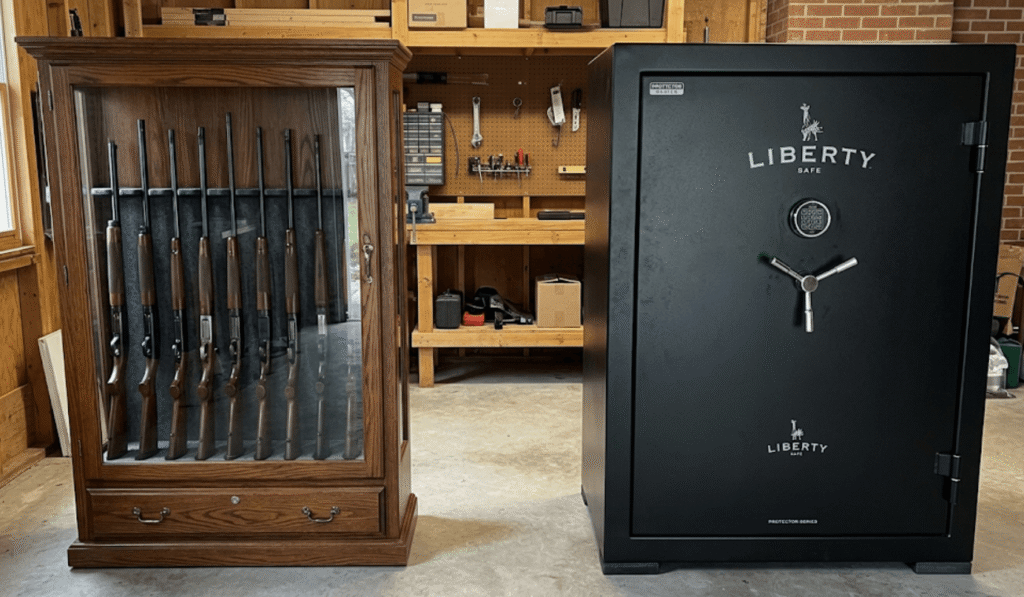
The most expensive mistake in firearm safe storage starts at the sporting goods store, when a buyer picks up a gun cabinet, thinking it performs the same function as a gun safe.
It does not.
A gun cabinet is a thin sheet-metal enclosure with a basic key lock. It will keep a curious seven-year-old out. It will not stop a determined teenager, a pry bar, or a house fire. Most gun cabinets are built from 20-gauge steel or thinner. A standard flathead screwdriver can defeat the door in under a minute.
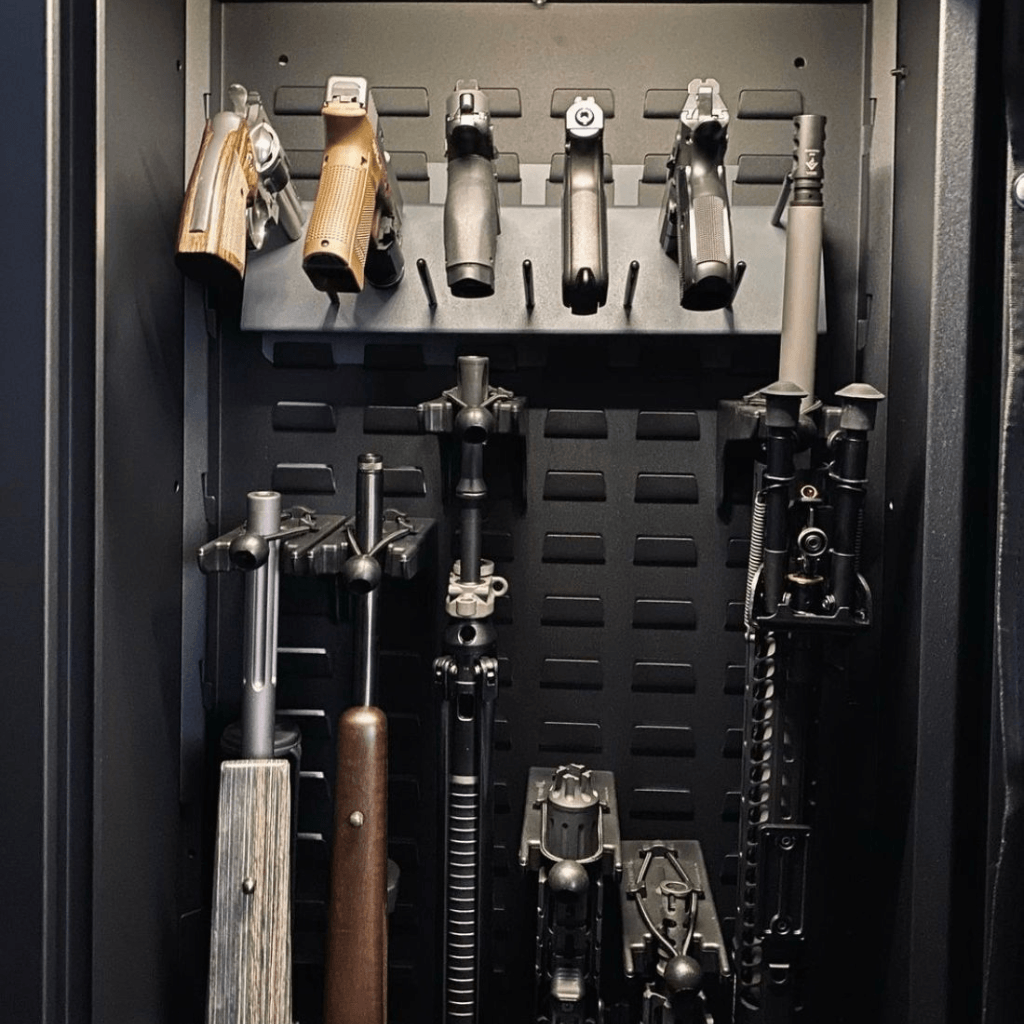
A gun safe is a rated security container. It uses a steel body of at least 12-gauge, a UL-listed electronic or biometric lock, and optionally a certified fire rating. It can be bolted to the floor or wall framing. When someone tries to force the door, it holds.
A gun cabinet keeps honest people honest. A gun safe keeps your firearms secure from theft, fire, and unauthorized hands.
These are not two price tiers of the same product. They are different categories entirely. Any firearm safe storage decision that starts with a gun cabinet is not a security decision. It is a liability waiting to be activated.
What Do the 2026 Firearm Storage Laws Require from You?
The legislative environment for firearm safe storage tightened significantly in 2026. Illinois enacted the Safe Gun Storage Act (Public Act 104-0031), effective January 1, 2026, requiring firearm owners to secure guns in a locked container any time a minor, at-risk person, or prohibited individual could gain access. The mandate covers both homes and vehicles.
The penalty structure is tiered. A general violation carries a civil penalty of up to $500. If an unauthorized individual gains access and misuses the firearm, that climbs to $1,000. If the access causes injury, death, or the commission of a crime, the penalty reaches $10,000. A violation also serves as evidence of negligence per se in any civil lawsuit that follows.
Illinois is not alone. Colorado and Washington passed additional storage-adjacent mandates in 2025, and the 2026 trend points consistently toward mandatory locked-container requirements wherever minors or at-risk individuals are present.
To check your specific state’s current firearm safe storage requirements, HandgunLaw.us maintains a regularly updated, state-by-state statutory database. GunCarrier’s dedicated gun storage laws 2026 guide covers the major 2026 changes in detail.
Here is what surprises most gun owners: civil liability for an improperly stored firearm does not require a storage law to exist in your state. If an unsecured firearm in your home is accessed and used to cause harm, your civil exposure is substantial regardless of what the criminal code does or does not say about storage.
As one father on a firearms forum put it: “I’m not risking my kids or their friends’ lives to save me 30 seconds when accessing a firearm.”
That is the correct calculation.
This section provides general information only. Storage laws vary by state and change frequently. Verify your current state requirements and consult a licensed attorney for guidance specific to your situation.
What Kind of Safe Does a Home Defender Actually Need?
This is where the real disagreement lives in the gun owner community. One school of thought says a quality biometric quick-access safe meets the standard for most home defenders. Another says a fireproof, bolted-to-structure solution is the only defensible benchmark. Both positions are correct, and which one applies depends entirely on your household.
One carrier on an industry forum framed the tension in a single sentence: “I tend to think that ‘safe storage’ and ‘immediate use’ are opposites with no middle ground.” Modern biometric safes have resolved that tension. Sub-3-second biometric access with a keypad backup means you no longer have to choose between locked and ready. For a deeper look at how to build the home defense side of this system, see our best home defense handguns guide.
Here is the decision by household type:
- Household with minors or at-risk individuals present: A full-size locked safe is the legal and ethical floor. A quick-access unit is an addition to that system, not a replacement for it.
- Solo adult, one or two handguns, home defense as the primary need: A quality biometric quick-access safe meets the functional minimum. Add a fireproof safe as the collection or circumstances change.
- Both home defense readiness and collection storage required: Two separate problems require two separate product solutions.
If you have children in your home, a bedside drawer is not a firearm safe storage solution under any circumstances.
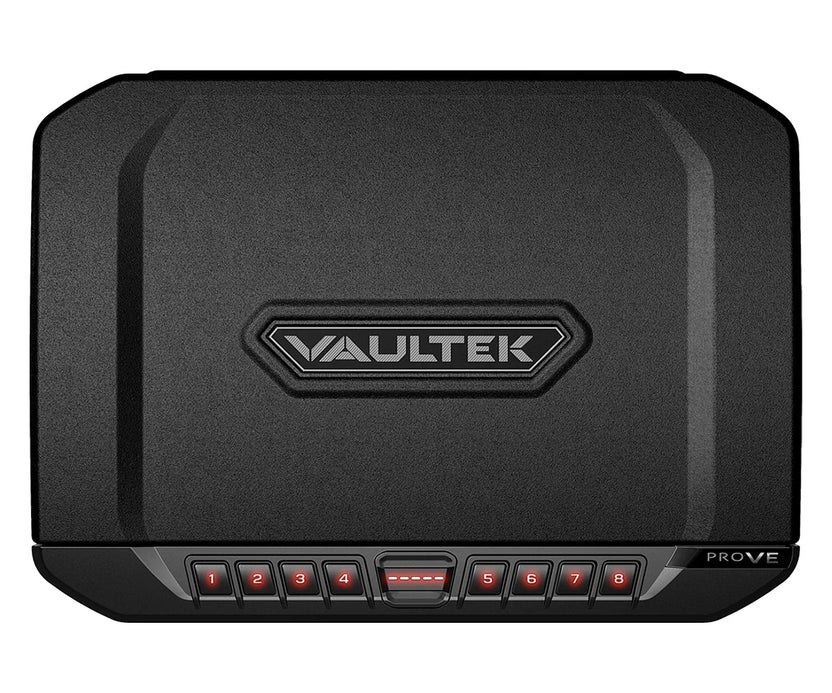
For the quick-access position, the Vaultek VT20i meets the core requirements: biometric scanner plus keypad backup, 16-gauge steel body, pre-drilled anchor points, and an interior sized for a full-frame pistol with a spare magazine.
What Should You Look for in a Fireproof Gun Safe in 2026?
Four benchmarks define adequate full-size firearm safe storage. Measure any safety measures you are considering against all four before purchasing.
- Pry resistance: The door and body should resist a standard pry attack for at least five minutes. A minimum 12-gauge steel body and active anti-pry bolt work on the door are the starting point. Anything thinner than 12-gauge fails this benchmark.
- Fire rating: A minimum 30-minute rating at 1,200 degrees Fahrenheit keeps the interior below 350 degrees during a typical residential structure fire. If you store documents, ammunition, or electronic media alongside your firearms, this rating is not optional.
- Anchor capability: An unbolted safe can be tipped, moved with a hand truck, or carried out entirely. Pre-drilled anchor holes in the floor plate or back panel let you bolt it to framing on installation day. A safe that is not anchored is a smash-and-grab scenario waiting to happen.
- Correct sizing: Buy at least one size larger than your current collection requires. Manufacturer capacity ratings assume a bare-minimum layout that rarely works once optics, accessories, and handgun storage are added. A safe sized for today almost always forces a costly upgrade within two to three years. Account for long guns, handguns, ammunition, and documents when estimating the capacity you need.
A 30-minute fire rating at 1,200 degrees Fahrenheit is the minimum standard that protects your firearms if you are not home during a structure fire.

- PROTECTS VALUABLES: 1.8-cubic-foot home safe for safeguarding important documents, jewelry, cash, devices, and other...
- RELIABLE SAFETY: This safe box features a programmable electronic keypad for secure, easy operation, along with a...
- DURABLE CONSTRUCTION: This mini safe is built with heavy-duty steel, including an 8-gauge steel door and 14-gauge steel...

Last update on 2026-10-09 / Affiliate links / Images from Amazon Product Advertising API
How Do You Pick the Right Firearm Safe Storage Setup for Your Home Right Now?
Three questions narrow the decision to the right tier.
- Is there anyone in your home who should not have access to a firearm? A child, a frequent visitor, or a prohibited person in the household means a full-size locked safe is the non-negotiable starting point. A quick-access unit is added on top of that requirement.
- Do you keep a firearm staged for home defense? If yes, you need a quick-access safe positioned within your response path: within arm’s reach of where you sleep, openable without vision, and accessible without fine motor precision under stress.
- Do you own more than two firearms? If yes, you need a full-size safe regardless of whether question one applies.
The layered architecture answers all three at once: one quick-access safe for the firearm you may need tonight, one full-size fireproof safe for everything else.
Which Firearm Safe Storage Tier Fits Your Situation?
| Safe Type | Best For | Fire Protection | Access Speed | Theft Resistance | Typical Price |
| Gun Cabinet | Display only | None | Key lock | Very low (pryable) | $100-$200 |
| Quick-Access Biometric Safe | Staged home defense firearm | None to minimal | Under 3 seconds | Moderate (anchor required) | $100-$250 |
| Mid-Size Fireproof Safe | Small collection, households with minors | 30-60 min at 1,200°F | 5-10 seconds | High (bolt-down required) | $200-$500 |
| Full-Size Fireproof Gun Safe | Multi-firearm households, growing collections | 30-120 min at 1,200°F | 5-10 seconds | Very high | $500-$2,000+ |
| Layered System (both types) | Any household with defense and storage needs | Full-size provides coverage | Under 3 sec via quick-access | Very high | $350-$2,500+ |
For buyers who want RFID wristband access alongside keypad entry on the bedside unit, the Hornady RAPiD Safe Night Guard adds that option at the mid-price tier without giving up steel-body construction.

- Discreet, Secure, Touch-Free Entry - the Hornady Rapid Safe Night Guard, 98215 keeps your handgun safes for pistols as...
- Quick Access Gun Safe - This Hornady gun safe uses the patented RFID technology to unlocks safes faster than keypads and...
- Heavy Duty and Tamper Proof – This nightstand safe is made from 14 gauge steel. Comes with a heavy duty 1500 lb. steel...
Last update on 2026-10-09 / Affiliate links / Images from Amazon Product Advertising API
Secure It Before You Need It: The Responsible Firearm Safe Storage Decision
Responsible ownership and defensive readiness are not in conflict. They require the same decision, made once and made correctly, before either problem shows up.
The 2026 storage law environment is tightening. Civil liability exposure exists in every state, regardless of whether a storage statute is on the books. The bedside drawer is not a firearm safe storage solution. The gun cabinet is not a gun safe. And the safe that slows you down in a home defense emergency creates its own category of liability.
Start with the tier that fits your household today. Upgrade as your collection and your circumstances require.
Your next step: confirm your state’s current firearm safe storage requirements at HandgunLaw.us, then use the comparison table above to identify the right product tier for your household.
Firearm Safe Storage: Answers to the Questions Most Buyers Ask
-
What is the difference between a gun safe and a gun cabinet?
A gun cabinet is thin sheet metal with a basic lock. It offers no fire protection and minimal theft deterrence. A gun safe uses rated steel construction, a UL-listed lock, optional fire protection, and anchor-bolt capability. They are categorically different products. Never substitute a cabinet for a safe when security or legal compliance is the goal in your firearm safe storage decision.
-
Do I legally need a gun safe in my state in 2026?
Requirements vary. Illinois enacted mandatory locked-container storage effective January 1, 2026, under Public Act 104-0031, with penalties reaching $10,000 when unauthorized access causes injury or crime. Colorado and Washington passed related mandates in 2025. Check your state at HandgunLaw.us and consult a licensed attorney for your specific situation.
-
What is the best quick-access gun safe for home defense?
The best quick-access option combines biometric scanning with a keypad backup, a steel body of at least 14-gauge, anchor-mount hardware, and a sub-3-second open time. Test your open time monthly and drill your access sequence under low-light, one-handed conditions. A quality biometric unit with those features meets the core standard for home defense firearm safe storage at the bedside position.
-
Do I need a fireproof gun safe, or is a standard safe good enough?
If you store documents, ammunition, or electronic media alongside your firearms, a fire rating is not optional. A 30-minute rating at 1,200 degrees Fahrenheit protects contents from typical residential fire temperatures. For a single home-defense handgun in a quick-access unit, a non-fireproof safe meets the functional minimum for that specific use case. Any full-collection firearm safe storage should include fire protection.
-
How large a gun safe should I buy?
Buy at least one size larger than your current collection requires. Manufacturer capacity ratings assume a bare-minimum layout that rarely works with optics, accessories, and handgun storage included. A safe sized for today almost always forces a costly upgrade within two to three years. Account for long guns, handguns, ammunition, and documents when estimating what you actually need.
-
Can a burglar break into a gun safe?
Every safe can be defeated with enough time and the right tools. The goal is to make the attempt difficult enough that an opportunistic burglar gives up or cannot finish before being interrupted. A pry-resistant body, UL-listed lock, and anchor bolts eliminate most smash-and-grab scenarios. No firearm safe storage solution eliminates risk, but the right setup reduces it dramatically compared to a cabinet or nightstand drawer.
-
Where should I put a gun safe in my home?
The home defense firearm belongs in a quick-access safe within your natural response path: within arm’s reach of where you sleep, unobstructed, openable without full visual confirmation. The full-size safe belongs in a low-visibility interior location such as a closet, basement, or dedicated room. Anchor both to the floor or wall framing. Never install a safe in a garage or near an exterior wall where vehicle access or tool use is easy.
-
Is a biometric gun safe reliable enough for home defense?
Modern biometric safes are reliable when they include a keypad backup. If the scanner fails under stress, wet hands, or a low battery, the keypad provides a second access path. Test your open time monthly and drill access under realistic conditions, including low light and one-handed operation. The biometric scanner is a convenience feature. The keypad backup is the reliability guarantee that makes firearm safe storage practical for home defense.
-
What is the minimum firearm safe storage requirement for a home with children?
In any household where a minor could gain access, locked-container storage is the legal minimum in a growing number of states and the civil liability standard in all states. A gun cabinet does not meet this threshold. A full-size locked safe or a quality biometric quick-access safe that physically prevents unauthorized opening does. Confirm your state’s statute at HandgunLaw.us and consult a firearms attorney for guidance specific to your situation.
Lock in your vote and tell us why is this the right call?👇