
Top Things to Know
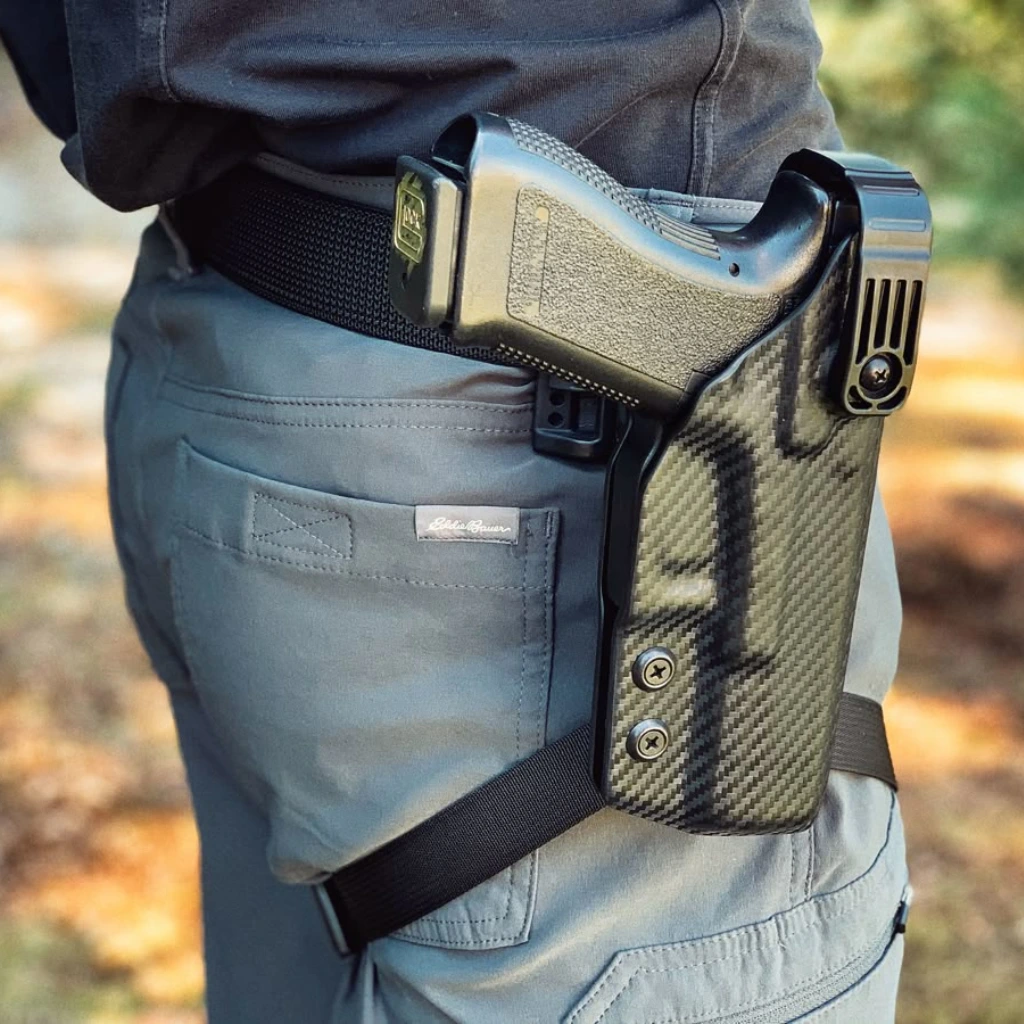
The best OWB holster for concealment in 2026 is the Tulster Contour, whose asymmetrical molded wings pull the grip tight to the body. For adjustability, the Vedder LightTuck OWB leads. Concealment-grade OWB needs a ride height under 0.75 inches, a 10 to 15 degree forward cant, and a rigid 1.5-inch gun belt.
Related: OWB Holster Concealment Guide for Everyday Carry
This article is for general education on concealed carry equipment and is not legal advice. Holster choice does not replace training, and carry laws vary by state. Consult a licensed attorney for questions specific to your situation.
Why Is Everyone in the CCW Community Suddenly Asking About OWB?
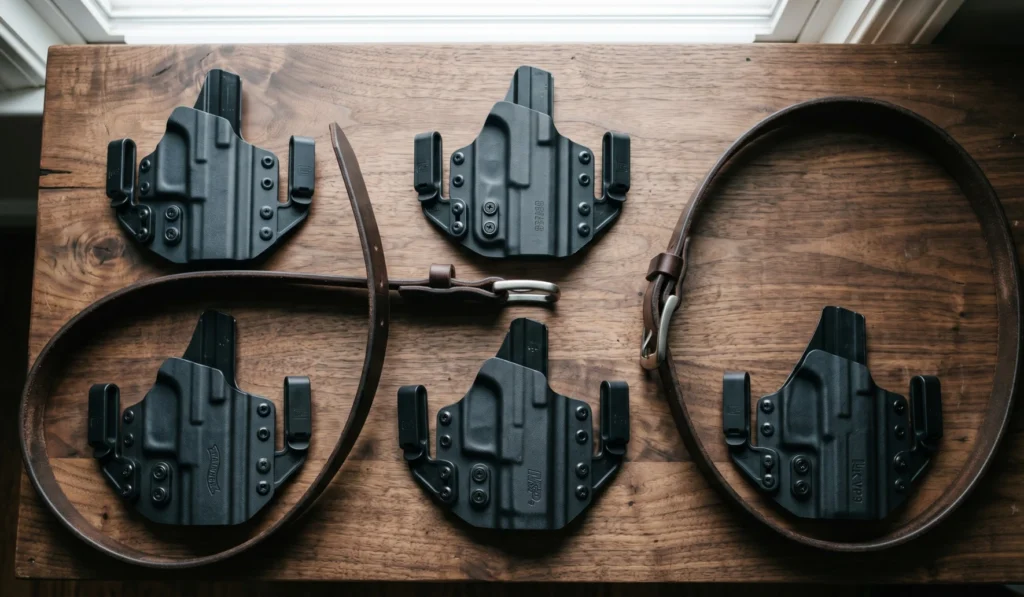
Walk into r/CCW in April 2026, and the same question is everywhere: “What would you say is the best OWB holster for concealment in 2026?”
Three things are driving it. Heat. Comfort. And a quiet shift in what kydex can actually do.
For years, OWB carry was the open carry rig or the range holster. If you wanted real concealment, you went IWB, accepted the discomfort, and moved on. That tradeoff is changing. A new generation of slim kydex OWB designs sits tighter to the body, rides lower, and angles the grip inward. Carriers who tried OWB three years ago and gave up are giving it another look.
Price is part of it, too. Kydex holster costs are up. Buyers are researching harder before clicking. Nobody wants to repeat the line every CCW carrier knows by heart: “I wasted a lot of money on cheap nylon holsters.”
So the question on the table is real: can OWB actually conceal for daily carry, or is IWB still the only honest answer?
OWB vs IWB: Which Is Better for Daily Carry in 2026?
The community is split on this. Some carriers are convinced OWB has caught up. Others say IWB is still the right call for true daily concealment under light clothing. Both sides are right, just at different stages of the carry journey.
- Where OWB wins: comfort across long days, faster and cleaner draws, easier reholstering, and less belt line pressure. Carriers who switch to OWB tend to report higher carry rates, because the comfort difference makes them less likely to leave the gun at home.
- Where IWB wins: maximum concealment under a t-shirt, a tighter print profile in still air, and better deep-concealment performance in office and dress wear.
The honest answer depends on three things you can measure: how often you actually carry, what you wear when you carry, and what your body type does to the grip line. A new carrier struggling to carry 15 days a month should buy the rig they will actually wear. A committed carrier who carries every day and is still fighting concealment should audit the entire system, not just the holster.
That last sentence is where most OWB buyers go wrong.
What Actually Determines OWB Concealment Performance?
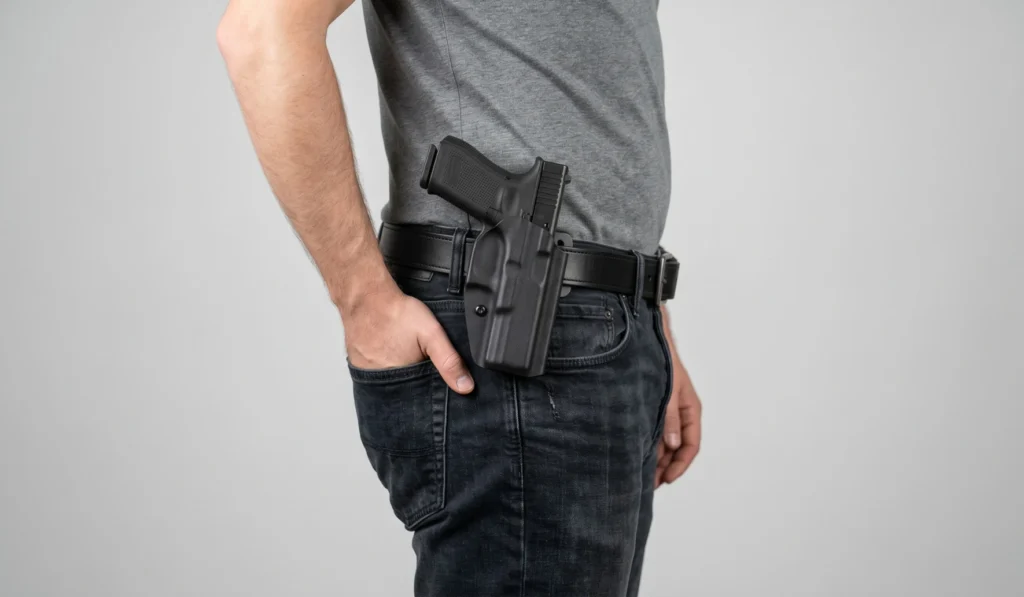
Concealment is a five-variable system, and understanding it is the difference between picking the best OWB holster for concealment and just buying another holster that ends up in a drawer. The holster is one variable.
The five variables:
- Cover garment. Cut one to two sizes long, draping past the grip line, worn untucked.
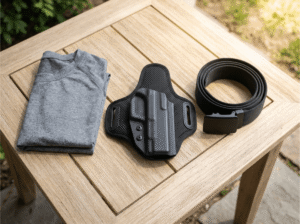
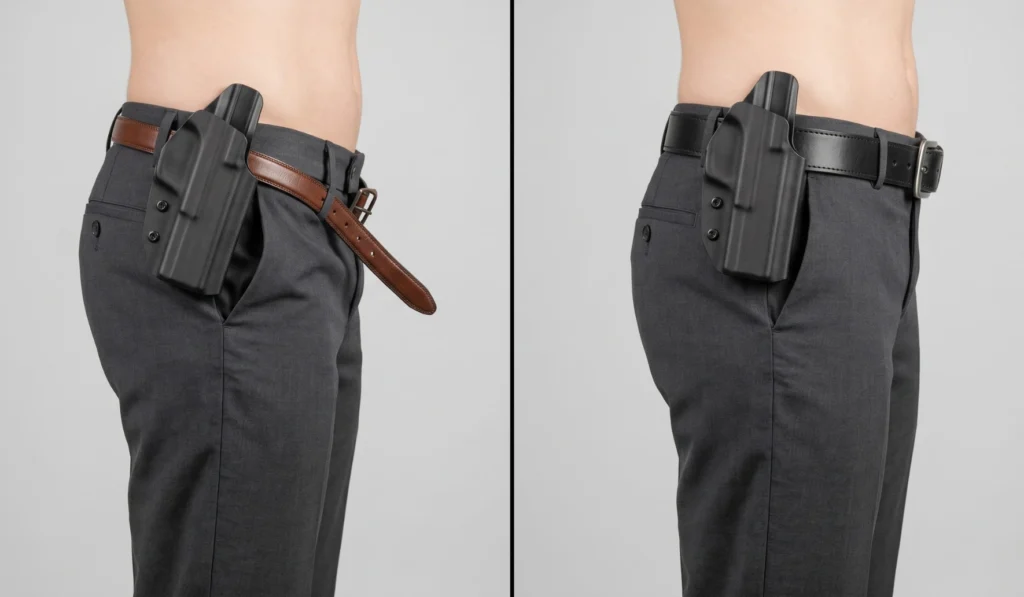
- Gun belt—rigid core, 1.5 inches wide, minimum. A standard dress belt collapses under a holster and breaks concealment within an hour.
- Ride height. Concealment-grade OWB sits at or below 0.75 inches above the belt line. Above that, the grip prints.
- Cant. A 10- to 15-degree forward angle pulls the grip into the body. Straight-drop OWB is a range setup, not a concealment setup.
- Body type. Narrow-frame carriers fight harder for concealment. Broader frames hide a grip more easily.
Two tests every OWB rig should pass before you commit:
The mirror test. Stand in front of a mirror in your normal clothing. Check front, side, and three-quarter views. Sit. Bend forward to tie a shoe. Reach overhead. If the print is visible, the system fails, not necessarily the holster alone.
The 10-rep retention test. Run ten vigorous movement reps under the cover garment: jumping jacks, twisting, and bending. If the gun shifts position or the grip prints visibly during reps, the holster fails the test regardless of marketing copy.
Print is data, not failure. Most carriers skip the mirror test entirely, then wonder why concealment never feels right.
Do You Need a Special Gun Belt for OWB Concealment?
Yes. This is the most overlooked variable in OWB concealment failures, and the one that costs carriers the most when they get it wrong.
A standard dress belt or casual leather belt collapses under the weight of a holster and a loaded firearm. Within an hour of wear, the belt sags, the holster shifts away from the body, the grip rotates outward, and concealment breaks. Most carriers blame the holster. The belt was the problem.
The non-negotiable belt spec for OWB concealment:
- Width: 1.5 inches. Every quality OWB holster in this article is built for 1.5-inch loops.
- Core: Rigid. Look for a polymer or steel-reinforced core, not just thick leather.
- Buckle weight: Substantial enough to anchor against the holster’s pull.
A purpose-built gun belt typically runs $50 to $90. That’s an unwelcome second purchase for a buyer who just spent $70 to $110 on the holster, but it is non-negotiable. The right holster on the wrong belt fails. The right belt makes a mid-tier holster perform like a premium one.
If your budget is tight, prioritize a quality belt paired with a competent mid-tier holster over a premium holster on a weak belt. Even the best OWB holster for concealment on the market fails on a belt that can’t support it.
Affiliate Disclosure: GunCarrier.com may earn a commission from qualifying purchases made through the Amazon links below, at no added cost to you. We only recommend gear we have evaluated against the standards described in this article.
What Are the Best OWB Holsters for Concealment in 2026?
Five picks. Each one is matched to a different reader and a different carry priority. We evaluated each against ride height, cant, retention, draw access, and the 10-rep retention standard described above. Each pick gets a Concealment Score from 1 to 10, based on ride height, cant geometry, and grip-tuck performance.
How We Selected and Scored These Picks
Scoring is based on published manufacturer specifications (ride height, cant adjustability, material, retention mechanism), cross-referenced against the concealment variables outlined above and against r/CCW community sentiment gathered from active 2026 threads. This is a desk research and specification-based ranking, not a hands-on, in-house wear test. Where a claim depends on firsthand fit testing rather than published specs, we have flagged it as community-reported rather than independently verified.
Selection Framework: How to Match a Pick to Your Carry Profile
Before the picks, use this filter to find the best OWB holster for concealment for your specific situation:
- If you have a narrow or average frame and want OWB to conceal like IWB: prioritize grip-tuck geometry (wings, asymmetrical molding) over price.
- If you carry in varied clothing or haven’t settled on a carry position: prioritize adjustability (cant and ride height) over a fixed concealment profile.
- If budget is the binding constraint and you are new to carrying: prioritize fit-specific molding at the lowest defensible price over premium features you will not yet use.
- If you are carrying daily and optimizing an established system: prioritize measured performance (mirror test, 10-rep test results) over marketing claims.
1. Tulster Contour OWB: Concealment-Priority Pick
Concealment Score: 9.5/10
Price tier: ~$110 | Material: 0.08-inch kydex | Cant: adjustable via belt-loop offset | Ride height: 3-position adjustable
The Contour is built specifically to defeat the printing problem that kills most OWB concealment attempts. Asymmetrical molded-in wings angle the grip toward the body instead of letting it stand off. Retention is dialed via a vertical slot system rather than a single screw, which holds tension over time without backing off.
Who it’s for: the committed carrier with an average to narrow frame who wants OWB to conceal like IWB, especially the carrier who has tried two or three OWB rigs already and given up.
The one tradeoff: premium price. If you carry occasionally, this is more holster than you need.

- Compatible with the Glock 19, 19 MOS, 19X, 23, 25, 32, 44, 45 pistol. Each holster is formed and fit to the firearm...
- Optic compatible with various red dot sights, from RMRs to SROs. Each holster is cut with optics in mind while...
- Enhance concealment with the asymmetrical wings of the Contour, which angle the holster and handgun towards your body...
Last update on 2026-10-14 / Affiliate links / Images from Amazon Product Advertising API
2. Vedder LightTuck OWB: All-Around Adjustable Pick
Concealment Score: 8.5/10
Price tier: ~$70 | Material: kydex | Cant: adjustable | Ride height: adjustable
The LightTuck is the do-everything benchmark of the kydex OWB category. Adjustable cant and ride height let you tune it to your body and your carry position, and it fits over 450 firearm models. The reason it shows up on every CCW list is not exotic engineering; it is the most consistently right answer for most carriers.
Who it’s for: the carrier who wants one rig that adjusts to whatever they’re wearing that day.
The one tradeoff: less concealment-specific than the Contour. You’re trading some grip-tuck for adjustability.

- Custom Precision Fit: Expertly handcrafted and molded specifically for the Glock 43x 9mm providing a secure 'click...
- Slim, Lightweight IWB Holster for Everyday Carry Comfort: Made from durable .080" KYDEX Sheet, this concealed carry...
- Fully Adjustable Retention, Cant & Ride Height: Customize your carry with adjustable retention, adjustable ride height...
Last update on 2026-10-14 / Affiliate links / Images from Amazon Product Advertising API
3. Alien Gear ShapeShift OWB Paddle: Modular Pick
Concealment Score: 7.5/10
Price tier: ~$70 | Material: composite modular | Cant: adjustable | Ride height: adjustable
The ShapeShift platform converts between IWB, appendix, and OWB with a screwdriver swap. The molded shell stays consistent across configurations, so your draw stroke stays consistent too. This is the rig for the carrier who hasn’t decided which carry position is final.
Who it’s for: the carrier transitioning between IWB and OWB seasonally, or still figuring out the right position for their body.
The one tradeoff: modular systems run bulkier than dedicated Kydex. The convertibility costs slimness.

Last update on 2026-10-14 / Affiliate links / Images from Amazon Product Advertising API
4. CrossBreed SnapSlide OWB: Hybrid Comfort Pick
Concealment Score: 7/10
Price tier: ~$70 to $90 | Material: leather backer plus kydex shell | Cant: 15° forward | Ride height: high-ride for concealment
The SnapSlide pairs a leather backer that molds to your body over time with a kydex shell that holds consistent retention. The leather softens the contact point against the body, which matters for carriers who find all-kydex uncomfortable on bare skin. Higher ride height supports concealment without going full slim-kydex.
Who it’s for: the carrier prioritizing all-day comfort, especially in warmer weather, who are willing to trade some slimness for body conformity. Broader-frame carriers also tend to favor hybrid construction.
The one tradeoff: hybrid construction runs bulkier than slim Kydex, and leather backers need a break-in period before they reach peak fit.
- Right Hand Draw
- Leather & Kydex
Last update on 2026-10-14 / Affiliate links / Images from Amazon Product Advertising API
5. Blackhawk SERPA CQC: Value Tier Pick
Concealment Score: 5.5/10
Price tier: ~$45 | Material: polymer | Cant: 0° straight-drop | Ride height: standard high
The SERPA is the most accessible price point in this lineup, and its active retention via the index-finger release adds a mechanical lock that purely passive systems don’t have.
A direct safety note belongs here, not a soft one. The SERPA’s index-finger release mechanism has a documented history of contributing to negligent discharges under stress. Federal law enforcement training evaluators found that during draw-stroke testing, shooters’ trigger fingers ended up improperly positioned near the trigger guard at a meaningful rate, and the design has been banned from training use by federal law enforcement programs and prohibited for issue by at least one major land management agency following multiple accidental discharge incidents in the field. Several independent instructors and training schools do not allow it on their ranges.
That history does not mean the SERPA cannot be carried safely. It means this is not a holster to draw from cold. If you choose this rig, put deliberate, repetitive, dry-fire draw-stroke reps in before you carry it loaded, ideally under the eye of a qualified instructor who can watch your trigger finger placement specifically. Treat it as a budget-tier holster that demands more trained reps than the other four picks on this list, not as a casual, lowest-price pick.
Who it’s for: the new or occasional OWB carrier who wants a working rig at the lowest defensible price and is willing to put in the trigger-discipline reps the design requires.
The one tradeoff: straight-drop cant limits concealment compared to the forward-cant options above, and the retention mechanism demands more deliberate training than the other picks here. This is a starter-tier or backup-tier holster, not an end-state holster.

- Passive retention detent adjustment screw and SERPA Auto Lock release
- Reinforces full master grip and superior draw technique
- Immediate retention and audible click upon re-holster for security

Last update on 2026-10-14 / Affiliate links / Images from Amazon Product Advertising API
How Do You Choose an OWB Holster for Your Body Type?
Picking the best OWB holster for concealment also means matching the rig to your actual body and how you carry, not just to a ranked list. Two decision trees.
By body frame:
- Narrow torso: Tulster Contour. Grip-tuck wings do the work your frame can’t.
- Average frame: Vedder LightTuck or Alien Gear ShapeShift. Adjustability lets you tune to your specific waistline.
- Broader frame: CrossBreed SnapSlide. Hybrid construction conforms to the body curve without poking ribs.
By carry position:
- 3 o’clock: most kydex OWB performs well here. Default to slim kydex.
- 4 o’clock: forward cant becomes critical. Choose a 10 to 15 degree cant rig.
- 5 o’clock: higher ride height matters for sit comfort. Hybrid options favor this position.
The two-week rule. Wear the rig daily for two weeks before deciding. Drawer time does not count. A holster that feels good at the kitchen table can fail in the car, at a desk, or while bending to tie shoes. Two weeks captures most of the conditions you actually carry in.
A holster is judged by what you carry, not what you own.
The Holster That Stays on Your Belt Wins
The best OWB holster for concealment in 2026 is not a single answer. It depends on where you are in the carry journey.
If you’re a new carrier, buy a competent mid-tier rig and start carrying. Optimization is premature when the carry rate is the real problem. If you’re a committed carrier struggling with concealment, audit the system before swapping holsters again: belt, garment, ride height, cant, and body type all vote. If you’re system-dialed and still optimizing, time the draw and run the 10-rep retention test, then pick the rig that wins on measured performance.
The holster that stays on your belt every day is the one that’s working. Drawer holsters don’t count.
Reminder: this article covers equipment selection only and is not a substitute for hands-on training or legal counsel. Confirm your state’s carry laws and seek qualified instruction before carrying any firearm in public.
What to Do Next
Sign up for the OWB Holster Buyer’s Guide 2026 to get the full concealment-rating breakdown by firearm model, ride-height comparison chart, and stage-based pick guide for your carry pattern.
Already know what you need? Browse the GunCarrier holster category for the full lineup.
Already know what you need? Browse the GunCarrier holster category.
Read more: Best IWB Holster for Concealed Carry in 2026: Top Picks for All-Day Comfort
Check out this video from Herrington Arms Warehouse
Frequently Asked Questions
-
What is the best OWB holster for concealed carry under a jacket?
Any quality kydex OWB holster with a ride height under one inch and a forward cant of 10 to 15 degrees will conceal under a jacket. The Tulster Contour and Vedder LightTuck both meet this profile easily. The jacket itself does most of the concealment work, so the holster only needs to ride close and not fight you.
-
Can you conceal an OWB holster without a jacket?
Yes, but it requires a tighter system. Use a slim kydex OWB with a low ride height, a 15-degree forward cant, a rigid 1.5-inch gun belt, and an untucked cover shirt cut one to two sizes long. Body type matters here. Narrow-framed carriers will struggle more than broader-framed carriers in this configuration.
-
What is the difference between OWB and IWB holsters for everyday carry?
IWB holsters ride inside the waistband and conceal more reliably in light clothing. OWB holsters ride outside the waistband and trade some concealment for comfort, draw speed, and easier reholstering. Modern slim-kydex OWB designs have closed much of the concealment gap that used to define this choice.
-
Which OWB holsters have the closest ride height for concealment?
OWB holsters with ride heights at or below 0.75 inches above the belt line are considered concealment-grade. The Tulster Contour, Tier 1 Concealed, and certain Vedder configurations meet this threshold. Ride height numbers should appear on the manufacturer’s spec sheet. If they don’t, treat that as a warning sign.
-
Is OWB or IWB more comfortable for all-day carry?
OWB is generally more comfortable for all-day carry because the gun rides outside the waistband instead of pressing against the body. The tradeoff is concealment, which depends on your cover garment. Many carriers who switched from IWB to OWB report higher daily carry rates because the comfort difference makes them less likely to leave the gun at home.
-
Do I need a special belt for OWB carry?
Yes. A standard dress or casual belt will collapse under the weight of a holster and firearm, breaking concealment and shifting the gun out of position. A purpose-built gun belt with a rigid core, 1.5 inches wide, is the minimum. This is non-negotiable for OWB carry and is the most overlooked variable in concealment failures.
-
How long should I wear a new OWB holster before deciding if it works?
Two weeks of daily wear in your normal clothing and routine. A holster that feels good at the kitchen table can fail in the car, at a desk, or while bending to tie shoes. Two weeks capture most of the real-world conditions you’ll actually carry in. Drawer time does not count toward this.
-
Are cheaper OWB holsters worth it for concealed carry?
A well-designed mid-tier holster in the $40 to $60 range that fits your specific firearm will outperform a poorly-fitting premium holster. Avoid universal-fit nylon holsters and unbranded imports. The cheapest acceptable holster is the cheapest one molded specifically to your firearm model with a defined ride height and cant.
Would you trust your life to this choice? Tell us why it earned your vote.👇