
Quick Answer
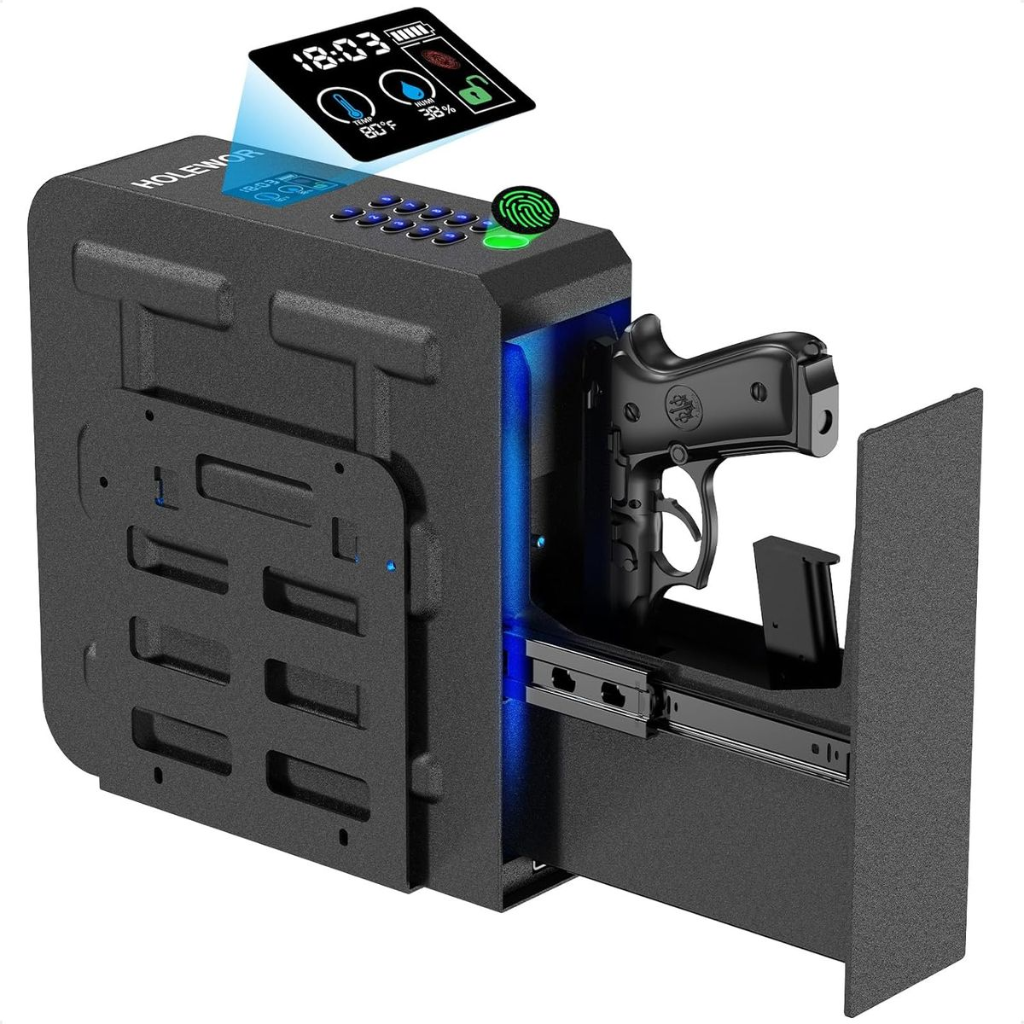
A bedside handgun safe is a compact, anchored storage unit designed for rapid one-handed access during a home defense emergency. In 2026, modern biometric sensors offer 99%+ recognition rates and unlock in under 2 seconds. For maximum reliability, choose a safe with a $150+ build quality, physical keypad or key redundancy, and permanent anchoring hardware that meets your state’s secured storage definition.
Related: Gun Storage | How To Hide Your Gun Safe
What Is a Bedside Handgun Safe and Why Does It Matter in 2026?
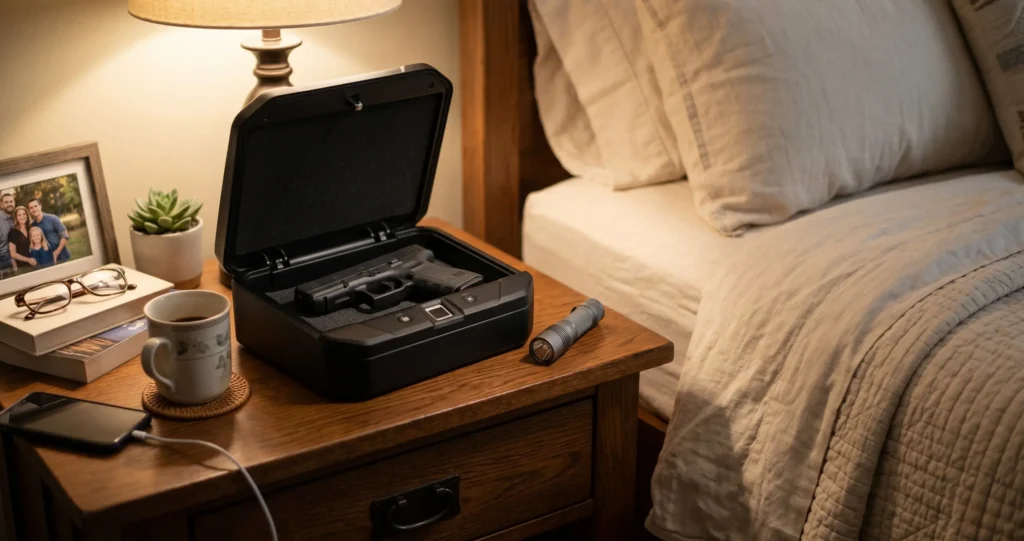
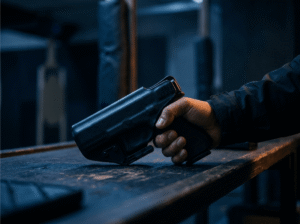
A bedside handgun safe is a compact, anchored storage unit built for one purpose: keeping a home defense handgun locked away from unauthorized hands while still letting the owner access it fast under stress.
Responsible gun ownership used to feel like a paradox. A locked gun is safe but slow. An unsecured gun is fast but dangerous, especially in a house with kids, visitors, or a sleepwalking teenager. Most owners ended up picking one problem over the other.
The 2026 biometric generation is the first product cycle that genuinely closes that gap. Current fingerprint sensors read the first time accurately, unlock in under two seconds, and offer reliable backup access methods. Combine that with expanding state storage laws and insurance requirements, and the bedside safe has moved from “nice to have” to a baseline expectation for the responsible gun owner.
One forum carrier described the old feeling this way: “I want to know I’m doing it right without wasting money or making a dangerous mistake.” That is the job this product category finally does well.
How Reliable Are Biometric Gun Safes for Home Defense?
If you shopped biometric safes between 2019 and 2022 and walked away frustrated, your instincts were correct. Early-generation sensors failed often enough that the community consensus was “stick with a keypad.”
That consensus is shifting in 2026. Modern optical and capacitive sensors are reading at 99%+ recognition rates across consecutive attempts. The current quality benchmark is simple: a safe should fail no more than twice in 100 reps. Anything worse is disqualifying, regardless of marketing claims.
Every serious bedside safe now includes a backup access method, either a physical key, a keypad, or both. That matters more than raw unlock speed. A primary biometric path with a tested backup gives you two routes to the gun when one might fail.
The honest way to evaluate a safe is to run the drill yourself. Open it 100 times over a week. Track failures. Numbers don’t lie, and specifications on a box can’t replace reps.
What Are the Non-Negotiable Features of a Bedside Safe?
Six criteria separate a safe worth owning from one that becomes a $150 mistake.
- Unlock speed. Under two seconds from touch to open is the working standard for the category. Anything slower starts to compromise the point of the product.
- Failure rate. Under 2% across 100 repetitions. This is the non-negotiable floor.
- Backup access. Physical key or keypad redundancy. A single-path safe is a single point of failure.
- Anchoring and tamper resistance. A safe you can pick up and walk away with is not a safe. Steel gauge, mounting hardware, and pry resistance matter.
- Battery life and low-battery warning. Most quality safes run 12 to 18 months on one set of batteries with an audible or visible low-battery alert. Replace batteries on a schedule, not on a warning.
- State-law compliance. Your state may specify what qualifies as “secured storage.” Check before you buy, not after.
Biometric vs. Keypad: Which Is Faster Under Stress?
Under perfect conditions, biometrics is faster. Touch and open, no sequence to remember.
Under stress, that gap narrows. Cold fingers, sweat, a partial print, or an awkward angle from a half-asleep position can slow a biometric read. A practiced keypad sequence, drilled into muscle memory, is remarkably resilient under adrenaline because it is a motor pattern, not a sensor dependency.
The honest answer is to own a safe that offers both. Use biometrics as your primary and the keypad as your backup. Drill both paths. The goal is redundancy, not preference.
This is where raw specification shopping breaks down. A 0.3-second advertised unlock time means nothing if your finger is cold and the reader misses. Pick a safe that gives you two reliable paths and practice both.
How Do You Build a Complete Bedside Defense Station?
This is the part of the conversation most product reviews skip. A handgun safe on a nightstand is not a home defense system. It is one component in one.
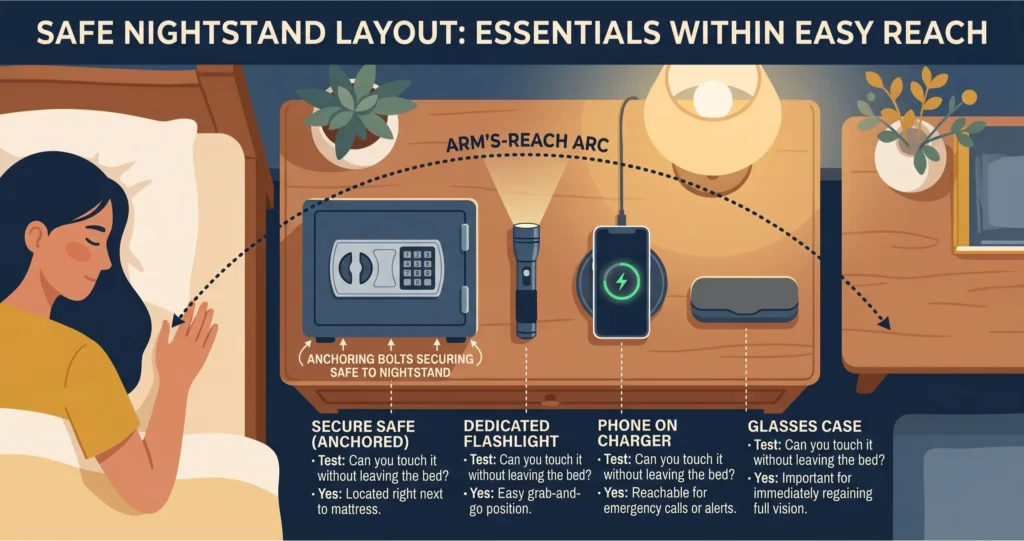
The complete bedside station has four elements, and you should be able to reach all of them without leaving the bed.
- The safe itself. Anchored to the nightstand or bed frame. Not loose. Not behind something. Not across the room.
- A dedicated flashlight. Not your phone. A real handheld defensive flashlight with enough output to identify a threat before you engage one. Threat identification is a legal and moral requirement before any use of force, and a phone screen will not give you that.
- Your phone is on its charger. For 911, for family coordination, for the timestamped record of the event. Keep it within reach but not inside the safe.
- Your glasses or contact case, if you wear them. This sounds minor until you need it. You cannot defend a house you cannot see clearly.
Run the audit tonight. Lie in bed. Eyes closed. Can you touch all four? If any element requires you to stand up, move across the room, or fumble, the station is not built yet.
The safe is the anchor of this kit, not the whole kit.

Last update on 2026-10-09 / Affiliate links / Images from Amazon Product Advertising API
Why Do Cheap Biometric Safes Fail When It Matters Most?
The $40–80 biometric safe category exists, and it is the most common first mistake new owners make.
Cheap safes fail in predictable ways. Sensors misread more often. Lid springs weaken within a year. Battery compartments corrode. The anchoring hardware is often undersized. The steel gauge is thin enough to be defeated with common household tools.
The $150 floor on reliable bedside safes is not marketing inflation. It is the honest cost of components that work when you need them to work. A carrier on one community forum put it plainly after an earlier gear cycle: “I wasted a lot of money on cheap nylon holsters.” The same logic applies to safes, and the stakes are higher.
If the budget is not there yet for a reliable biometric model, a mid-tier keypad safe at the same price point is a better choice than a cut-price biometric. Reliability beats features at this tier, every time

- Biometric gun safe features a new fingerprint scanner for advanced protection; New interior light for visibility in any...
- Gun safe is equipped with an improved gas strut for long-lasting performance; Instantly open safe door for single-handed...
- Gun safe is constructed with solid steel and a pry resistant door for strength and handgun security; Digital keypad and...
Last update on 2026-10-09 / Affiliate links / Images from Amazon Product Advertising API
Is a Bedside Handgun Safe Legally Required in Your State?
Storage laws are expanding. A growing number of states now specify what qualifies as “secured storage” when minors or unauthorized persons may be present in the home. Insurance carriers increasingly require documented secured storage as a policy condition.
Three examples of how the legal landscape varies:
- California imposes criminal liability under Penal Code §§ 25100–25140 when a minor accesses a negligently stored firearm, with penalties escalating if injury or death results. California’s statutory language is available through the official state legislative portal at leginfo.legislature.ca.gov.
- Massachusetts under M.G.L. c. 140 § 131L requires all firearms to be stored in a locked container or secured with a tamper-resistant locking device when not under the owner’s direct control, regardless of whether minors are present in the home.
- Texas under Penal Code § 46.13 imposes criminal liability when a child under 17 gains access to a readily dischargeable firearm through criminal negligence. Texas statutes are accessible through statutes.capitol.texas.gov.
These are three examples from a landscape of 50 different frameworks. Check your state’s current statute before you buy. Your safe should meet the legal definition of secured in your jurisdiction, not just the marketing definition.
Documentation matters here. Keep the receipt. Keep the product documentation. A compliant, documented storage setup is evidence of responsible ownership if you ever need to demonstrate reasonableness after an incident. This is standard practice for the responsible gun owner, not paranoia.
This section reflects general principles and identifies three state frameworks as examples. Statutes are amended regularly. Verify current law in your jurisdiction through the official state legislative portal before relying on this framing.
Pick the Safe You’ll Actually Drill With
GunCarrier’s position on bedside safes splits based on where you are in your ownership journey.
If you are a newer owner buying your first bedside safe, pick a reliable mid-tier biometric in the $150 to $200 range. Anchor it. Drill the access pattern 10 times before you need it. A working safe you have practiced with will beat a premium safe you have not every single time.
If you are an established carrier with documented training reps, the upgrade path to a premium safe is real. The access-time difference between a mid-tier and top-tier safe is a meaningful variable once your fundamentals are automatic. But this is the second safe, not the first.
The safe does not make the system. The reps do. Buy the one you will actually open in the dark, from sleep, with one hand, in a hurry.

- Discreet, Secure, Touch-Free Entry - the Hornady Rapid Safe Night Guard, 98215 keeps your handgun safes for pistols as...
- Quick Access Gun Safe - This Hornady gun safe uses the patented RFID technology to unlocks safes faster than keypads and...
- Heavy Duty and Tamper Proof – This nightstand safe is made from 14 gauge steel. Comes with a heavy duty 1500 lb. steel...
Last update on 2026-10-09 / Affiliate links / Images from Amazon Product Advertising API
Build the Complete Bedside Station
The safe is the anchor. The station is the system. Download the Home Defense Readiness Checklist for the complete bedside station audit, the access drill protocol, and the state-by-state storage law quick reference.
Check this video from Woody Goody Woodworks Reviews.
Frequently Asked Questions
-
What is the best biometric gun safe for a nightstand?
The best model balances 99%+ recognition speed with a secondary keypad or key backup and a $150 to $200 price floor for mechanical reliability. Look for anchoring hardware, 12-month battery life, and a failure rate under 2% across 100 repetitions. Reliability matters more than peak specification numbers.
-
How reliable are biometric gun safes in 2026?
Current-generation biometric safes read accurately 99% or better across consecutive attempts, a significant improvement over 2019 to 2022 models. Quality safes fail no more than twice per 100 repetitions. Test yours by running 100 reps over a week and tracking failures. The specification on the box doesn’t replace real data from your own hand.
-
Can a biometric safe be opened if the fingerprint doesn’t work?
Yes. Every quality biometric bedside handgun safe includes at least one backup access method, usually a physical key, a keypad code, or both. This redundancy is non-negotiable. A safe with only one unlock path creates a single point of failure you can’t afford on a home defense tool.
-
What is the fastest-opening bedside gun safe?
Premium biometric safes can open in under one second under perfect conditions. Realistic sleep-to-muzzle times, factoring in grip establishment and threat identification, land closer to three to four seconds. Raw unlock speed matters less than consistent reliability, because a failed read resets the clock entirely.
-
Is a biometric safe better than a keypad safe?
Neither is universally better. Biometrics is faster under ideal conditions. The keypad is more resilient to cold fingers, moisture, and stress-degraded motor skills. The honest answer is to choose a safe that offers both, use biometric as primary and keypad as backup, and drill both paths until either one works automatically.
-
How long do biometric safe batteries last?
Quality safes run 12 to 18 months on alkaline batteries. Always replace them on a set schedule, like every January, rather than waiting for the low-battery warning. A dead battery is a failed safety, and the warning chirp is not a guarantee you will hear it in time. Swap on the calendar, not the alarm.
-
Are bedside handgun safes required by law?
It depends on your state. States like California, Massachusetts, and New York have statutory secured-storage requirements with criminal penalties, while others rely on child access prevention laws that trigger after an incident. Some insurance carriers require documented secured storage as a policy condition. Verify current law in your jurisdiction through the official state legislative portal.
-
Can kids open a biometric gun safe?
No. A properly configured safe only responds to enrolled fingerprints. This high level of security is why many states now recognize biometric safes as compliant secured storage. Anchor the safe, separate backup keys from the unit itself, and enroll only authorized adults to maintain that compliance.
-
Where should a bedside handgun safe be mounted?
Anchor the safe to the nightstand or bed frame within arm’s reach of your sleeping position. You should be able to touch it without sitting up. Avoid placing it inside a drawer you would have to open first. Loose, unanchored safes can be carried off during a burglary, which defeats the purpose.
-
What should I store in my bedside safe besides a handgun?
A spare magazine, a copy of your carry permit, and possibly a backup light. Keep your phone outside the safe on its charger. Avoid storing anything that competes with the handgun for grip space or slows the access motion. The safe is a defensive tool, not a jewelry box. Less is more.
Lock in your vote and tell us: Why is this the right call?👇