
Key Facts
AIWB places the gun inside the front waistband for a faster draw and strong concealment under a loose top. OWB rides outside the waistband and fits better for business dress, higher-BMI builds, and extended seated time. The AIWB vs OWB decision comes down to your body type, daily clothing, and how long you sit each day.
Related: Best IWB Holster for Summer Concealed Carry 2026
“AIWB won’t work in the clothes I wear.” That comment appeared in a SigTalk forum thread on carry position right alongside a direct reply: “I’m skinny with no belly so it works for me.” Two experienced carriers, same question, opposite answers, and both are correct for their situations.
If you are a new carrier working through the AIWB vs OWB question and getting contradictory answers from every source you check, the contradiction is not a failure of the advice. It reflects a documented fact: the right carry position depends on three variables specific to you. Your body type. Your daily clothing. How much of your day do you spend seated? This guide builds a decision framework around those three variables so you can stop reading opinions and start testing what actually works.
What Is the Difference Between AIWB and OWB Carry?
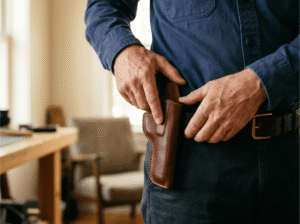
AIWB stands for appendix inside the waistband. The gun goes inside your pants at the front of your body, positioned between 12 o’clock and 2 o’clock. The muzzle points down toward the inner thigh area. Because the muzzle is directed toward the femoral artery in this position, a safe re-holstering technique is not optional. It is the skill that makes AIWB responsible.
OWB stands for outside the waistband. The gun rides outside your pants at the strong-side hip, typically between 3 o’clock and 4 o’clock, secured by a paddle or belt loops. A jacket, longer overshirt, or cover garment conceals it from view.
One point of confusion worth clearing up: AIWB is a specific position within the broader IWB category. Standard strong-side IWB at 3 to 5 o’clock is not the same as AIWB at 12 to 2 o’clock. If you have tried one and found it uncomfortable, that experience does not predict how the other will feel on your body.
Both sides of the AIWB vs OWB comparison share one non-negotiable requirement: a purpose-built holster with full trigger guard coverage and a rigid holster mouth that stays open for one-handed re-holstering. That is not an advanced standard. It is the minimum for either position.
AIWB and OWB are not competing philosophies. Two carry positions solve different problems for different bodies and lifestyles.
Is AIWB or OWB Better for Concealment?
Clothing determines the answer far more than position does.
AIWB conceals well under a loose, untucked shirt or hoodie. The grip follows the natural forward taper of the body, which reduces printing. Adding a claw attachment pushes the grip inward against the waistband. A wedge tilts the muzzle away from the body. With both accessories in place, AIWB can nearly disappear under a t-shirt for most body types.
OWB requires a longer cover garment because the gun sits outside the pants. A jacket worn open, a button-up over a t-shirt, or a longer untucked overshirt conceals an OWB holster reliably. In business casual environments where a sport coat is standard dress, OWB often outperforms AIWB for daily concealment because the outerwear provides consistent coverage that does not depend on body taper or waistband tension. The USCCA’s holster selection guide notes that OWB carry also allows more comfortable use of full-size frames, which matters if you want to carry a larger pistol without printing.
Concealment is not a feature of the position. It is a product of the position, the holster, the gun, and the wardrobe working together.
The practical test: try each position in the clothes you actually wear on your real days, not in ideal conditions. The position that disappears in your daily clothing is the right one for your situation.
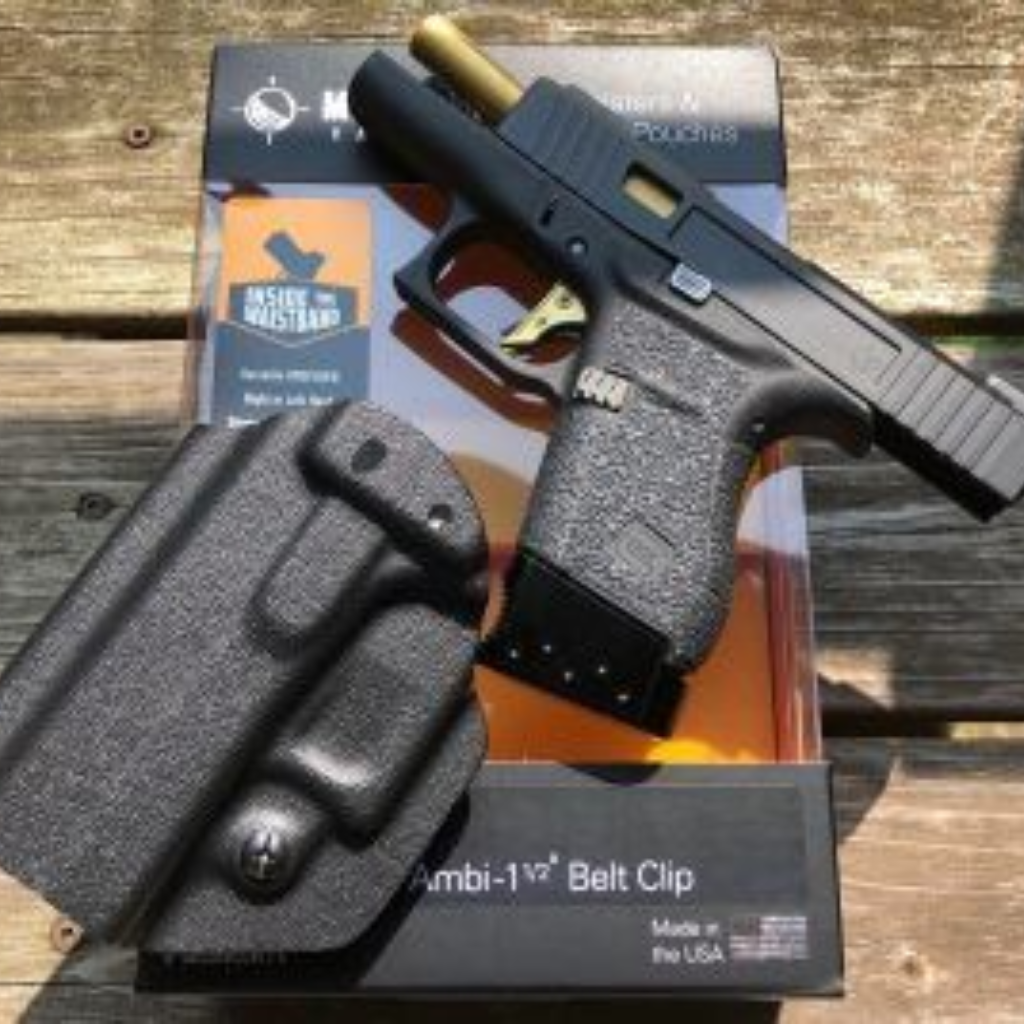
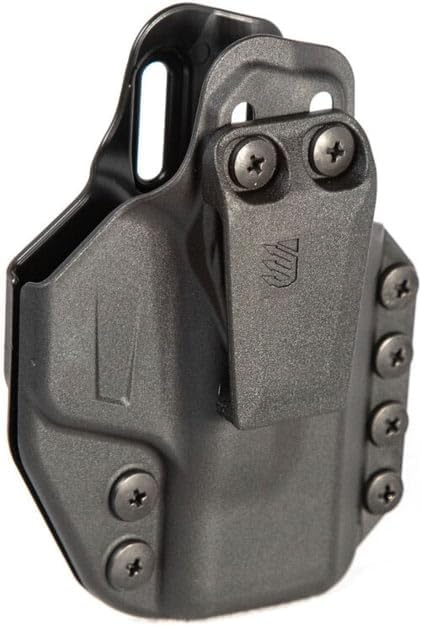
- Impact-reinforced, injection molded polymer design
- 1.5" J-style belt clip adjustable for height & cant
- Ambidextrous, adaptable for right or left hand carry

Last update on 2026-10-09 / Affiliate links / Images from Amazon Product Advertising API
This article contains affiliate links. GunCarrier may earn a commission if you purchase through links on this page, at no additional cost to you.
Which Carry Position Works Best for Your Body Type and Clothing?
Three questions determine where the AIWB vs OWB decision starts for you.
- What does your daily clothing look like? Relaxed-fit jeans with an untucked shirt or hoodie: AIWB is worth testing first. Fitted slacks, tucked shirts, or business casual as a daily standard: start with OWB and a cover garment.
- How much of your day do you spend seated? Primarily at a desk or behind the wheel for long stretches: many carriers find OWB at 3 to 4 o’clock more comfortable during extended sits. AIWB can create direct pressure at the waistband and lap during long seated periods, particularly with full-size frames. Trainers and carry educators have consistently identified holster discomfort during seated carry as one of the primary reasons daily carriers become inconsistent carriers. On your feet and moving most of the day: AIWB’s faster draw access becomes more relevant to your actual context.
- What is your body type? Lean to average midsection: AIWB is a practical starting point. Significant abdominal mass: OWB is the correct default. As one gear reviewer put it plainly, “some find it uncomfortable, especially with a larger stomach or carrying a full-size gun.” No holster accessory fully resolves those anatomical constraints.
Female carriers face an additional variable. The hip-to-waist ratio on female anatomy means AIWB sits differently than it does on a male frame. Strong-side IWB at 3 to 4 o’clock often provides cleaner concealment on female body proportions. Test both before committing to either.
The right carry position is determined by your body, your wardrobe, and your daily context.
What Mistakes Do New Carriers Make When Choosing Between AIWB and OWB?

The most common mistake is choosing a position before testing it. The second most common is tolerating a position that makes you not want to carry.
Most new carriers pick their first holster based on what instructors or content creators use. Those people carry in different bodies, with different daily clothing, and in different daily contexts. Their answer is not wrong for them. It may not be right for you.
The mistake that costs real money is buying the holster before testing the position. Dry-fire with an empty, verified-safe gun in the candidate position for a week before purchasing anything. “Expect plenty of trial and error and a closet shelf of rejects” is the most common complaint in the carry community. Most of that expense is preventable with a free testing period first.
The mistake that creates real risk is choosing a soft-sided or universal-fit holster. “I wasted a lot of money on cheap nylon holsters” appears in CCW forums with consistent regularity. A holster without a rigid trigger guard cover and a stable holster mouth that holds its shape during re-holstering does not meet the minimum safety standard for AIWB vs OWB carry or any other position.
The mistake that undermines everything else is tolerating discomfort until carrying becomes optional. A gun sitting in the safe defeats the purpose. If the holster is uncomfortable enough that you occasionally leave the gun at home, the position is wrong for your current setup, regardless of how technically sound it may be for someone else.
The best holster is the one you put on every morning without negotiating with yourself.

- OUR CUSTOM MADE gun holster for men and women to fit the Walther PDP Compact & Full Size 4” is made to ensure the...
- DURABLE .08” KYDEX CONSTRUCTION ensures the durability and gives this concealed gun holster full trigger protection...
- CUSTOMIZE YOUR CANT for 20 degrees in either direction with adjustable retention screws that are claw compatible for...
Last update on 2026-10-09 / Affiliate links / Images from Amazon Product Advertising API
This article contains affiliate links. GunCarrier may earn a commission if you purchase through links on this page, at no additional cost to you.
Which AIWB and OWB Holsters Are Worth Considering for Everyday Carry?
Always verify gun model compatibility before purchasing any Kydex holster. All prices are approximate and may vary.
For AIWB carry, the Vedder LightTuck IWB/AIWB Kydex (approximately $70 to $85) is a widely used starting point. Handcrafted per gun model, it offers 30 degrees of adjustable cant in both directions, a tuckable steel clip, and an audible retention click on holstering. It supports both appendix and strong-side IWB positioning in a single holster. For a lower-cost entry into the AIWB vs OWB testing process, the Concealment Express Rounded AIWB Kydex (approximately $45 to $60) provides solid trigger guard coverage with optic-ready variants available.
For OWB carry, the Concealment Express OWB Paddle Kydex (approximately $50 to $65) rides close to the body for concealment under a cover garment and uses a compact paddle for quick on-and-off without removing the belt. The Safariland 6378 ALS Paddle and Belt Loop Combo (approximately $65 to $85) adds an Automatic Locking System that secures the gun on holstering and releases cleanly with a thumb press on the draw. Suede interior lining protects the finish of the firearm. It performs equally well at the range and in daily carry.
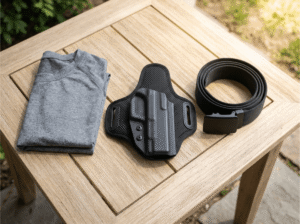
[AAWP shortcode: Concealment Express OWB brand store search] [AAWP shortcode: Safariland 6378 brand store search]Both the AIWB and OWB positions require a dedicated gun belt. A purpose-built belt in stiff leather or reinforced nylon prevents the holster from shifting, canting, or printing during daily activity. This is not optional for either position. As USCCA’s holster fundamentals guide notes, without the proper belt, the holster is useless.
Related: AIWB Appendix Carry Holster Setup: The 2026 Guide to Comfort, Speed, and Safety

- Black 1 3/8" (35mm) wide heavyweight webbing belt with no buckle, hard plastic or metal parts. Nickel free and...
- Features unique combined hook & loop fasteners - there is not a hook side and a loop side - both sides are the same...
- Rubber coated on both end tips. Provides protection from dings and scratches.
Last update on 2026-10-09 / Affiliate links / Images from Amazon Product Advertising API
Choosing the Right Carry Position Takes One Test, Not Endless Research
The AIWB vs OWB decision is not about which position is objectively better. It is about which position works for your body, your clothing, and your daily life.
Run the test. Put on your real daily clothes. Holster an empty, verified-safe gun in the position you are considering. Attempt a full draw from concealment. Sit down. Get into a car. Walk around for an hour. If the position causes you to adjust, fidget, or print before the first hour is over, it is not your starting point.
Then apply the consistency check: would you put this holster on every single morning without exception? If the answer is “most days,” the position needs to change. Training program data documented at KR Training consistently shows that carry consistency is the variable that determines whether your investment in training and equipment means anything at all. Both AIWB and OWB work. The one that works for you is the one you carry every single day.
Check out this video from Herrington Arms Warehouse.
Frequently Asked Questions
-
What is the difference between AIWB and OWB carry?
AIWB positions the gun inside the waistband at the front of the body, typically between 12 and 2 o’clock. OWB carries the gun outside the waistband at the strong-side hip, typically at 3 to 4 o’clock, under a cover garment. In the AIWB vs OWB comparison, AIWB sits inside the pants while OWB rides outside and stays covered by clothing.
-
Is AIWB or OWB better for concealment?
It depends on your clothing. AIWB conceals well under a loose, untucked shirt or hoodie. OWB conceals better under a jacket or longer cover garment and is the stronger option for business casual environments. Neither position in the AIWB vs OWB comparison conceals reliably without clothing specifically matched to the carry setup.
-
Is AIWB safe for everyday carry?
Yes, when used with a rigid Kydex or polymer holster that provides full trigger guard coverage and supports one-handed re-holstering. AIWB requires a deliberate holstering technique: go slowly, verify the trigger finger is clear, and never force the gun in. The muzzle points toward the inner thigh area in this position, which makes safe re-holstering the critical skill, not the draw.
-
Can someone with a larger midsection carry AIWB?
AIWB becomes increasingly uncomfortable and difficult to conceal as the abdominal mass increases. Many carriers with higher BMI find OWB at 3 to 4 o’clock or strong-side IWB more practical and sustainable for daily carry. Body type is a real anatomical variable. Holster accessories do not fully overcome structural fit problems at higher BMI ranges.
-
What is the best OWB holster for concealed carry?
A quality OWB holster for concealment should ride high on the hip, stay close to the body, and include positive retention. The Safariland 6378 ALS Paddle and Belt Loop Combo and the Concealment Express OWB Paddle Kydex are widely used starting points in the $50 to $85 range. Always verify gun model fit before purchasing any Kydex holster.
-
What is the fastest draw position: AIWB or OWB?
AIWB generally produces faster draw times because the gun is directly in front of the body and accessible with less shoulder movement. That said, the practical difference between well-practiced AIWB and OWB at realistic defensive distances is small. Consistent daily practice with your actual carry setup matters more than any theoretical positional advantage.
-
Should beginners start with AIWB or OWB?
Most beginners are better served starting with OWB. The gun is easier to observe during re-holstering, the technique is more forgiving, and there is less body-position dependency in daily carry. Once safe draw and re-holstering habits are established, AIWB is a natural next step for carriers whose body type and clothing support the position.
-
Is AIWB or OWB better for driving?
Most carriers find OWB at 3 to 4 o’clock more comfortable during extended driving. AIWB can press against the lap and seatbelt in a seated position, particularly with a full-size frame. If your daily commute is long or you spend significant time behind the wheel, test your AIWB vs OWB setup specifically in your vehicle before committing to either position.
-
Do I need a special belt for AIWB or OWB carry?
Yes. Both positions require a dedicated gun belt built to resist the weight of the holster and firearm without flexing, canting, or allowing the holster to shift. A standard dress or fashion belt will fail under the weight of either rig. A purpose-built gun belt in stiff leather or reinforced nylon is not optional for AIWB or OWB everyday carry.
-
What holster material is best for AIWB and OWB carry?
Rigid Kydex or polymer is the standard for both positions. It provides full trigger guard coverage, a defined holster mouth that stays open for one-handed re-holstering, and consistent retention across daily use. Soft-sided or universal-fit nylon holsters do not meet the minimum safety standard for AIWB vs OWB carry or any position used for everyday carry.
Lock in your vote and tell us: Why is this the right call?👇