
Key Insights
H.R. 38, the Concealed Carry Reciprocity Act, would let any eligible CCW carrier carry concealed in any state that allows it. As of April 2026, the bill has cleared the House Judiciary Committee but has not received a full floor vote. It is not law. State-specific rules still apply to every carrier crossing state lines.
Related: Traveling With Your Carry Gun: The Pre-Trip Reciprocity Checklist
This article is informational, not legal advice. Concealed carry laws vary by state and change regularly. Consult a licensed attorney in your jurisdiction before relying on any summary of state or federal firearms law.
What Is H.R. 38 (Concealed Carry Reciprocity Act)?

A carrier on a public forum recently said it plainly: “I’m very nervous to be driving through Illinois, even though I know the rules.” That sentence captures the durable problem H.R. 38 concealed carry reciprocity is meant to address.
Right now, a CCW carrier driving from one state to another navigates fifty different permit regimes, dozens of overlapping reciprocity agreements, magazine capacity rules that change at state lines, no-carry zones that vary by city, and in some states, local law enforcement officers who themselves disagree about what the law allows. One forum user called multiple Illinois sheriff’s departments and got conflicting answers about whether a non-resident could have a loaded handgun in a vehicle while passing through.
H.R. 38 is the federal bill written to put a single floor under that confusion. In plain language, it would let a person eligible to carry concealed in their home state carry in any other state that allows concealed carry. That is what would change. There is also a long list of things that would not change, and that list is where most of the work for traveling carriers actually lives.
What Is the Current Status of H.R. 38 in 2026?
The bill was introduced in the 119th Congress on January 3, 2025, by Rep. Richard Hudson (NC-09), with more than 120 co-sponsors. On March 25, 2025, the House Judiciary Committee voted 18 to 9 to advance it. On October 3, 2025, it was placed on the Union Calendar (#289), positioning it for a full House floor vote.
A companion bill, S. 65, sits in the Senate. In May 2025, twenty-four state attorneys general filed a letter urging the House to pass H.R. 38, the largest formal show of state law-enforcement support for the legislation in this Congress.
As of April 2026, H.R. 38 has not received a full House floor vote. It is not the law.
Verify before you travel. Bill status changes. Check the official action record on Congress.gov before making any decision that depends on the current state of the legislation.
How Would Federal Reciprocity Change CCW Travel?
If H.R. 38 becomes law, a person eligible to carry in their home state could carry concealed in any other state that allows concealed carry, including residents of constitutional-carry states without a permit. The bill preempts most state and local laws that would otherwise interfere with that cross-state carry right. It also creates a private right of action for carriers whose rights under the law are violated.
Here is what would not change: state use-of-force law, duty-to-retreat status, castle doctrine, no-carry zones (federal buildings, secured airport areas, military installations, plus state-defined zones like schools, courthouses, and posted private property), reportable-incident rules, magazine capacity restrictions in some states, and ammunition type restrictions in others.
This is the central principle: carrying permission and legal defense in a defensive shooting are two different problems. A reciprocity statute answers one of them. The other still needs your attention before you cross the state line.
The table below maps the split:
| Category | What H.R. 38 Would Do | What H.R. 38 Would Not Do |
| Carry Rights | Let’s have eligible carriers carry concealed across state lines | Does not override federal no-carry zones (federal buildings, airports, military bases) |
| Permit Recognition | Requires reciprocal recognition of home-state permits and constitutional-carry status | Does not standardize permit issuance, training requirements, or eligibility rules |
| State Restrictions | Preempts most state and local laws blocking cross-state carry | Does not preempt magazine limits, ammunition rules, or posted no-carry zones |
| Use of Force Laws | No change | Duty-to-retreat, castle doctrine, presumption of reasonableness, still governed by the state where the incident occurs |
| Post-Incident Process | No change | Reportable-incident rules, prosecutor discretion, and applicable jury instructions all run on local law |
| Legal Defense | Creates a private right of action for rights violations under the bill | Does not provide criminal-defense funding or representation |
Is Federal Reciprocity Actually Safer for Carriers?
There is a real argument inside the carrier community about whether national reciprocity helps or hurts the average traveler.
One side: a federal floor reduces the chance of accidentally crossing into a non-reciprocal state. The carrier that today plans a route around Illinois because its permit isn’t recognized would, under H.R. 38, face one less variable.
The other side: a federal carry permit can quietly replace the legal homework instead of supplementing it. The carrier who used to consult Handgunlaw.us before every road trip has stopped consulting it. The carrier who used to call the state attorney general’s office stops calling. And the moment a defensive incident happens, that carrier discovers the federal carry right is not a federal legal defense.
The reconciliation is a phase model. Treat reciprocity as a permission tool at the pre-trip stage. Treat the destination state as the legal-standard jurisdiction the moment you are inside it. And understand that, after any defensive incident, the law of the state where the shooting occurs is the law that governs.
Reciprocity tells you where you can carry. It does not tell you how the law will judge you if you have to use the gun. Those are two different questions, and you need an answer to both before you cross the state line.
What Should You Do Before You Cross a State Line With Your Carry Gun?
Six items, every trip:
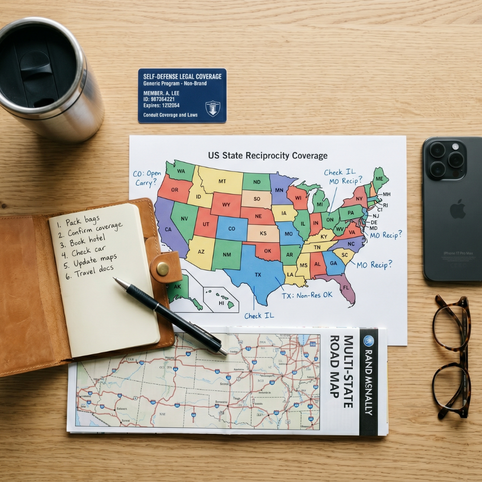
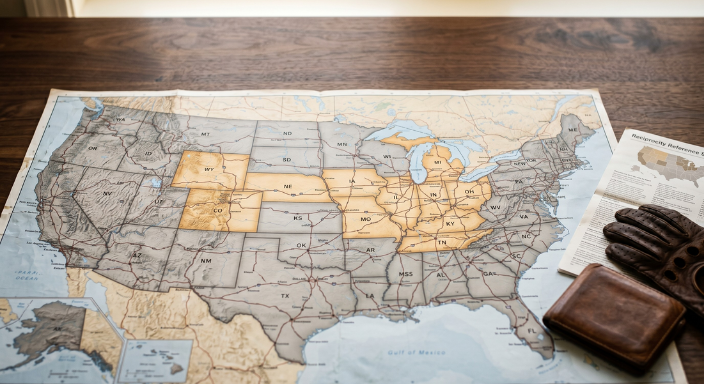
- Verify reciprocity for every state on your route, not just your destination. Use Handgunlaw.us, the USCCA reciprocity map, and the destination state attorney general’s published guidance. Print a hard copy for the glove box. (See our state-by-state CCW guide hub for current reciprocity by state.)
- Identify state-specific restrictions that override reciprocity: magazine limits, no-carry zones, posted-business rules, in-vehicle storage rules, and ammunition restrictions.
- Read the destination state’s use-of-force statute. Duty to retreat or stand your ground. Castle doctrine scope. Presumption of reasonableness. One sentence on each, before you go. (Background: Use-of-Force Basics for the Armed Citizen and Castle Doctrine and Stand Your Ground Explained.)
- Carry your self-defense legal coverage card and a current training portfolio. Save the contact information for an attorney licensed in each state on your route. (Primer: Self-Defense Legal Coverage, What Actually Matters.)
- Match your travel carry to your home carry. Same gun, same holster, same ammunition. A long road trip is the wrong time to introduce an unfamiliar platform.
- Apply the environmental scan on every stop: gas stations, restaurants, motels, and parking lots. Awareness does not transfer at the state line. You carry it with you.
The Bottom Line on H.R. 38 in 2026
The Bottom Line on H.R. 38 in 2026
H.R. 38 is advancing. It is not the law. The problem it would solve is real, and the problems it would not solve still need your attention. The disciplined CCW carrier prepares for both versions of the future: the bill passes, the bill stalls.
Bookmark this article. Re-check the Congress.gov status link before any cross-state trip. Keep the printed reciprocity map in your glove box. That is what travel-ready carry looks like, regardless of what the federal statute says this week.
This article is informational, not legal advice. Concealed carry laws vary by state and change regularly. Consult a licensed attorney in your jurisdiction before relying on any summary of state or federal firearms law.
Washington Gun Law: Are the Cops Really Opposed to National Carry Reciprocity?
Frequently Asked Questions
-
Is H.R. 38 law in 2026?
No. As of April 2026, H.R. 38 has cleared the House Judiciary Committee on an 18 to 9 vote (March 25, 2025) and is on the Union Calendar awaiting a full House vote. The Senate companion bill is S. 65. Until both chambers pass it and the President signs it, current state-by-state reciprocity rules apply.
-
What does H.R. 38 actually do?
It establishes a federal framework, letting a person eligible to carry a concealed handgun in their home state carry in any other state that allows concealed carry. It preempts most state and local laws that would interfere with cross-state carry. It does not change state use-of-force law, no-carry zones, or post-incident legal rules.
-
If H.R. 38 passes, do I still need to know each state’s gun laws?
Yes. Reciprocity addresses your right to carry. It does not address state-specific magazine limits, no-carry zones, posted-business rules, or, most importantly, the use-of-force law that would govern a defensive shooting in that state. Those still apply locally, and they still matter.
-
Does H.R. 38 cover residents of constitutional carry states without a permit?
The bill is written to extend cross-state carry rights to residents of permitless-carry states as well as permit holders. Exact mechanics depend on the final bill text, which can change before passage. Verify the current language on Congress.gov before relying on this point.
-
Would I be able to carry in New York or California if H.R. 38 passes?
The bill requires every state that allows concealed carry to recognize permits and constitutional-carry status from other states. Both New York and California allow some form of concealed carry, so reciprocity would generally apply, subject to state-specific no-carry zones, which the bill does not preempt.
-
What about no-carry zones, schools, federal buildings, and posted businesses?
Federal no-carry zones (federal buildings, secured airport areas, military installations) remain off-limits regardless of reciprocity. State and local no-carry zones, including schools, courthouses, posted private property, and public transit in some states, generally remain enforceable. Check destination state restrictions before traveling.
-
Do I still need self-defense legal coverage if reciprocity passes?
Yes, arguably more than before. Reciprocity expands where you carry. It does not expand where you have legal support. Coverage that funds criminal defense in any state you travel to is the standard worth carrying. Confirm your provider’s geographic coverage before relying on it across state lines.
-
Where can I check H.R. 38’s current status?
Congress.gov maintains the official action record. For state-by-state reciprocity, Handgunlaw.us and the USCCA reciprocity map are widely used. For use-of-force law in your destination state, read the state attorney general’s published guidance, and consider consulting an attorney before relying on any third-party summary.
Make the case: Why did you vote that way?👇