
Key Points
You can rack a pistol slide with arthritis by switching from a grip-and-pull method to a push-pull technique using both hands simultaneously, using an overhand palm grip on the slide, or using slide assist tools such as the Handi-Racker. If technique adjustments alone are not enough, reduced-power recoil springs and purpose-designed pistols with lighter slides offer additional solutions. The goal is ten consistent, reliable racks under realistic conditions, not “most of the time.”
⚠️ Critical Safety Protocol
Before attempting any of the mechanical techniques described in this guide, you must adhere to these three rules:
Verify Clear: Ensure the firearm is completely unloaded with no ammunition in the room during practice.
Safe Direction: Always maintain muzzle discipline, pointing the barrel at a reinforced backstop or safe area.
Finger Discipline: Keep your trigger finger indexed high on the frame until you are ready to fire; never use the trigger for leverage while racking.
Related: 5 Best Low-Recoil Handguns for Seniors
It’s Not Your Grip. It’s Your Technique
“At 72 years old and arthritic in almost every joint in my body, on top of losing strength in my hands, racking most slides on semi-autos is difficult as well as painful.”
That was posted in a SIG Talk forum thread. It could have come from a thousand of them.
If you’re in that position, you’ve probably already searched for answers and found a lot of conflicting advice, a few product recommendations with no context, and the quiet suggestion sometimes not so quiet that maybe it’s time to switch to a revolver.
Here’s the problem with that suggestion: a double-action revolver trigger pull runs 10 to 12 pounds. For most people with arthritic hands, that’s not a solution. It’s a different problem.
Arthritis doesn’t have to end your relationship with semi-automatics. It changes the problem. This guide solves it step by step, in order.
Why Is It So Hard to Rack a Pistol Slide With Arthritis?
Most service pistol recoil springs are rated between 12 and 20 pounds. Arthritis reduces grip force and pinch strength, the two things most people rely on when they rack a slide. According to the Arthritis Foundation, joint protection involves using larger muscle groups (like the forearm and shoulder) to compensate for loss of fine motor pinch strength. When those go, the standard approach fails.
Here’s what most people get wrong: racking a slide is a leverage problem, not a strength problem. The technique the majority of people use, gripping the slide with two fingers like a slingshot and pulling, is also the technique that loads the most stress directly onto finger joints. That’s the first thing to fix.
“My thumbs and fingers are the problem. I just can’t hold onto the slide on many of my pistols anymore.”
That’s not a strength failure. That’s a technique mismatch.
What Is the Push-Pull Method and Why Does It Work Better Than Pulling the Slide?
The push-pull method is the highest-value fix available, and it costs nothing.
Step 1: Establish a Master Grip.
Hold the pistol frame with your dominant hand, keeping your finger off the trigger, and the muzzle pointed in a safe direction.
Step 2: Position the Support Hand.
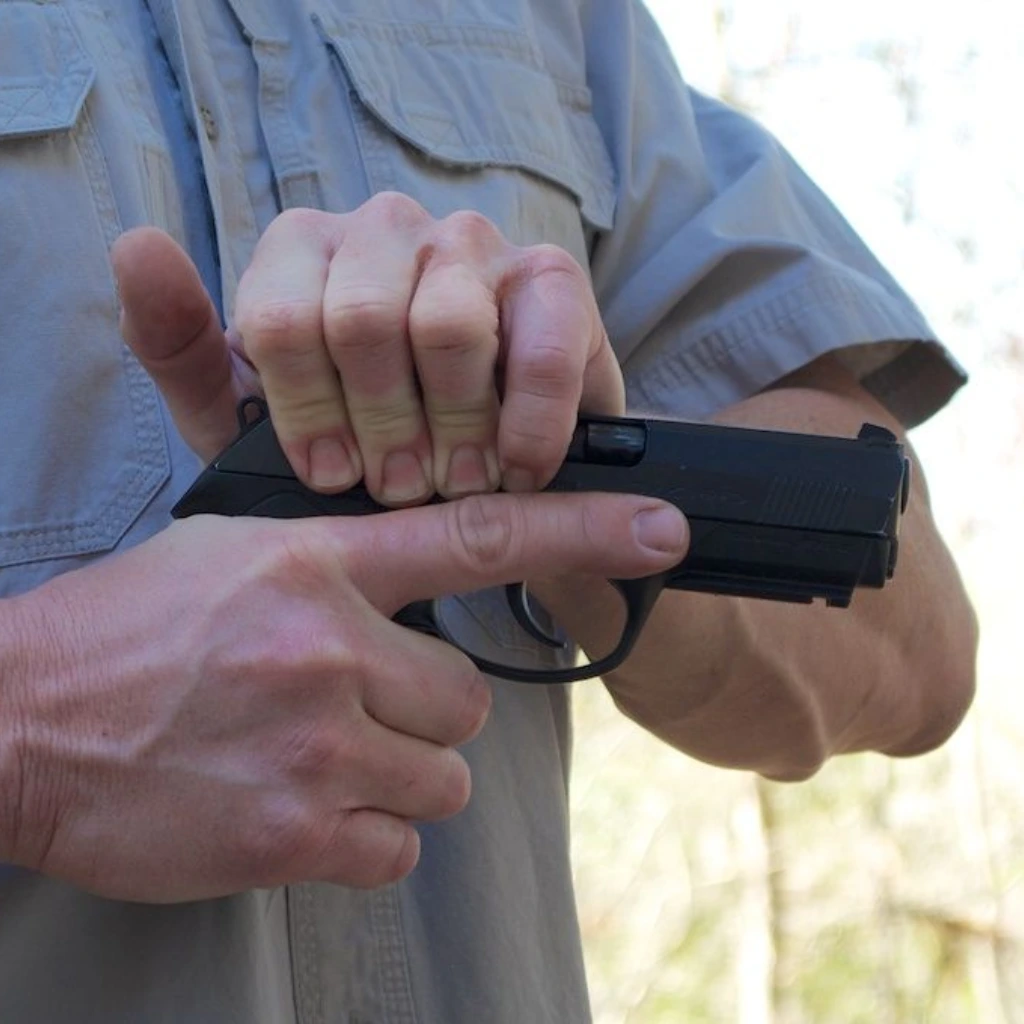
Place the heel of your support hand palm down over the top of the slide. Avoid using a “pinch” or “slingshot” grip with just your fingers.
Step 3: Simultaneous Opposition.
Push the frame forward with your strong hand while pushing the slide rearward with your support hand palm.
Step 4: The Clean Release.
Once the slide reaches its rearward limit, abruptly “snap” your support hand away, allowing the recoil spring to chamber the round with full force.
You are not pulling the slide. You are pushing in two directions at once, which distributes the load across both arms and eliminates the pinch-grip failure point.
Shooters Forum:
“I have found that pushing the slide back is easier than pulling it back.”
Your test: Try this 20 times in dry practice. If you fail more than once, move to the next technique, but try this one first.
What Are the Other Techniques for Racking a Slide With Limited Hand Strength?
- The Overhand Palm Grip: Instead of pinching the slide with your fingers, lay the heel of your palm over the rear of the slide. The larger muscle group in your palm and forearm does the work. This is most effective when arthritis is concentrated in your knuckles and finger joints rather than the wrist. Work it the same way as the push-pull, frame forward, palm rearward, release clean.
- The Rear Sight Hook: Hook the rear sight over a belt edge, boot heel, or hard surface edge. Push the frame downward. The slide stays fixed; the gun moves. This is a recognised technique for one-handed operation and for situations where grip is severely compromised.
- Safety note: Muzzle direction is critical here. Know exactly where the barrel is pointed before you use this technique, and practice it deliberately before you rely on it.
- The Slingshot Grip Done Right: Index and middle finger curl over the rear of the slide; the remaining hand drives the frame forward. The common error is using those two fingers to pull like a slingshot, which fails because it loads all the force onto the weakest joints. The fix is the same as above: push with the frame hand, guide with the slide hand, let go clean.
When Technique Isn’t Enough, Which Products Actually Help You Rack a Pistol Slide?

Run the 10-for-10 test after practising the techniques above. Rack the slide ten consecutive times with your carry ammunition, in your actual carry clothing, at a realistic speed. If you fail even once, your current method is not reliable enough for defensive carry.
If technique alone doesn’t get you there, equipment is the next step, and it is a legitimate one.
- Handi-Racker Slide Assist Tool (~$20–$25). A T-shaped tool that hooks over your slide serrations and lets you push the muzzle against a hard surface to rack one-handed. Works well for loading and unloading at home or at the range. Not designed for on-body carry or rapid deployment, but for the morning load-up, it solves the problem cleanly.
- Talon Grips / Pachmayr Tactical Grip Gloves (~$10–$30). Adhesive grip tape applied to the slide, or grip gloves worn on the support hand, increases the friction between your palm and the slide surface. This reduces the force you need to apply to maintain purchase. Most effective for moderate grip loss, where slip is the issue; less effective for advanced joint damage.
- Aftermarket Charging Handles and Extended Serrations (~$25–$60). Products like the Brass Stacker charging handle mount to your existing slide and provide a larger, more accessible rack surface. Some are removable; some are permanent. Check compatibility with your carry holster before committing.
Should You Switch Pistols? What to Look for in an Easy-to-Rack Semi-Automatic
If technique and tools together still don’t get you to 10-for-10, that is information. Act on it.
Switching platforms is not a failure. It is the third step in a logical sequence.
What makes a slide easier to rack:
- Longer grip surface on the slide
- Lower factory recoil spring weight
- Hammer-fired action (cocking the hammer first reduces racking force significantly)
- Extended factory serrations or moulded grip wings
Platforms worth testing:
- S&W Shield EZ (9mm / .380): purpose-designed for reduced grip strength; the lightest-racking factory pistols in their class. This was specifically engineered with a reduced-power recoil spring to lower the ‘racking weight’ for those with limited hand strength.
- H&K VP9: factory-moulded “wings” on the rear of the slide give a larger contact surface
- Walther PDP: smooth, extended serrations across the full slide length
A note on reduced-power recoil springs: Lighter aftermarket springs lower the racking force, but the spring must still be heavy enough to cycle your carry ammunition reliably. Run at least 50 rounds through any reduced-spring setup before trusting it. A spring that’s too light for your ammunition will produce malfunctions.
You Don’t Have to Choose Between Arthritis and a Semi-Automatic
“I want to keep shooting, but this is a problem.” Handgun Forum
It is a problem. And it has a sequence: technique first, tools second, firearm selection third. Most people find their answer in step one or two. Some find it in step three. All three paths are legitimate, and all three are available to you.
The only test that matters is the 10-for-10 test under realistic conditions. If you clear it, you’ve solved the problem. If you don’t, you have more information, and now you know exactly what to do with it.
Check this video from Tactical Hyve: Is The Push Pull Method Still A Viable Technique?
Frequently Asked Questions
-
What is the easiest way to rack a pistol slide with arthritis?
The push-pull method, strong hand pushing the frame forward while the support hand pushes the slide rearward simultaneously, is the most effective starting point. It redistributes the workload away from finger-joint pinch strength. Try it 20 consecutive times in dry practice before moving to any equipment solution.
-
Is it safe to carry a pistol with one in the chamber if I struggle to rack the slide?
Carrying a chambered gun is standard practice for defensive carry and is generally safer than carrying an unchambered gun. You will not have time to react in a real defensive situation. It does not eliminate the need to solve the racking problem, however. You still need to clear malfunctions and reload under pressure. Solve the problem; don’t carry around it.
-
Will a lighter recoil spring make my pistol easier to rack?
Yes, within limits. A reduced-power recoil spring lowers the force required to rack the slide. The tradeoff: the spring must still be heavy enough to cycle your carry ammunition reliably. If the spring is too light for the ammunition you’re running, the pistol will malfunction. Verify with at least 50 rounds before trusting the combination.
-
What is the Handi-Racker, and does it actually work?
The Handi-Racker is a T-shaped plastic tool that hooks over the slide and lets you push the muzzle against a hard surface to rack the slide one-handed. It works well for loading and unloading at home or at the range. It is not designed for on-body carry or rapid deployment in a defensive situation.
-
Are there pistols specifically designed to be easy to rack for people with arthritis?
Yes. The S&W Shield EZ series was purpose-built for reduced grip strength, using a lighter recoil spring and grip safety design that significantly lowers racking force. The H&K VP9 includes factory-moulded wings on the rear of the slide. Several optics-ready platforms with extended serrations also offer meaningful real-world improvements.
-
Can grip gloves or grip tape actually help me rack a slide?
Yes, for moderate grip loss. Grip gloves and adhesive grip tape on the slide increase friction between your hand and the slide surface, reducing the force required to maintain purchase. They work best when the problem is slippage and loss of grip, not complete loss of hand strength.
-
Is a revolver a better choice than a semi-automatic if I have severe arthritis?
Not necessarily. A double-action revolver trigger pull runs 10 to 12 pounds, which is often harder on arthritic hands than racking a properly fitted semi-automatic. A hammer-fired semi-automatic, a purpose-designed easy-rack pistol, or an assisted rack tool frequently preserves more of what you already know and trust.
-
What is the overhand palm grip for racking a slide?
Instead of pinching the slide with your fingers, you lay the heel of your palm over the rear of the slide and drive it rearward using the forearm. This removes most of the stress from finger joints. It is especially effective for arthritis concentrated in the knuckles and finger joints rather than the wrist.
-
How do I know if my racking solution is reliable enough for defensive carry?
Run the 10-for-10 test: rack the slide ten consecutive times with your carry ammunition, in your actual carry clothing, at a realistic speed. If you fail even once, your current method is not reliable enough. Solve the failure before you carry on, not after.
-
Can the rear sight be used to rack a pistol slide one-handed?
Yes. Hooking the rear sight over a belt edge, boot heel, or table edge and pushing the frame downward is a recognised technique for one-handed operation. Muzzle direction and trigger discipline are critical throughout. Practice this deliberately before relying on it; do not attempt it for the first time under stress.
Does this pick give you the most confidence in the field? Tell us why.👇