Quick Look at Appendix Carry Holster for Women
- Petite appendix carry success is mostly about holster geometry + ride height + positioning, not gun size alone.
- Use a wing/claw and correct belt tension to rotate the grip inward and reduce printing.
- Consider holsters/systems with strong adjustability (Enigma, CERTUM3, JMCK, Flint, LightTuck, OATH).
- Comfort comes from small, systematic tweaks and choosing a setup that spreads pressure and stays stable.
- Safety requires rigid trigger coverage, a rigid holster mouth, and preventing clothing interference.
Related: IWB Holster For Women With Curves
Appendix Carry Holster for Women With a Small Frame: How to Choose One That Actually Fits
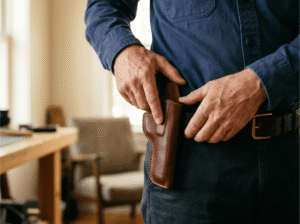
Appendix inside-the-waistband carry (AIWB) is often recommended for smaller-framed women because it places the gun on the front of your body, where clothing tends to drape more predictably and the grip is easier to control for concealment. For many petite carriers, it can also be easier to access than hip carry because you’re not reaching behind your body.
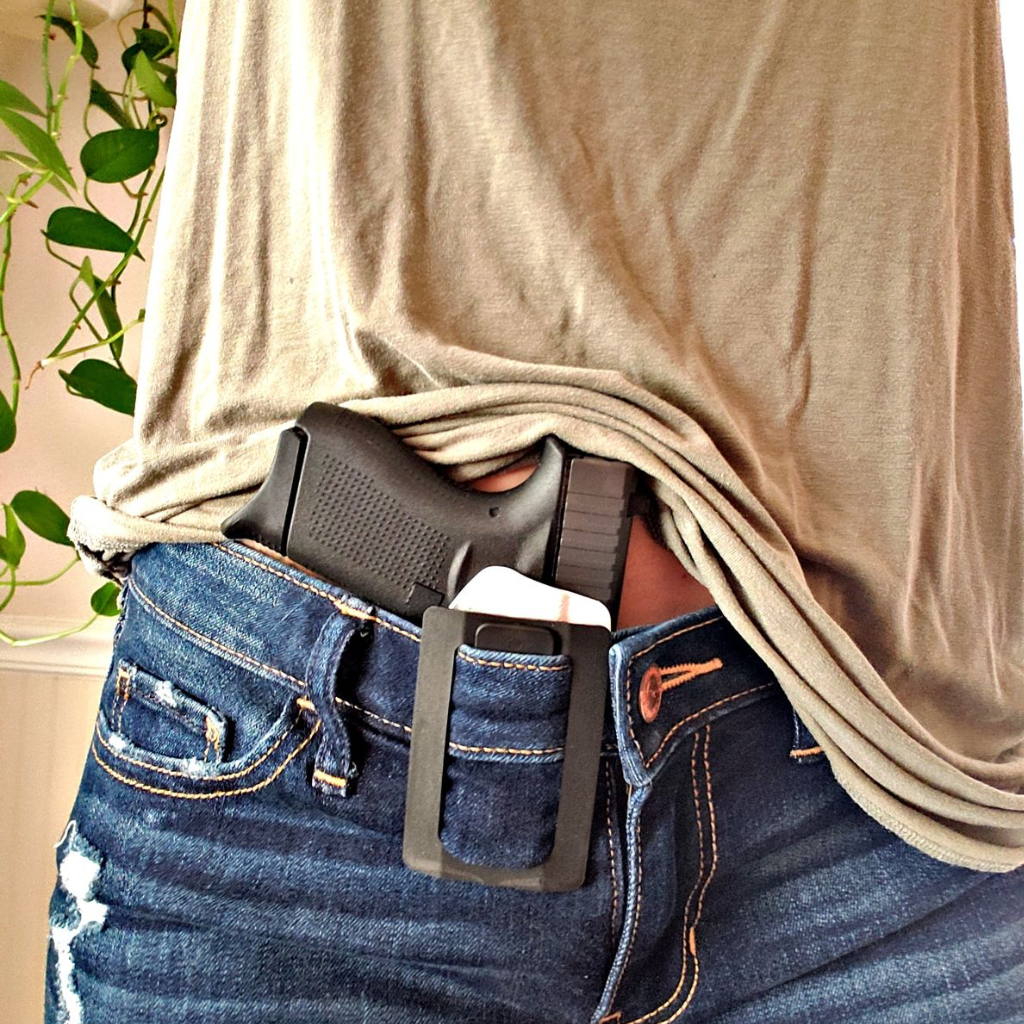
But if you’ve tried appendix and hated it, you’re not alone. Common small-frame complaints are real:
- The holster digs into your ribs when you sit.
- The muzzle presses your pelvis or thigh.
- The grip prints because there’s not much torso height to hide it.
- You feel like you’re constantly repositioning just to stay comfortable.
Here’s the key: for small frames, appendix carry success depends as much on holster geometry, ride height, and exact placement as it does on firearm size. In fact, some “smaller guns” can create sharper hot spots, while a slightly longer holster can spread pressure and feel better.
Why Appendix Carry Can Work Well for Small-Framed Women
Central positioning can improve concealment
Front-of-body carry often stays inside your clothing silhouette better than a gun perched on the hip “peak.” Many concealment resources describe hiding the gun in a “valley” instead of on a body “peak,” because peaks press clothing tight and make printing easier.
Less grip printing than hip carry (for many petites)
On a narrow waist, strong-side carry can push the grip outward. Appendix lets you use belt pressure and holster features (like a wing/claw) to rotate the grip inward.
Faster, simpler access
Appendix carry is typically easier to reach without twisting, especially in a car or seated. (No “tactics” here, just basic ergonomics.)
Better balance for lightweight builds
With less body mass to “absorb” wobble, stability matters. A well-set appendix rig can feel more centered and less like it’s pulling your waistband sideways.
Challenges Small-Framed Women Face With Appendix Carry
- Limited vertical space
If your holster is too tall or rides too high, it meets your ribs fast. - Pressure on the ribs or pelvis
Short torso + seated posture can turn a sharp edge into a pressure point. - Grip length vs. torso height
Even with a compact pistol, the grip may be the first thing to print when you bend or sit.
Clothing constraints
Many women’s pants have softer waistbands, fewer belt loops, or higher rises that change where the holster can anchor.
Key Holster Features for Small-Frame Appendix Carry
When you’re petite, look for “fit controls” more than brand hype.
Slim profile and minimal bulk
Extra material and thick attachments can create printing. Minimal footprint designs can be easier to hide under fitted tops.
Adjustable ride height
Ride height determines whether the holster crowds your ribs or pokes your pelvis. The ability to move the holster up or down (even slightly) is a major comfort lever.
Adjustable cant (or neutral cant)
Petite carriers often do best near neutral, with minor tweaks. Some women prefer a slight forward rotation to reduce printing, but too much can compromise comfort or consistency.
Holster length choices
Counterintuitive truth: a very short holster can create a concentrated “hot spot.” Some concealment education notes that extra length can act like a “keel,” spreading pressure over more area and improving comfort.
Rounded edges and comfort contours
Look for radiused edges and smooth contact points (especially along the muzzle end and belt line).
Secure trigger coverage and a rigid mouth
A rigid holster that fully covers the trigger is non-negotiable, and a rigid opening helps safe reholstering.
Best Appendix Carry Positions for Small Frames
This is about micro-adjustments, not techniques.
Center appendix (12–1 o’clock)
Best for some petite builds because it can sit in a natural “valley” where clothing drapes. If you have a pronounced midline “peak,” shifting off-center may help.
Slight offset appendix (1–2 o’clock)
Often more comfortable for short torsos because it can avoid rib contact and sit closer to the hip crease.
Why exact positioning matters more when you’re petite
When the available space is small, your holster has fewer “good” places to go. A quarter-inch shift can change:
- where the muzzle contacts,
- how the grip rotates under belt tension,
- and how your shirt drapes when you sit
Comfort Tips Validated by Women’s CCW Guides
These are common across multiple CCW resources because they’re mechanical, not magical.
Lower the ride height to reduce rib pressure (if you can still get a clean grip)
Many carriers find that a slightly lower setup reduces rib digging, but you still need safe, consistent access.
Use a wing/claw to reduce grip printing
A wing (also called a claw) uses belt pressure to rotate the grip inward, which can cut printing under fitted tops.
Dial belt placement and tension, not “tight as possible”
Concealment mechanics commonly emphasize that belt pressure activates your holster’s features. Too loose and the holster shifts; too tight and you create pressure points.
Expect a break-in period for your body (not the kydex)
Kydex doesn’t “break in” much, but your comfort map does. Give yourself a few short wear sessions, then adjust one variable at a time.
Listen to body feedback
Numbness, bruising, or sharp pain is your signal to change ride height, holster length, wedge/wing setup, or position. Comfort is a safety issue because constant fidgeting leads to bad habits.
Product Comparison Section (Monetization-Ready)
Affiliate note: If you use affiliate links, label them clearly. Prices below are MSRP/starting prices observed on Jan. 30, 2026, and can change.
Best Appendix Carry Holsters for Small-Framed Women
1) PHLster Enigma Express (beltless chassis system)
- Holster style: Beltless AIWB system (includes holster)
- Bulk/profile: Very low-profile on the belt line; designed to conceal under varied clothing
- Adjustability: Extensive; marketed as adjustable “from plus size to petite” and for micro-adjustments
- Comfort highlights (petite): Lets you position the gun independent of belt loops/waistband height, helpful with women’s clothing
- Best use case: Dresses, skirts, leggings, outfits where a stiff gun belt is hard
- Price range: $154
2) Tenicor CERTUM3 (AIWB/IWB)
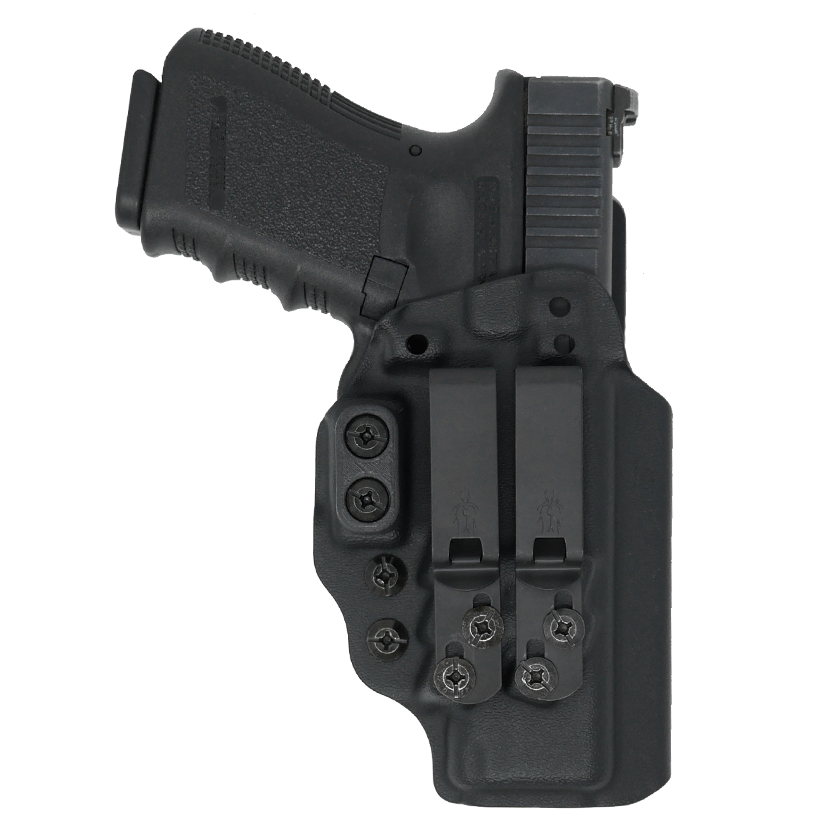
- Holster style: AIWB/IWB kydex holster
- Bulk/profile: Slim; uses 0.093-inch thermoplastic
- Adjustability: About 1 inch ride height and 30 degrees of cant via mounting slots
- Comfort highlights (petite): Multiple camming bars to fine-tune grip rotation without adding bulk
- Best use case: Petite carriers who want premium adjustability with a clean, minimal rig
- Price range: $109
3) JM Custom Kydex Wing Claw 2.5 (custom AIWB)
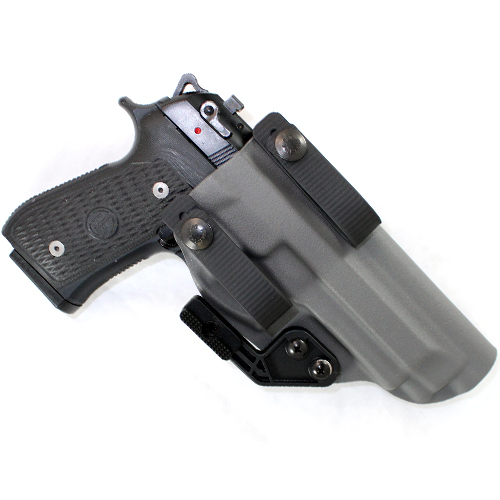
- Holster style: AIWB holster with wing/claw options
Bulk/profile: Moderate to slim, depending on clip/loop choice - Adjustability: Ride height and cant adjustment via hole patterns; wide patterns can spread support
- Comfort highlights (petite): Custom options help you match holster length and attachments to limited torso space
- Best use case: You know your gun/light setup and want a tuned, made-to-order fit
- Price range: $75 base
4) Henry Holsters Flint (AIWB/IWB “foldover”)
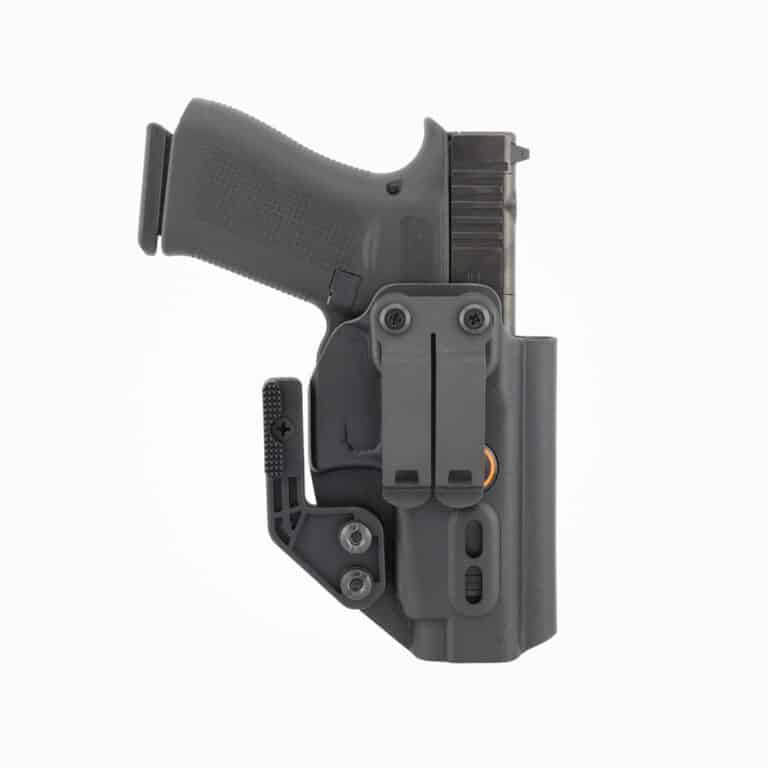
- Holster style: Minimalist foldover IWB/AIWB
- Bulk/profile: Slim with stable dual-loop options
- Adjustability: Ride height and cant are adjustable (dual-loop setups)
- Comfort highlights (petite): Built-in wedge concept to improve concealment and manage pressure
- Best use case: All-day wear with a simple, sturdy rig
- Price range: From $89
5) Vedder LightTuck (IWB that can do AIWB)

- Holster style: Slim IWB; commonly used at the appendix with the right setup
- Bulk/profile: Slim, lightweight design
- Adjustability: Vedder describes the LightTuck as having multiple ride height levels and up to 30 degrees of cant
- Comfort highlights (petite): A straightforward way to experiment with ride height/cant without spending premium dollars
- Best use case: Budget-friendly entry into appendix tuning
- Price range: $69.99
6) Tulster OATH (optic-ready, ambidextrous)
- Holster style: Tuckable IWB/AIWB, ambidextrous
- Bulk/profile: Minimal footprint; matte edge; designed to disappear under clothing
- Adjustability: Adjustable ride height; compatible with wedges/clip systems
- Comfort highlights (petite): Clean edges and tuckable design help with fitted outfits
- Best use case: Petite carriers who want simple, sleek, optic-friendly AIWB
- Price range:$74.99
Comparison Table (High Conversion)
| Holster | Bulk/Profile | Adjustability | Comfort for Small Frame | Concealment | Best For | Price |
| PHLster Enigma Express | Low-profile system | Very high | Great for variable waistlines | Deep conceal | Dresses/skirts/leggings | $154 |
| Tenicor CERTUM3 | Slim (0.093 in) | High | Easy to fine-tune | Excellent | Premium daily AIWB | $109 |
| JMCK Wing Claw 2.5 | Varies by setup | High | Customizable for short torsos | Very good | Tuned, made-to-order rigs | $75+ |
| Henry Flint | Slim foldover | Medium-high | Built-in wedge concept | Very good | All-day simple setup | $89+ |
| Vedder LightTuck | Slim/light | Medium-high | Solid starter for tuning | Good | Value + flexibility | $69.99 |
| Tulster OATH | Minimal footprint | Medium | Smooth, tuckable | Very good | Optic-ready, sleek AIWB | $74.99 |
Clothing and Wardrobe Considerations
- High-waisted pants: Often easier for petites because the belt line sits closer to your “abdominal equator,” which can help the gun stay more vertical and reduce tipping.
- Low-rise pants: Can force the holster into the pelvis zone and increase discomfort.
- Dresses and skirts: Beltless systems shine here because you’re not relying on belt loops.
- Layering: Light layers (open button-up, cardigan, jacket) can hide minor printing without changing your whole style.
Avoid tight waistbands: A tight waistband amplifies pressure points and can push the grip outward.
Safety Considerations for Appendix Carry (Small-Frame Focus)
- Trigger coverage is mandatory. Don’t compromise here for “comfort.”
- Rigid mouth matters for reholstering. Soft, collapsing holsters can force unsafe reholstering behavior.
- Prevent clothing interference. Keep drawstrings, shirt hems, and jacket cords away from the holster mouth. One major safety rule from training orgs is: the holster area should contain only the gun and holster, not other objects.
- Fit reduces risk. A stable holster that doesn’t shift means less fidgeting, fewer adjustments, and fewer chances of bad handling.
Safety note: If you’re new to AIWB, get coaching from a qualified instructor and practice with verified-safe procedures.
Appendix Carry Can Be an Excellent Option for Small-Framed Women When Fit Is Prioritized
If you’re petite, appendix carry is less about “finding the smallest gun” and more about building a setup that respects your limited torso space. Holster geometry, ride height, grip rotation, and exact placement do the heavy lifting.
Start with a holster that offers real adjustability, make one change at a time, and evaluate comfort standing, walking, and seated. With responsible experimentation, many small-framed women find AIWB becomes their most consistent and concealable option.
Key Takeaways
- Small frames need more adjustability, not more discomfort.
- Ride height + grip rotation usually matter more than gun size alone.
- A wing/claw and smart belt tension reduce printing.
- Safety comes from rigid trigger coverage, stable fit, and careful handling.
Compare Appendix Holsters Designed for Petite Builds
If you’re shopping, compare holsters by fit controls (ride height, cant, wing/claw options) and comfort shaping, not trends. Choose the option that lets you tune the gun into your body’s “sweet spot,” and prioritize safe trigger coverage and stability over ultra-minimal shortcuts.
FAQ
Is appendix carry comfortable for small-framed women?
Yes, it u003cemu003ecanu003c/emu003e be comfortable, but comfort depends on fit. Petite frames have less space between ribs and hips, so small adjustments in ride height, holster length, and belt tension matter more. A slim holster with rounded edges and a wing/claw often reduces pressure and printing.
What holster ride height is best for petite builds?
Most petite carriers do best with a moderate-to-lower ride height: low enough to keep the holster from crowding the ribs, but high enough for a safe, consistent firing grip. Start mid-range, then adjust in small increments while testing standing and seated comfort.
Does appendix carry print more on small frames?
Not necessarily. Many small-framed women print u003cemu003elessu003c/emu003e at appendix than on the hip because the front of the body can hide the grip in a natural “valley.” Printing usually comes from grip angle and belt tension, not body size alone. A wing/claw and correct ride height help most.
Can small women carry all day appendix style?
Many can, with the right setup. All-day comfort usually comes from stability and pressure distribution. A slightly longer holster (even with a compact gun) can spread pressure and reduce hot spots. If you’re constantly adjusting, change one variable at a time: height, position, or belt tension.
What appendix position works best for a shorter torso?
Petite carriers often prefer u003cstrongu003e1–2 o’clocku003c/strongu003e (slight offset) because it avoids rib contact and sits closer to the hip crease when seated. Others conceal best at u003cstrongu003e12–1 o’clocku003c/strongu003e if their clothing drapes well in the center. Micro-shifts matter more on a short torso, so test positions in ¼-inch steps.
Should petite women use cant (angle) for appendix carry?
Usually, u003cstrongu003eneutral to slight forward cantu003c/strongu003e works best. Too much cant can create new pressure points and make the grip harder to manage under clothing. If printing is your issue, adjust grip rotation with a wing/claw first, then fine-tune cant only if needed.
Is a shorter holster always better for small frames?
No. Very short holsters can feel “pointy” because pressure concentrates in one spot, especially when sitting. Many petite carriers find that a slightly longer holster body improves comfort by spreading contact and keeping the rig from tipping. Your comfort improves when pressure is distributed, not minimized.
What belt tension is best for petite appendix carry?
Think “secure, not crushed.” Too loose allows shifting and increases printing; too tight creates pressure points on ribs or pelvis. Tighten until the holster stays stable during normal movement, then back off slightly if you feel sharp pressure when sitting. Small tension changes can make a big difference.
What clothing works best for petite appendix carry?
High-waisted pants often help because the belt line sits higher and supports the holster more consistently. Avoid overly tight waistbands that force the grip outward and increase pressure. For dresses or skirts, beltless carry systems can be easier because they don’t rely on belt loops or stiff waistbands.
What are the biggest safety priorities for petite appendix carry?
Use a rigid holster that u003cstrongu003efully covers the triggeru003c/strongu003e, stays open for safe reholstering, and doesn’t shift. Keep clothing (drawstrings, shirt hems) away from the holster mouth. A stable, properly fitted setup reduces fidgeting, which lowers handling risk. If comfort is poor, adjust the system, not your habits.