
Top Things to Know
Why Does Concealed Carry for Senior Adults Require a Different Gear Approach?

The gear that worked for you at 40 is not automatically the gear that works for you at 70, and that is a fit problem, not a failure.
Grip strength fades. Joints stiffen. Vision shifts. None of that makes a person unfit to carry. It means the gun, the holster, and the training plan have to be chosen for the body doing the work today, not the body that first bought the permit.
This is not a minor cosmetic issue. CDC survey data show arthritis prevalence climbing from 3.6% among adults ages 18 to 34 to 53.9% among adults ages 75 and older, a trend that directly affects grip strength, trigger control, and slide manipulation. USCCA’s reporting on senior carriers notes that seniors often face reduced grip strength, diminished vision, and hearing loss, and each of those changes touches a different piece of gear.
Perception plays a role too. In a long-running USACarry forum thread on older carriers, one longtime member argued that thieves look at them as easy prey, a view echoed across similar threads. Whether or not that perception matches actual crime data, it is the reason many older adults look into concealed carry for senior adults in the first place, and it is exactly why system fit matters more, not less, as you age.
Which Handgun Features Matter Most for a Senior Shooter with an Aging Grip?
The right handgun for a senior is not the smallest one on the shelf. It is the one you can rack, grip, and fire consistently under stress.
Handgun selection for concealed carry for senior adults comes down to controllability first, concealment second. A gun that hides perfectly but cannot be operated reliably under stress is not a defensive tool.
- Why Smaller Isn’t Safer
A tiny pistol that is hard to rack and snappy to shoot is often the wrong answer for a stiff or arthritic hand, even though it is the first thing many counters recommend. One holster retailer’s guide to carrying with arthritis puts the tradeoff plainly: the smaller and lighter the firearm, the more the shooter will feel the recoil. That recoil adds up fast in a hand that already tires easily. It is the single most common misstep in gear advice for concealed carry for senior adults. - When a Revolver Solves the Problem
A slightly larger, better-balanced gun frequently offers a fuller grip and softer recoil. One recent roundup of concealed carry adjustments seniors make summarized the tradeoff this way: confidence comes from manageability, not minimum dimensions. For many older shooters, a revolver removes the slide-racking step entirely and simplifies the manual of arms. - Slide-Assist and Tip-Up Options
If racking a slide is the specific sticking point, a tip-up barrel pistol or a slide-assist device solves the mechanical problem directly, without giving up a semi-auto’s capacity. Some instructors build this accommodation into the class itself. In a USACarry thread on carry options for low-vision and low-dexterity shooters, one instructor described pulling back the slide for an elderly person with arthritis and poor grip strength as a routine part of state-approved training. Test multiple options before buying, since the right answer for concealed carry for senior adults is rarely the first gun a counter suggests.

Last update on 2026-10-18 / Affiliate links / Images from Amazon Product Advertising API
How Should Your Holster and Wardrobe Change as Your Body Does?
If you cannot draw from your holster in the clothing you actually wear today, the holster is wrong, no matter how well it worked five years ago.
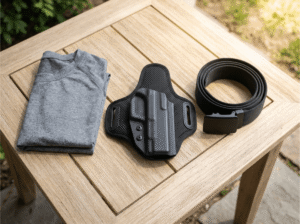
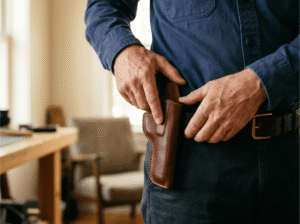
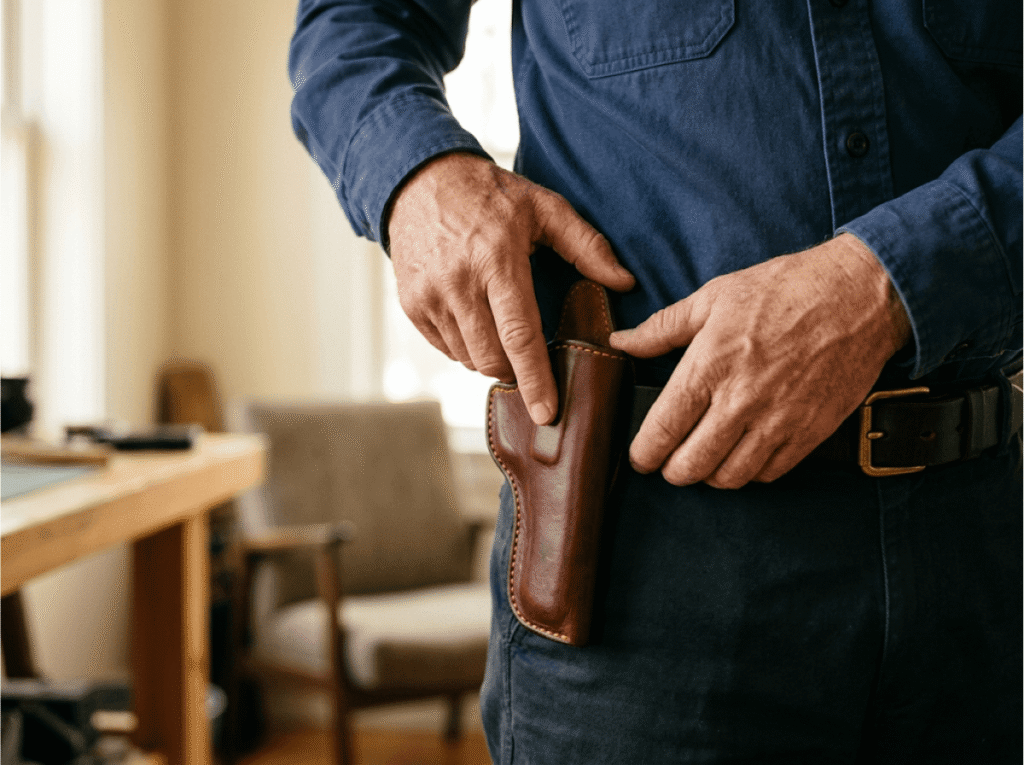
A gun that fits your hand still fails you if the holster does not fit your life. Test your draw in the clothing you actually wear now, seated and standing, not the clothing you wore a decade ago.
Weight changes, medical devices, looser or layered clothing, and reduced flexibility all shift what carry position actually works. A holster that presses on a hip replacement, a surgical site, or an arthritic joint gets left in the drawer, and a gun left in the drawer protects no one.
Reassess your position whenever your body or your daily routine changes in a meaningful way. Treat that reassessment as routine maintenance, not an admission that something has gone wrong. For concealed carry for senior adults, this fit check often matters more than the gun itself. Our IWB versus OWB holster fit guide walks through the tradeoffs by body type and mobility level.
How Much Training Does Concealed Carry for Senior Adults Actually Require?
The competency floor does not move with age. Only the pace you use to reach and maintain it does.
There is a persistent myth that concealed carry for senior adults means training less. It does not. It means training smarter, on a schedule the body can actually sustain.
Concealed carry for senior adults still requires a documented floor: a clean draw from concealment, an accurate first shot at a realistic defensive distance, and the ability to clear a basic malfunction without needing a stronger grip than you have. That floor is not a suggestion reserved for younger shooters.
What changes with age is how you get there. Shorter, more frequent dry-fire sessions build and maintain skill better than one intense class a year, especially when live-fire range time is limited by cost, mobility, or scheduling. Our dry-fire practice routines guide breaks this down into a repeatable weekly schedule.
Retest yourself against a published benchmark on a fixed schedule, roughly every six months, since both skill and physical capability shift gradually. Adequate, well-documented competency protects you legally and physically. It is the floor you must reach, not a ceiling you are being told to settle for.

- ✊ Improve Your Grip Strength - The forearm strengthener is perfect for improving strength, power and speed in the...
- 🏆 Portable and Convenient - Your hand exerciser grip strengthener needs to be accessible no matter where you go. A...
- ♻️ Universal Fit - We designed this hand exerciser grip strengthener with you in mind. Other hand strengthening...
Last update on 2026-10-18 / Affiliate links / Images from Amazon Product Advertising API
What Matters More With Age: Situational Awareness or Physical Shooting Skill?
As physical margin narrows, awareness and avoidance carry more of the defensive load, and that shift is not a downgrade; it is a recalibration.
Trainers genuinely disagree on this question. One camp argues that real defensive encounters usually start already close, so physical skill at contact range, weapon retention, positioning, and disengagement is the priority. Another camp argues that avoidance and early recognition matter more than any physical skill, because the earlier a threat is spotted, the less physical capability is ever required.
Both are right, depending on your body. If mobility or strength is limited, awareness and avoidance carry more of the load, since escaping a close encounter physically is harder than preventing it from developing in the first place. If you are still strong and mobile, it is worth layering in some contact-distance awareness training on top of the same floor.
Either way, a ten-second scan of any space you enter, exits, unusual behavior, and environmental changes is one of the highest-value habits available at any age. It costs nothing but attention, and it does not require a strong grip or a fast draw. This is where concealed carry for senior adults quietly gets easier: awareness scales with attention, not muscle.

- TRAIN WITH YOUR OWN EQUIPMENT- use our 9mm SureStrike laser cartridge (with red visible laser) to train with your...
- SUPERIOR HIGH QUALITY LASERS - Unlike our competitors, our lasers are made in Israel from a CNC machined stainless steel...
- PERFECT ADDITION TO OUR REACTIVE TARGETS - Use your SureStrike laser cartridge with multiple electronic targets - made...
Last update on 2026-10-18 / Affiliate links / Images from Amazon Product Advertising API
Ready to Build a Carry System That Actually Works for You?
Concealed carry for senior adults is not about lowering your standards. It is about applying the same serious standard to a body that has changed.
Choose a firearm you can operate under stress, a holster that matches your real life, and a training floor you actually maintain. Done right, concealed carry for senior adults is simply carry, done honestly, for the body you have now. Awareness costs nothing and pays constantly. Download the readiness checklist below, walk through it honestly, and use it as the starting point for a fit check with a qualified instructor before you carry.
10 Best Concealed Carry Guns for Seniors in 2026: #1 Is a Game Changer from Weapon Whisperer.
Frequently Asked Questions
What is the best gun for a senior with arthritis or a weak grip?
There is no single best gun. The right choice is whatever you can rack, grip, and fire repeatedly without strain. Revolvers, tip-up barrel pistols, and models with light slides and soft recoil are common answers. Test several before buying, and prioritize reliable operation over size or price.
Do seniors need a different concealed carry permit process than younger applicants?
No. The legal permitting process is the same regardless of age in nearly every state. What changes is your responsibility to confirm you can still meet any state-specific vision, training, or renewal requirements as your health changes over time. Requirements vary by state, so verify current rules directly.
Is a revolver better than a semi-auto for older shooters?
For some older shooters, yes. Revolvers remove the need to rack a slide and tend to have fewer manipulation steps, which helps with reduced grip strength. Others do better with an easy-rack semi-auto. The right answer depends on your specific hand strength and dexterity, not your age alone.
How do I choose a holster if my body shape has changed?
Reassess your holster whenever weight, posture, or mobility changes meaningfully. Try your current holster with the clothing you actually wear now, seated and standing. If the draw feels awkward or the ride position digs in, that is your signal to adjust position, retention, or holster style.
Can vision problems disqualify someone from legally carrying a concealed firearm?
Vision problems alone typically do not disqualify a person from a carry permit, since permitting standards focus on legal eligibility, not physical performance. However, corrected or uncorrected vision affects your practical ability to identify a threat and use sights accurately, which training and equipment choices should address directly.
How much training does an older adult actually need to carry responsibly?
You need a documented, repeatable floor: a clean draw from concealment, a first accurate hit at real defensive distance, and basic malfunction clearance. That floor does not change with age. What changes is the pace of training and the tools used to reach it comfortably and safely.
What if my grip strength is not enough to rack a slide reliably?
This is common and solvable. Options include revolvers, tip-up-barrel pistols, slide-assist devices, and instructor-guided technique adjustments that use leg or holster leverage rather than hand strength alone. Do not force a firearm you cannot manipulate reliably; an unreliable manipulation under stress is a safety risk.
Should memory or cognitive changes affect a decision to carry a firearm?
Any noticeable change in memory, judgment, or confusion is a serious safety question that deserves an honest conversation with a physician and trusted family members, not a solo decision. Firearm access and use require consistent judgment, so this deserves direct, unemotional evaluation rather than avoidance.
What is the safest caliber choice for a senior with recoil sensitivity?
There is no universally safest caliber. The right choice is the caliber and gun combination you can shoot accurately and repeatedly without flinching. A manageable 9mm or .380 you shoot well beats a theoretically stronger round you cannot control or will not practice with regularly.
How often should an older concealed carrier retrain or requalify?
Retest your skill against a defined benchmark at least every six months, since both proficiency and physical capability can shift gradually with age. Pair that with regular dry-fire practice between range sessions. Consistency in shorter, more frequent sessions matters more than one intense annual course.
Is appendix, hip, or shoulder carry best for a senior with limited mobility?
There is no universal best position. Test your draw seated, standing, and in the clothing you actually wear. Hip carry often accommodates reduced flexibility better than appendix carry, while shoulder carry can help with significant hip or lower back issues. Fit and consistent access matter more than any trend.
Should a senior carry with a round already in the chamber?
Only if your holster fully covers the trigger guard, your draw is consistent, and you can safely reholster without looking. If any of those are uncertain, work through them in training before carrying chambered. Consistent judgment and practiced technique matter more than following a default rule blindly.
Are laser sights or red dot optics worth it for older shooters?
For many, yes. Red dots and lasers can help compensate for presbyopia and reduced near focus, which affect traditional iron sight alignment with age. Both still require dedicated practice to draw and index correctly, so treat the optic as a training investment rather than a shortcut around practice.
Lock in your vote and tell us: Why is this the right call?