
Ammo Stockpiling in 60 seconds:
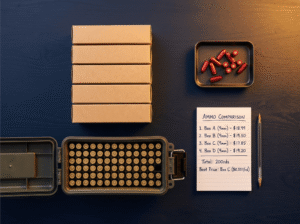
- 9mm FMJ is running $0.20–$0.24 per round as of early 2026, near its lowest point since 2019
- Winchester raised prices 3–8% effective January 2026. Kinetic Group (Federal, Remington, CCI, Speer, Blazer) raised prices 3–12% effective October 2025. Those hikes are now filtering through retail
- Your defensive hollow points and your training FMJ are two separate inventories with two separate purposes; treat them that way
- The right stockpile size is not a number. It’s a training standard. Define the standard first, then reverse-engineer the round count
- Most states have no quantity limit on ammo storage. A handful have purchase requirements you must know before you buy
Updated April 2026
Related: Eco-Friendly Ammunition: Gauging the Performance of Green Ammo
Why “Just Buy More” Is the Wrong Strategy for 2026
There’s a saying that has circulated in the serious end of the shooting community for years, and it’s worth putting at the top of this article rather than the bottom: stockpiles don’t win fights. Well-trained shooters do.
That’s not an argument against stockpiling. It’s an argument against stockpiling as a substitute for training, which is exactly how most gun owners approach it. They have a number in their head. They don’t know where that number came from. And they’ve never attached it to any particular skill they’re working toward.
The 2025 article you’re updating right now gave you numbers: 200 rounds for home defense, 500 for range practice, 1,000 for long-term preparedness. Those numbers aren’t wrong. But without a performance standard attached to them, they’re arbitrary. Two hundred rounds mean nothing if you’ve never defined what “ready” looks like for you.
The 2026 market adds a layer of urgency to getting this right. Late 2025 was a genuine buying window; 9mm was hovering near prices not seen since before the COVID surge. That window is closing. Major price increases from Winchester and the Kinetic Group brands (Federal, Remington, CCI, Speer, and Blazer) have already taken effect and are working their way through distributor and retail pricing. Supply is functional but not fully normalized. Availability still comes in waves on popular calibers, and raw material constraints on smokeless powder and primers are structural issues, not temporary ones.
Smart buyers don’t respond to this environment with panic. As one regional gun community put it recently: “Be the shooter who buys smart, not scared.” Panic buying is self-fulfilling; it creates the shortage it’s trying to outrun. The right response is a purchasing plan grounded in how you actually use ammunition, not in how anxious the current news cycle makes you feel.
This guide gives you that plan.


Last update on 2026-10-09 / Affiliate links / Images from Amazon Product Advertising API
(As an Amazon Associate, we earn from qualifying purchases.)
The 2026 Ammo Market: What’s Actually Happening Right Now
To buy smart, you need an accurate picture of the market. Here it is.
- Pricing:
9mm FMJ has been trading near $0.20–$0.24 per round since late 2024 and into early 2025, the closest to pre-pandemic pricing the civilian market has seen in years. The 2020 surge hit $0.71 per round at its peak. The recovery has been real. But the floor appears to be behind us. - Announced increases:
Winchester raised catalog prices 3–8% on a wide range of handgun and rifle calibers, effective January 1, 2026. The Kinetic Group, which manufactures Federal, Remington, CCI, Speer, Blazer, and Fiocchi, among others, raised prices 3–12% effective October 1, 2025. A 7% bump on a 500-round case of 9mm adds $7–10 to your cost. On a 500-dollar case of rifle ammunition, a 7% hike is $35. These aren’t abstract percentages. They compound. - Supply character:
The 2026 market is best described as “constrained but functional.” Shelves are stocked. But popular calibers, particularly 9mm and 5.56, restock and sell down in cycles rather than sitting indefinitely. The underlying constraints are structural: smokeless powder and primer production capacity remain limited, and U.S. Army munitions investment, while meaningful for the long term, won’t translate into civilian market relief in the near term. Military procurement competes directly with civilian production runs. - The tariff variable:
There is an ongoing discussion about import tariffs affecting ammunition from foreign manufacturers. The effect, if realized, would be upward pricing pressure concentrated in calibers that rely heavily on imported components. Monitor this, but don’t make purchasing decisions based on news cycles. Buy to your standard; don’t buy to your fear. - The bottom line:
The late-2025 price window was real, and it was good. If you built your stockpile then, you made the right call. If you didn’t, you’re buying into a market that is already on a steady upward slope. Buying now, before the current round of increases fully filters to retail shelves, is still a reasonable move for calibers you actually shoot.
The Two-Inventory Problem Nobody Talks About
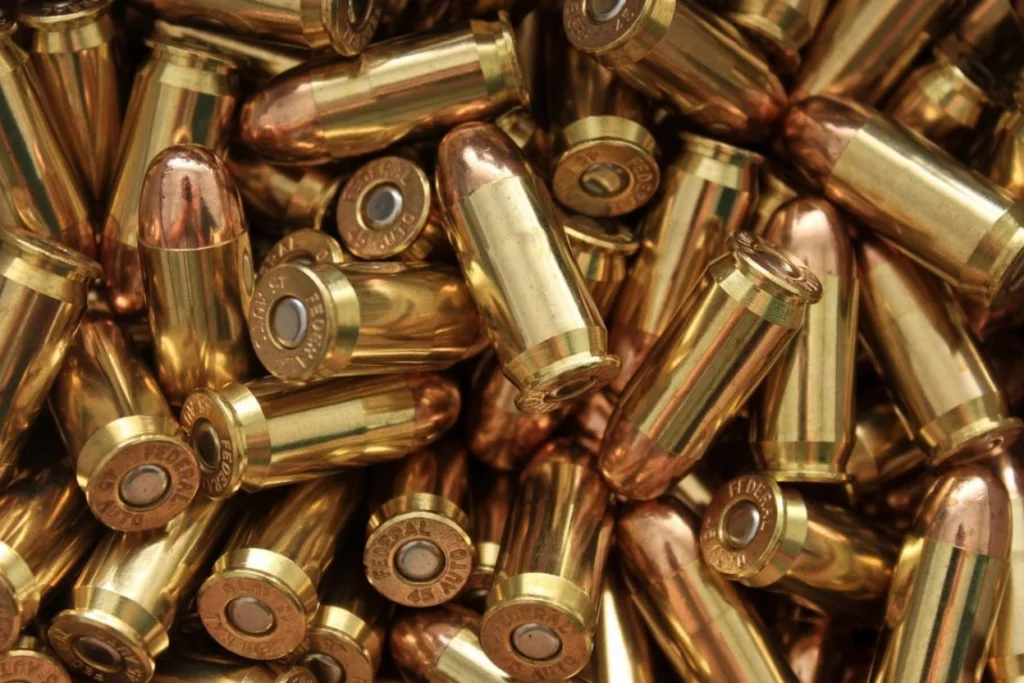
Before you think about quantities, you need to separate your ammunition into two completely different categories. Most gun owners don’t do this. It creates budget confusion, rotation errors, and a false sense of readiness.
Inventory 1
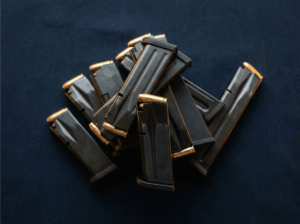
Defensive ammunition. This is the hollow point you carry every day, the load you keep chambered in your home defense firearm, and the rounds you’ve tested in your actual gun for reliable feeding and function. This ammunition is expensive, typically $0.50–$1.00+ per round for quality defensive loads. You don’t run this through the range by the box. You carry it, test it for function (typically 50–100 rounds when you first adopt a new load), then rotate it annually. A full defensive inventory for a CCW carrier with a home defense handgun is 200–300 rounds. That’s it. Any more is wasted money sitting in a can.
Inventory 2
Training ammunition. This is FMJ brass-case practice ammo, the fuel for skill maintenance. This is what you buy in bulk. This is what your round count targets apply to. This is where the math of “how much is enough” actually lives. The quality floor here is simple: factory-new brass-case ammunition from a major manufacturer. Avoid remanufactured or reloaded ammunition regardless of price. The cost savings are real; so are the reliability risks. Your training ammo needs to go bang every single time without exception.
These two budgets should never be conflated. When you see a sale on Federal HST 9mm +P, that’s a defensive inventory purchase: 200 rounds, done, next year you buy another 200 and rotate. When you see Blazer Brass 9mm at $0.19/round, that’s a training inventory purchase. Buy a case, stack it labeled with the date, and train through it.
Keeping these separate also protects you from a common mistake: shooting your defensive hollow points as range ammo because you ran out of FMJ. That’s an expensive range session and an empty defensive reserve.
How Much Ammo Do You Actually Need?
Here’s the framework. Three phases. Each one builds on the last.
| Use Case | Recommended Rounds | Primary Calibers | Storage Priority |
| Home Defense | 200 per firearm | 9mm, .45 ACP, 12GA | Immediate Access / Humidity Controlled |
| Range Training | 500 per caliber | .22LR, 9mm, 5.56 NATO | Rotating Stock / Easy Transport |
| Hunting | 100 per rifle | .308, 6.5 CM, .30-06 | Precision Grade / Zero Verification |
| Emergency (SHTF) | 1,000+ per caliber | 9mm, 5.56 NATO, .308 | Long-term Sealing / Deep Storage |
Phase 1: Establish the Floor
This phase is for anyone who does not currently have a published benchmark they can pass. If you’ve never shot a timed qualification, never measured your draw-to-first-shot time, and don’t have a standard you’re working toward, you’re in Phase 1.
The goal here is not to build a massive stockpile. The goal is to build enough training ammunition to a measurable baseline of defensive competency, and enough defensive ammunition while you get there.
What to have on hand:
- 500 rounds FMJ in your primary defensive caliber
- 200 rounds of quality defensive HP in your primary caliber
- 200 rounds FMJ for any secondary platform you’d use for home defense
What to be doing with it: Training at a minimum twice a month, working toward a basic pass on a published qualification, the Rangemaster Bullseye Test, the FBI Qualification, or the KR Training AT-1. These are free, public, and represent an honest baseline for defensive competency.
Phase 1 is not a permanent state. It’s a starting point with a clear exit condition: the first time you pass a published benchmark at full speed, from concealment, with your actual carry gun.
Phase 2: The Maintenance Budget
This is where most active shooters should live. You have a baseline. You train regularly. Your stockpile now needs to support consistent practice without requiring an emergency trip to the gun store every few weeks.
The math:
- Calculate your actual monthly round consumption: sessions per month × rounds per session
- Multiply by 6
- That’s your training FMJ stockpile target
Example: You train twice a month, 150 rounds per session. That’s 300 rounds/month × 6 = 1,800 rounds of 9mm FMJ on hand. When you drop below 900 rounds (3 months of supply), you buy another case and reset. This eliminates panic buying, you never hit zero, and you always buy when prices are stable rather than when you desperately need ammo.
Defensive reserve: 200 rounds of your chosen carry load, rotated annually. If your home defense platform is a separate firearm in a different caliber, add 200 rounds for that one, too.
The secondary platform problem: One of the most common stockpiling errors is owning multiple defensive firearms and only maintaining a training budget for one of them. If you carry a 9mm daily and keep a 12-gauge for home defense, your training stockpile needs to include both. A shotgun that hasn’t been fired in eight months is not a reliable home defense tool. Every platform you would reach for in an emergency needs to see regular live fire.
Phase 3: The Expanded Reserve
Phase 3 is for specific contexts, not universal advice. The question to ask before expanding your stockpile beyond Phase 2 is: Does my actual situation justify a larger reserve?
Legitimate reasons to hold more than 6 months of training ammo include: rural location with no nearby retailer (supply disruptions affect you first and hardest), an extended household with multiple trained members who share the same calibers, or a documented pattern of high training volume, competitive shooters running 1,000+ rounds per month in training.
At this level, 2,000–5,000 rounds per primary caliber is the rational ceiling for most civilians. As one experienced trainer put it: “You don’t need 50,000 rounds unless you’re leading a fire team.” Beyond that level, you’ve moved from preparedness to a logistics problem with other emergency resources, such as water, food, and medical supplies that deserve an equal or greater priority.
The Disagreement Worth Knowing About
Training vs. Standards: The Performance Gap. The shooting community is divided between two philosophies, but the reality is they are sequential, not competing:
- The High Bar: Stockpile to support consistent training toward rigorous, published performance benchmarks.
- The Realistic Floor: Focus on the “3 rounds at 5 yards” reality of most civilian encounters to establish a baseline.
The Verdict: If you haven’t passed a basic qualifier, that is your priority. Build your stockpile to reach a measurable floor. Once achieved, recalibrate your round count to maintain that standard. A stockpile without a defined skill standard is just expensive weight.
Storage: Where Stockpiles Survive or Die
Ammunition lasts decades if protected from moisture, heat, and physical damage. Follow this protocol to ensure 100% reliability:
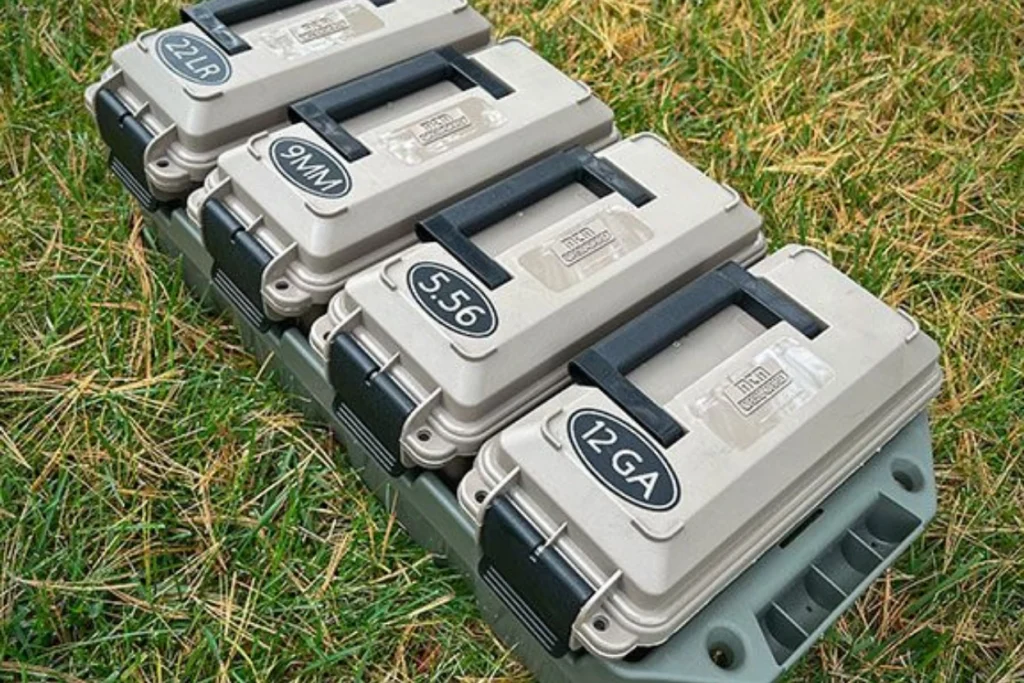
- The Gold Standard: Use gasket-sealed metal ammo cans with 2–3 silica desiccant packs.
- The Environment: Store in climate-controlled interiors (55–85°F). Never store ammo on garage floors or in sheds; moisture and thermal cycling lead to documented primer failure and oxidation.
- Rotation (FIFO): Practice “First-In, First-Out.” Label every can with the purchase date and shoot your oldest stock first.
- Safety & Compliance: If children are present, ammo must be locked separately from firearms or stored in a biometric safe. Secure storage is a legal and moral mandate that outweighs convenience.
Legal Compliance in 2026: What You Need to Check Before You Stack

Most gun owners in most states face no hard limit on how much ammunition they can legally store. But “most” is not “all,” and the law is only one part of the compliance picture. Here’s what to audit before building a serious stockpile.
Note: This section provides a general legal overview, not legal advice. Laws change. Verify your current state and local requirements through NRA-ILA’s state law database (nraila.org) or your state’s official firearms code before making any significant purchase.
Purchase Requirements: States Where Buying Ammo Requires a Permit or Check
Six states currently regulate ammunition purchases beyond basic federal age requirements:
California
Every ammunition purchase requires a background check through a licensed dealer. As of July 2025, the background check fee increased to $5 per transaction. All ammo must be processed through an FFL. Online purchases cannot ship directly to California buyers.
New York
Background checks are required for all commercial ammunition transfers, conducted through the state’s license and record database.
Illinois
Buyers must present a valid Firearm Owners Identification (FOID) card. No FOID, no purchase.
Massachusetts
A firearm permit or license is required to purchase ammunition. The license you hold determines what types of ammunition you can buy.
New Jersey
A valid Firearm Purchaser Identification Card or permit to purchase a handgun is required for handgun ammunition. Hollow-point ammunition has additional restrictions.
Connecticut
A permit is required to purchase ammunition.
If you live in one of these states and have been buying online through retailers that ship directly without these checks, you may be out of compliance. Ignorance is not a defense.
Ammo Types With Restrictions
Several ammunition types face federal or state-level restrictions regardless of where you live:
Federally restricted: Armor-piercing handgun ammunition (defined as projectiles with cores made from tungsten alloy, steel, iron, brass, bronze, depleted uranium, or beryllium copper, designed for handgun use) is restricted under the Gun Control Act.
State-restricted types: New Jersey bans hollow-point possession outside the home under most circumstances. California bans lead ammunition for hunting. Florida and Illinois ban Dragon’s Breath incendiary shotgun shells. Flechette rounds face restrictions in California, Florida, and Illinois.
For defensive carry purposes, standard JHP ammunition from major manufacturers (Federal HST, Speer Gold Dot, Hornady Critical Duty, Winchester Ranger, Remington Golden Saber) is legal in every state except New Jersey, where possession of hollow points outside the home is heavily restricted.
Shipping Restrictions
Eight states and several municipalities restrict shipping ammunition in some form:
- California: All ammo must go through an FFL dealer, no direct-to-door shipping
- Illinois and New Mexico: Drop shipments (direct-to-consumer delivery) are prohibited
- Hawaii: Ammunition must be transported by boat
- Alaska: Limited to sea or truck delivery only
- Maryland: Legal to ship statewide except within Annapolis city limits
If you’re ordering online and your retailer offers direct-to-door shipping without requiring your FFL information, and you live in one of these states, either the retailer is non-compliant, or the laws in your state have changed. Check before you order.
Safe Storage Laws: 2026 Updates
California enacted Universal Mandatory Storage requirements effective January 1, 2026 (SB 53), significantly expanding safe storage obligations for all gun owners in the state. Firearms must be stored in a locked container or with a trigger lock when not in use. Combined with the state’s child access prevention laws, this creates a clear requirement that applies to your ammunition storage setup as well, not just the firearms themselves.
Beyond California, safe storage laws vary significantly by state. In any state, if a minor lives in or regularly has access to your home, the legal and moral obligation to prevent unauthorized access applies regardless of whether your state mandates it.
If you have any doubt about your obligations, the safest and most defensible position is a locked, separate storage location for both firearms and ammunition, with the key or combination controlled by the gun owner only.

- Versatile Storage: Includes one standard-sized box. Perfect for .30 caliber, 9mm, 5.56 ammunition, and more. Great for...
Last update on 2026-10-09 / Affiliate links / Images from Amazon Product Advertising API
Caliber Priority for 2026: Where to Put Your Budget First
| Caliber / Type | 2026 Priority & Market Strategy | Recommended Baseline Stock | Technical Notes & Trusted Brands |
| 9mm Luger | Highest (Bulk Buy): Optimal balance of price, training utility, and availability. | 1,000 Rounds (Quality Brass FMJ) | Brands: Blazer, Magtech, Federal, Winchester. Your primary lead investment. |
| 5.56 NATO / .223 Rem | High (Hedge): Supply is volatile due to military contract priority. | 500 Rounds (Minimum) | AR-15 essential. Restocking is often uneven; buy when prices stabilize. |
| 12-Gauge | Medium (Home Defense): High effectiveness despite lower storage density. | 200 Rounds (Buckshot) + Target loads | AR-15 essential. Restocking is often uneven; but when prices stabilize. |
| Specialty (.45 ACP, .40 S&W, .357) | Strategic (Buffer): These are the first to vanish during supply shocks. | 12–18 Month Reserve | Slower restock cycles. Build a deeper reserve to avoid “panic prices.” |
| Defensive Hollow Points (HP) | Maintenance (Rotation): Reliability is dictated by fresh primers/seals. | Annual 100% Rotation | Do not neglect due to the shell size. High-quality buckshot is a defense cornerstone. |
Where to Buy in 2026
A few sourcing notes for the current market:
- Palmetto State Armory Reliable for bulk 9mm and 5.56; consistent case pricing on Winchester and Blazer brass.
- MidwayUSA Broad caliber selection, reliable shipping, quality-tier options across price points.
- Ammo.com Good for case-quantity purchases; subscription discount model for regular buyers.
- AmmoSeek.com Price aggregator. Set alerts for your primary calibers at your target price-per-round threshold. This is how you buy on the floor, not the spike. Input your target number (e.g., $0.19/round for 9mm brass-case), set an alert, and buy when it triggers. This eliminates emotion from the purchasing decision entirely.
Buying strategy: Set a price threshold per round for each primary caliber you shoot. When your stockpile drops below 3 months of your training consumption, and the market hits your threshold, buy a case. If prices are above your threshold and your supply is healthy, wait. Do not buy cases of ammo you don’t shoot because the price looks good. Caliber diversification is not a financial hedge; it’s just a storage problem.
- ▶Outside Dimension: Length 11.65inch Width 8.35Inch Height 3.78 inches.Inside Dimension: Length 10.54inches Width...
- ▶ SECURE CLOSURE & PRESSURE RELEASE: Equipped with sturdy, double-throw latches for a reliable, airtight seal and a...
- ▶ COMPACT WITH SOFT HANDLE DESIGN: Despite its robust protection, the case is engineered to be surprisingly...
Last update on 2026-10-09 / Affiliate links / Images from Amazon Product Advertising API
Your 2026 Ammo Readiness Checklist
Before you hit “Place Order” on that next bulk case, ensure your strategy is grounded in data rather than headlines. Here is your three-step pre-purchase audit to ensure every round has a purpose:
- Define Your Performance Standard: What benchmark are you training toward? If you can’t name one, you’re just turning money into noise. Research the Rangemaster Bullseye Test or the FBI Qualification. Both are free, publicly available, and built for real-world defensive scenarios. Set a target and write it down before you buy the rounds to shoot at it.
- Verify the 2026 Legal Landscape. If you are shipping to or living in CA, NY, IL, MA, NJ, or CT, pause. Legislative updates in late 2025 and early 2026 have introduced new background check and delivery requirements that many buyers are still catching up on. Use the NRA-ILA state law database as your primary source to verify compliance before completing a transaction.
- Audit and Segment Your Inventory. Stop treating all brass the same. Physically separate your Defensive HP (Duty) from your Training FMJ (Range).
- The Maintenance Formula: (Monthly Consumption $\times$ 6) = Your Phase 2 Maintenance Number.
- Compare this to your actual stock. The gap between these two numbers is your only logical purchase target.
Bottom Line: The market is a moving target. Prices will fluctuate, and there will always be a headline trying to trigger a panic buy. None of that matters once you have a plan. Build the plan first. Then buy into the plan.
Check out this video from God Family and Guns: It’s Time! How Much Ammo Should You Stockpile RIGHT NOW!
FAQ
-
How long does properly stored ammo last?
Decades, if stored correctly. Military surplus ammunition from the 1940s still fires reliably when it was stored in sealed metal containers. The enemies are moisture, heat cycling, and physical damage to primers. Metal ammo cans, silica gel desiccant packs, and a climate-controlled storage location give you a practical shelf life that exceeds any reasonable defensive planning horizon.
-
Is stockpiling ammo legal in the United States?
In most states, yes, there are no quantity limits on how much ammunition a legal gun owner may store. However, six states (California, New York, Illinois, Massachusetts, New Jersey, and Connecticut) impose purchase requirements, including background checks and permits. Several states and cities restrict online shipping to residents. Safe storage laws, particularly in California, effective January 2026, create obligations that affect how you store your ammunition if children have access to your home. Check your specific state before building a large reserve.
-
What are the 2026 price increases I should know about?
Winchester raised prices by 3–8% across a wide range of calibers, effective January 1, 2026. The Kinetic Group (Federal, Remington, CCI, Speer, Blazer, Fiocchi) raised prices 3–12% effective October 1, 2025. These increases are now working through distributor and retail pricing. The late-2025 pricing floor of 9mm at approximately $0.20/round is the reference point; 2026 pricing is trending modestly higher on most platforms.
-
What’s the difference between training ammo and defensive ammo, and why does it matter?
Training ammo (FMJ, full metal jacket) is what you buy in bulk for range sessions. It’s designed to go bang reliably and economically. Defensive ammo (JHP, jacketed hollow point) is what you carry and load in your home defense firearm. It’s engineered for controlled expansion and terminal performance. They serve different purposes, cost different amounts, and should be managed as separate inventories. Conflating them leads to either an empty defensive reserve or wasted money on expensive range sessions.
-
What’s the best caliber to stockpile first?
Your primary defensive caliber, whatever you carry or keep for home defense. For most people, that’s 9mm. Establish your training reserve there before building secondary caliber stocks. A 500-round base in your primary caliber is more useful than 100 rounds each in five calibers you shoot irregularly.
-
How should I store ammo to protect it?
Metal ammo cans with rubber gaskets, two to three silica gel desiccant packs per can, stored in a climate-controlled interior space between 55–85°F. Label every can with caliber, quantity, and purchase date. Rotate older stock to range use first. Keep it off concrete floors and away from temperature extremes.
-
What’s the one thing most gun owners get wrong about stockpiling?
They buy ammo without knowing what they’re buying it for. A pile of ammunition that isn’t connected to a training program isn’t preparedness it’s inventory. Define your standard first. The round count follows automatically.
Have more ammo in your safe than you’ve shot in the last six months? That’s not a stockpile, that’s a storage fee. Tell us in the comments what your training benchmark is, or share this with someone who’s still buying by the feeling.