
Key Facts
“Is it even legal to carry there?”
That question hits right as you are packing your range bag on July 3rd, realizing the fireworks event tomorrow is at the city park and you have not thought once about whether the rules change. You carry every day. You know your state law. But a city-sponsored July 4th event in a public park is new territory, and you are suddenly not sure “I can carry here” still applies.
Good instinct. The answer is not simple, and guessing wrong carries real consequences. Here is what you need to check before you go, and what you need to know to stay safe at the range this holiday weekend.
Is It Legal to Carry at a July 4th Celebration?
Your state’s carry permit or constitutional carry status is one layer of the legal picture, not the whole picture. The legal framework for July 4th carry is not a single rule. It is a stack. Before attending any July 4th event, verify three separate layers.
- Layer 1: State statute. Most states permit concealed carry in public spaces, but many carve out prohibitions for permitted events, places where alcohol is served, or government-owned property. These carve-outs apply even in constitutional carry states. A Texas LTC holder can carry most places, but Texas law prohibits carry at events where the organizer has posted a 51% sign. That sign at the Fourth of July beer garden changes your legal status on the spot.
- Layer 2: Local ordinance. Municipalities can layer restrictions on top of state law. A city can prohibit firearms at city-permitted events, and that restriction may be legally enforceable even where state law would otherwise allow carry. This is where most carriers get blindsided. They know state law and ignore the local layer entirely.
- Layer 3: Property ownership. A state park, city park, county fairground, and National Park Service site are all “public parks” in the casual sense, but they operate under different legal frameworks. If the July 4th fireworks show is on NPS land, federal law governs. Concealed carry in national parks follows the law of the state where the park is located, but open carry rules can differ and individual park units may post additional restrictions. Federal land means federal rules stack on top of state rules.
Google the address of your July 4th destination, find out who manages the property, and look up the current rules for that property type. It takes 10 minutes and it is worth it.
Your state laws may vary. Confirm current law with a licensed attorney in your state before making carry decisions based on any general legal overview.
Does Open Carry Change at City-Permitted July 4th Fireworks Events?
Open carry at a July 4th fireworks event is legally and tactically different from open carry in a regular parking lot. Three factors shift the equation.
- First, permitted events carry their own restrictions. Many cities treat July 4th permitted events differently than regular public spaces. If the fireworks show required a city permit, the organizer may operate under conditions attached to that permit, including a no-firearms restriction. “No firearms” signs at permitted events may carry legal weight in your jurisdiction even in open carry states.
- Second, alcohol changes the legal calculus. Open carry laws in many states explicitly exclude locations where alcohol is the primary business. A park that normally allows carry can change status when the July 4th beer tent goes up. Check your state’s specific language, because it varies considerably.
- Third, crowd density creates a tactical argument against open carry even where it is legal. A crowded, low-light environment exposes your firearm to disarmament attempts in ways that IWB concealed carry does not. Get both the legal question and the tactical question right before you decide how to carry at a July 4th celebration.

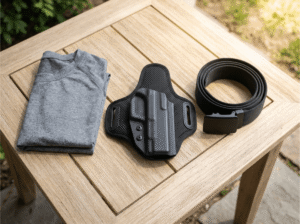
- COMPATIBILITY: Fits S&W M&P SHIELD 9EZ (No WML); Optic/Red-Dot Cut; right or left hand; no WML or Weapon Mounted Light...
- FEATURES: Precision formed for your gun; fully enclosed trigger guard; true full length sweat guard keeps the gun off...
- COMFORT & CONCEALMENT: Only three ounces and slim through the body; claw compatible to minimize printing; carry appendix...
Last update on 2026-09-03 / Affiliate links / Images from Amazon Product Advertising API
Can You Carry Concealed in a Public Park on July 4th?
Most states allow concealed carry in state parks, but “most” is not a safe operating assumption for July 4th carry planning. Here is a quick starting point. Verify current law with a licensed attorney in your state before acting on any of this.
- Texas: State parks allow carry for valid LTC holders, but state law prohibits carry at certain government-sponsored events. Check your specific July 4th destination.
- Colorado: Generally allows concealed carry in state parks, but local jurisdictions retain authority to restrict carry in municipal areas. Denver has city ordinances that differ from state law.
- California: Prohibits concealed carry in state parks in most circumstances. Assume public parks are off-limits unless your attorney has confirmed otherwise.
- Florida: State law prohibits carry in specific recreational areas. The restrictions are detailed and have changed. Confirm with a licensed Florida attorney before attending any July 4th event in the state.
- Federal land, including national parks and monuments: July 4th carry on federal property is governed by the law of the state in which the park is located, but park superintendents retain authority to restrict firearms in certain facilities and areas. If your July 4th destination is any federally managed property, verify the current rules directly with the managing agency.
For a comprehensive overview, check our Gun Laws by State and your Concealed Carry Reciprocity Laws 2026 before you travel.
This article is educational information only, not legal advice. Confirm all carry laws with a licensed attorney in your jurisdiction before making decisions.
What Range Safety Rules Matter Most on a Holiday Weekend?
The range gets more dangerous on holiday weekends. Not because the rules change, but because the population changes. July 4th brings people who shoot twice a year, first-time owners who received a gift firearm, and enthusiastic people moving fast in a social atmosphere.
Independent research on civilian defensive shooting incidents shows that most carriers do not practice enough to maintain the skills they had when they last trained. A July 4th holiday range trip does not fix that gap. What it does is reinforce habits, good ones or bad ones.
The four universal safety rules apply every time, no exceptions.
- Treat every firearm as loaded. Even when you know it is not. This rule exists precisely for the moment your brain tells you it is okay to break it.
- Never point the muzzle at anything you are not willing to destroy. If someone in the next lane sweeps you while handling their firearm, stop shooting and get the range safety officer. Do not try to correct a stranger yourself in a high-stimulus environment.
- Finger off the trigger until your sights are on target. Straight along the frame, not curled inside the guard. Every time you pick up the gun, every time you re-holster, every time you do anything that is not an intentional trigger press.
- Know your target and what is beyond it. Outdoors, this gets practical weight. Shooting at rocks, hard soil, or steel targets at incorrect distances creates fragmentation risk. Know your backstop and what is lateral to your firing line.
Double up on hearing protection outdoors: foam plugs plus over-ear muffs together. Fireworks alone can push your noise exposure significantly before you reach the range on July 4th. The cumulative effect on hearing is real and permanent.

- Razor ultra-thin rubberized cups
- Two omni Directional Microphones
- Provides sound Activated protection over 89 DB at 0.02 reaction time
Last update on 2026-09-03 / Affiliate links / Images from Amazon Product Advertising API
Pre-Range Checklist for July 4th Weekend
- Function check your firearm. Field strip, inspect, reassemble, and confirm function. A feed malfunction at the range burns ammo and confidence. Finding it before you go costs 90 seconds.
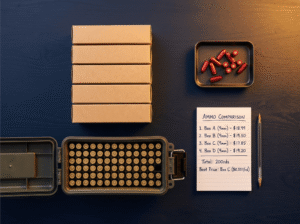
- Rotate your carry ammo. Summer heat accelerates primer degradation in ammunition stored in hot vehicles. If your carry rounds have been in your car’s console since spring, shoot them at the range and replace with fresh rounds. Carry ammunition belongs in a climate-controlled location between range sessions.
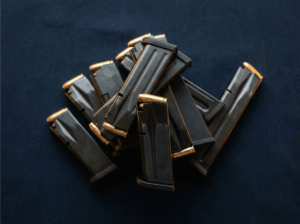
- Inspect magazines. Check for debris, follower function, and feed lip deformation. A damaged feed lip is a malfunction waiting to happen.
Carrying in a Crowd: What July 4th Demands from Your Mindset
If you have confirmed it is legal to carry at your July 4th event, the environment demands a calibration shift.
- Your threat recognition runs against a new baseline on July 4th. Fireworks, crowds, low lighting, and noise that mimics gunshots are all normal at July 4th celebrations, and all of them suppress your standard threat recognition cues. The Ability-Opportunity-Jeopardy framework that governs use-of-force decisions does not change because you are at a fireworks show. What changes is the environmental noise floor. Your job is to reset your baseline for this specific setting, not to treat the holiday crowd as a threat.
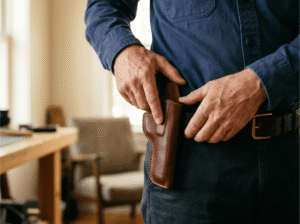
- Use a retention holster. In a dense July 4th crowd, a minimalist holster creates disarm risk. Active retention (a thumb break, trigger guard lock, or equivalent mechanism) keeps your firearm secure when people press past you. Match your holster to the environment, not just the weather.
- Zero alcohol while carrying. Not one drink. If you are carrying at a July 4th event, you are not drinking. In most states, carrying while impaired is a separate criminal offense on top of whatever else occurs. This is not a gray area.
- Know your exits. Before you set up on the lawn, note where crowd density drops and where you would move if you needed to go fast. July 4th makes basic situational awareness more relevant, not less.
What Are the Most Common Carry Mistakes at July 4th Events?
- Assuming constitutional carry overrides event-specific prohibitions. It does not. Constitutional carry removes the permit requirement. It does not strip municipalities of authority to restrict carry at July 4th permitted events.
- Not checking if the July 4th event is on federal land. National Mall fireworks, national park celebrations, and events at federal sites operate under federal rules, not just your state’s open carry statute. Verify property ownership before you go.
- Running a firearm that has not been function-checked recently. Clean and inspect before your July 4th range trip. A malfunction at the range is annoying. A malfunction when it matters is worse.
- Using a lightweight summer holster in a crowd setting. Minimalist holsters trade retention for comfort. A July 4th crowd is exactly where retention matters most.
- Drinking while carrying. The most common and most serious mistake at July 4th events. If you are going to drink, secure your firearm first. Alcohol and a loaded firearm are not compatible.
- Skipping ear protection because you are outdoors. “We’re outside, it won’t be that bad” is how people accelerate permanent hearing loss. Double up: foam plugs under earmuffs, every time.

- HIGHEST NOISE REDUCTION (NRR 33): MAXIMUM Disposable Foam Earplugs offer the highest noise reduction rating of any...
- CONFORMS TO INNER EAR: The bell shape matches contours of your inner ear to ensure maximum noise reduction and hearing...
- PROMOTES PROPER HYGIENE: Push-in earplugs feature a smooth, soil-resistant closed-cell foam skin to help prevent dirt...

Last update on 2026-09-03 / Affiliate links / Images from Amazon Product Advertising API
Carry Responsibly This July 4th: Three Steps in Order
- First, verify the legal stack for your specific July 4th destination. State statute, local ordinance, and property ownership. Do not assume. Check.
- Second, run a pre-range checklist before shooting this weekend. Clean, function-checked firearm. Fresh carry ammo. Inspected magazines.
- Third, if you are carrying in public on July 4th, use a retention holster, reset your environmental baseline, and keep alcohol out of the equation entirely.
July 4th is worth celebrating. Go enjoy it with the same competence and responsibility you bring to every other day you carry.
This article is for educational purposes only and does not constitute legal advice. Carry laws vary by state, municipality, and property type. Consult a licensed attorney in your jurisdiction before making any carry decisions.
Not sure about your state’s specific public carry rules? Download our free CCW State Law Cheat Sheet below, a quick-reference guide to carry laws in all 50 states updated for 2026. Get it free at guncarrier.com.
This article contains affiliate links. We may earn a commission if you purchase through them at no additional cost to you.
If you carry, you need a plan for the legal aftermath, too. USCCA’s Self-Defense Shield membership starts at $29/month and covers attorney fees, bail bond funding, and expert witness costs if you ever have to use your firearm defensively.
Frequently Asked Questions
-
Can I carry at a July 4th fireworks show if my state has constitutional carry?
Constitutional carry removes the permit requirement but does not override local ordinances, event-specific restrictions, or federal land rules. Verify all three layers (state, local, and property owner) before carrying to any July 4th event. A constitutional carry designation does not grant a universal right to carry in every location.
-
Is a city park treated the same as a state park or national park for carry purposes?
No. City parks, state parks, county fairgrounds, and National Park Service sites each fall under different legal frameworks. Property ownership determines which legal layer governs. Look up the managing agency for your specific July 4th destination before making any carry decisions.
-
Can I carry in a park where there is a July 4th beer tent?
Possibly not. Many states explicitly restrict carry where alcohol is served as the primary business. In Texas, a 51% sign at a beer garden changes your legal carry status on the spot, even at a venue where carry is normally permitted. Check your state’s specific statutory language before attending any July 4th event that includes alcohol service.
-
What holster should I use when carrying in a July 4th crowd?
Use a retention holster with an active retention mechanism, such as a thumb break or trigger-guard lock. Dense crowds create a disarm risk that minimalist holsters do not address. Match your holster to the environment, not just the temperature or your wardrobe.
-
Should I double up on hearing protection at an outdoor range during the July 4th weekend?
Yes. Use foam earplugs under over-ear earmuffs together. Cumulative noise exposure from July 4th fireworks before and after your range session accelerates permanent hearing damage. Outdoor conditions do not reduce the risk of noise-induced hearing loss.
-
Does federal land use its own carry rules, or does my state permit cover me?
Federal land uses its own rules in addition to state law. Concealed carry in most national parks follows the law of the state in which the park is located, but individual park units and facilities may impose additional restrictions. If your July 4th destination is federally managed property, verify the current rules directly with the managing agency before you travel there.
-
What is the AOJ triangle and why does it matter at a July 4th event?
AOJ stands for Ability, Opportunity, and Jeopardy. It is the three-part framework for evaluating whether a threat legally justifies a defensive response. All three elements must be present. At a July 4th event, environmental noise (fireworks, crowd sounds) can affect your ability to accurately assess whether all three are genuinely present, which is why resetting your situational baseline matters before you carry in that environment.
-
Is it legal to carry at a July 4th event at a city-owned venue that normally allows carry?
Not necessarily. A venue that allows carry on ordinary days may operate under event-specific restrictions when a city permit is involved. The permit conditions, posted signs, and the presence of alcohol service can all change your legal carry status. Verify the rules for the specific July 4th event, not just the location.