
Overview
This article is for educational and informational purposes only. Nothing in this guide constitutes legal advice. Firearm discharge laws, noise ordinances, and private property shooting regulations vary by state, county, and municipality and are subject to change. Consult a licensed attorney in your jurisdiction before making any legal decisions related to firearm discharge on private property. GunCarrier.com is not responsible for actions taken based on the information presented here.
America turns 250 this July 4th. That makes this the biggest Independence Day in half a century, and it means more people are planning outdoor shooting events, more guests are showing up at backyard ranges, and more hosts are setting up informal firing lines for the first time. Independence Day shooting safety has never mattered more on a calendar date than it does this year.
Most range accidents at informal events are not caused by ignorance. They are caused by skipped steps that seemed obvious until they were not. The person who swept the line was experienced. The guest who put a round into the berm at the wrong angle thought he knew the backstop. The host who skipped the safety briefing assumed everyone already knew the rules.
“A backyard range must function like a real range. You need discipline, physical barriers, and clearly assigned roles.”
That quote comes from the shooting community, not a range manual. It captures exactly what separates a clean July 4th event from one that ends with an injury report.
This guide gives you the framework before the first round, not after the first incident.
Does Your July 4th Shooting Plan Hold Up Before the First Round?
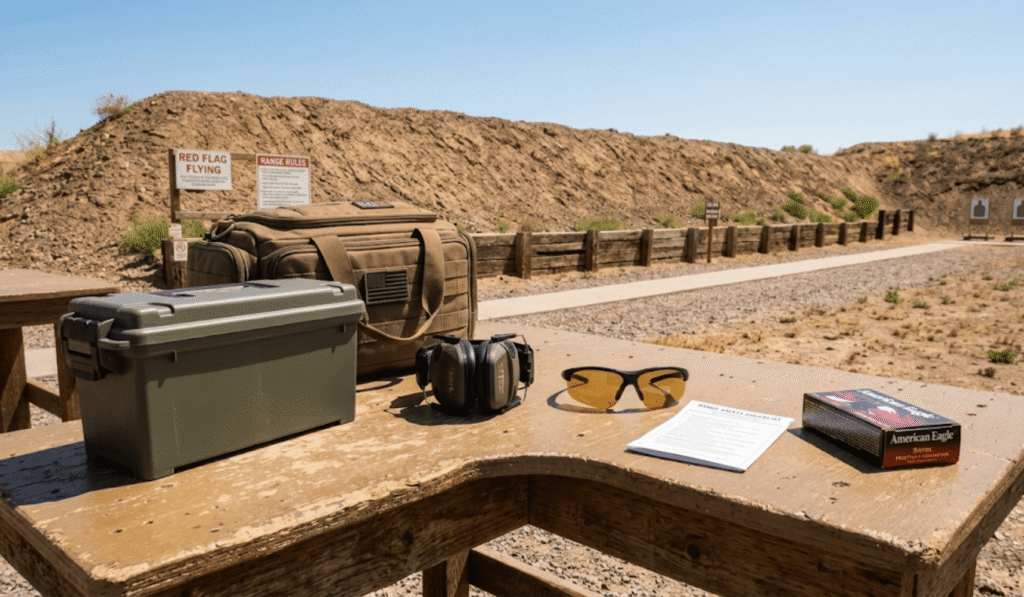
Good Independence Day shooting safety starts with three questions that need solid answers before guests arrive.
- Is discharge legal on this property? State law is the starting point, not the finish line. Most states allow discharge on private property, but your county may have its own ordinance that overrides that default. Some municipalities restrict discharge within a certain distance of any structure, road, or property boundary. Holiday periods sometimes trigger noise ordinance windows that independently restrict gunfire even where discharge is otherwise permitted. Confirm with your county sheriff’s office or zoning board before the event, not after. The NRA Range Safety Officer program and NSSF range safety resources both provide guidance on minimum verification steps for private range setup.
- Is your backstop adequate? A backstop is not a fence, a hay bale, or a stand of trees. It is a compacted earth berm tall enough and wide enough to fully contain every round fired, including ricochets, during a malfunction or unintended discharge. If your property does not have an adequate natural backstop or you cannot build one to that standard, the responsible choice is to move the event to a commercial outdoor range.
- Is there a designated Range Safety Officer? One person, named in advance, runs the line. Not the most experienced shooter in the group. The most disciplined one. Their job is to call hot and cold, enforce cease-fires, and control movement downrange. Without a designated RSO, these decisions happen informally, inconsistently, or not at all.
“Owning the land does not guarantee you can shoot on it.” Confirm the legal question first. Everything else builds from there.
What Does Summer Heat Actually Do to Your Ammo?
There is a persistent myth in online shooting communities that ammo left in a hot car or range bag becomes dangerous. Centerfire ammunition does not cook off in a parked vehicle. The temperature threshold required to initiate primer ignition outside a chamber is far above anything a closed car reaches in July, even in the Southwest. Forum experiments and manufacturer data consistently confirm this. If your vehicle ever reached temperatures high enough to detonate centerfire rounds, your dashboard and interior plastics would have melted first.
The real heat concern for Independence Day shooting safety is consistency and accuracy, not detonation.
Documented field testing has shown that rounds left loose in direct sunlight for 90 minutes can reach temperatures 30 or more degrees above ambient, producing measurable point-of-impact shift at common rifle distances. This pattern is consistent with NSSF-recommended staging practices, which specify keeping ammunition shaded and away from direct sunlight throughout any outdoor range session. For defensive pistol distances under 10 yards, the practical accuracy effect is negligible. For any precision rifle work, it is worth managing.
Practical rules: keep your ammo in a shaded range bag or insulated container during transport. Do not stage loaded magazines on a metal bench in direct sunlight. Rotate your carry ammunition on an annual cycle, and more frequently in high-humidity climates. The threat to long-term carry ammunition is humidity-driven oxidation over months, not a single hot afternoon.
One more item heat affects is your firearm’s lubrication. Heat accelerates lubricant thinning. If your gun sat in a hot vehicle for several hours before the session, give it a quick function check and apply a fresh wipe of lubricant before the first round.
The heat affects your concentration and trigger discipline long before it affects your cartridges.
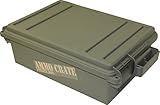
- Carry up to 65 pounds of gear with two strong side handles
- Stackable design and double padlock tabbed for security; Four tie-down points on side
- Water-resistant O-ring seal for dry storage; Non-submersible

Last update on 2026-10-23 / Affiliate links / Images from Amazon Product Advertising API
Affiliate Disclosure: GunCarrier.com earns from qualifying purchases.
How Do You Run a Safe Group Shooting Event on July 4th?
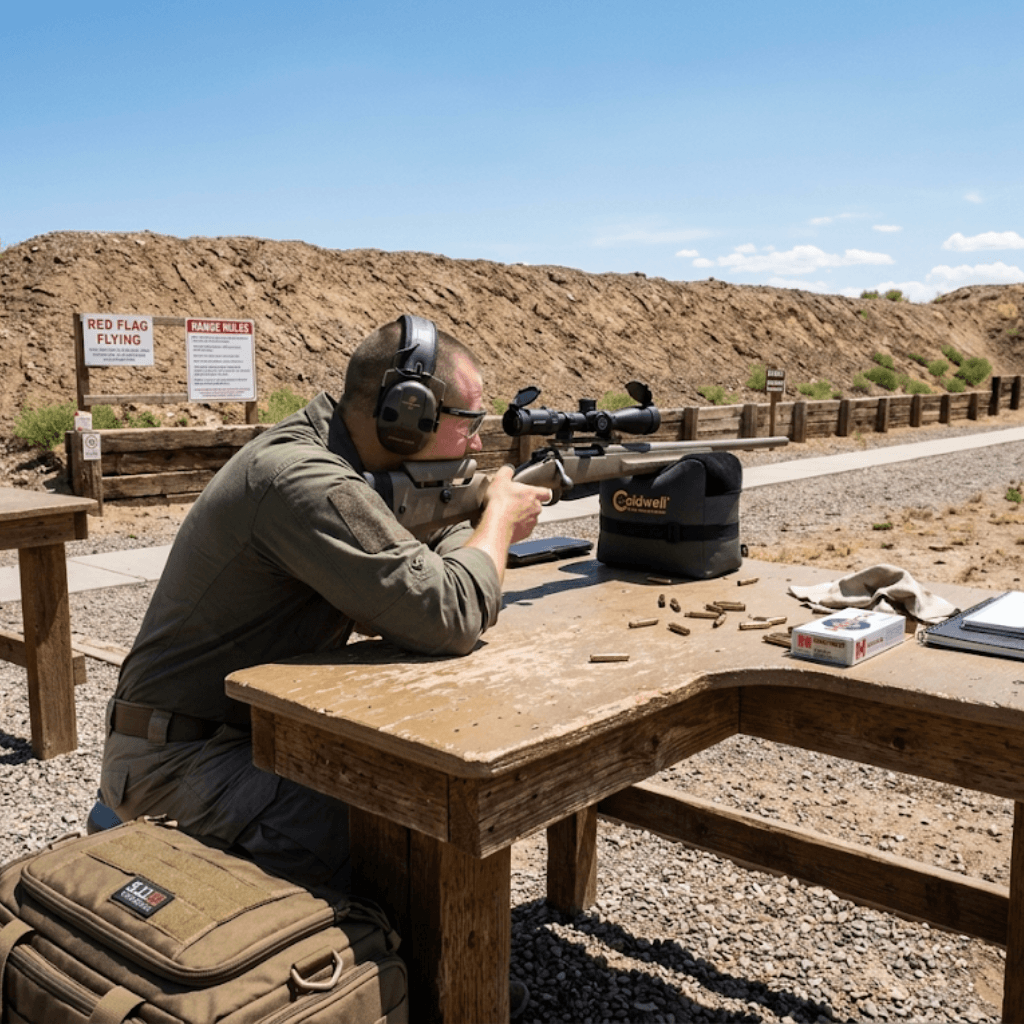
The RSO is the most important role at any informal range event. This person calls the range hot. They call it cold. They enforce the cease-fire. They control when anyone moves downrange. They do not leave the RSO position while the range is active, and they do not fire while filling this role.
If no one takes this job seriously, no one is actually running the line. What fills that vacuum is group drift: everyone assumes someone else is watching, and decisions that require a direct call get made inconsistently or not at all.
- Run the four firearm safety rules as a live demonstration, not a recitation. Before any guest picks up a firearm, walk through all four. Treat every firearm as if it is loaded, always. Never point a firearm at anything you are not willing to destroy. Keep your finger outside the trigger guard until you are on target and have made the decision to fire. Know your target and what is beyond it.
These rules are the actual safety system. Range accidents at informal events are overwhelmingly caused by a failure to apply one of these four rules in a specific moment, not by any technical deficiency.
- Establish the hot and cold protocol before the first round. The range is cold until the RSO declares it hot. When the range is cold, all firearms are grounded with actions open and no one touches a firearm. When anyone calls a cease-fire, the range goes cold immediately and completely. Anyone at the event can call a cease-fire, for any reason, at any time.
- Address the guest gun fit before going live. An ill-fitting firearm is not just an accuracy problem. It is a grip failure waiting to happen, and grip failures lead to muzzle control failures. Before any guest fires an unfamiliar firearm, verify that they can achieve a full grip, that their trigger finger reaches the trigger without shifting the grip, and that they understand the manual of arms for that specific gun. Have them complete a dry-fire sequence before going live. If they cannot demonstrate safe handling on the dry run, they do not advance to live fire.
- There is a legitimate debate about briefing depth. The case for maximum rigor: the only way to know whether a guest handles a firearm safely is to watch them do it, not to assume competence based on reputation. The case for a leaner approach: most negligent discharges at informal events trace to two specific failure modes, finger on trigger while moving, and muzzle sweep during administrative handling. A targeted briefing covering those two points is statistically adequate for experienced shooters who have handled this specific gun before.
The practical resolution: if a guest has not previously fired this specific firearm, observe a dry-fire sequence before going live. If all guests are experienced with this specific firearm, run a focused briefing covering the two highest-risk failure modes. If any guest is a first-time shooter, the dry-fire gate is unconditional. This is the core of sound Independence Day shooting safety when guests with mixed skill levels share a firing line.
The range goes hot when the RSO says it goes hot, and cold when anyone on the line says cease-fire.
What Heat Safety Rules Does Every Shooter Need at a Summer Range?
Heat degrades the shooter before it degrades the equipment. This is the part of July range planning that is most consistently skipped and produces the most preventable problems.
Range instructors with outdoor instruction experience document a consistent pattern: students arrive healthy and begin showing signs of heat exhaustion within 60 to 90 minutes of July range time without recognizing it. The symptoms do not announce themselves clearly. From the inside, they feel irritable and have difficulty concentrating. From the outside, they look like a shooter making sloppy decisions.
“Intense heat can make us become impatient, stressed, irritable, and not our best selves. Don’t allow yourself to make bad decisions because you are hot and uncomfortable.”
That observation comes from the shooting community and describes a real safety variable in any Independence Day shooting safety plan.
- Hydration starts before you arrive. Waiting until you feel thirsty at the range means you are already behind. Hydrate the night before and the morning of the event. For sessions over 90 minutes, add electrolyte supplementation. Sweat strips sodium and potassium faster than plain water replaces them, and electrolyte depletion produces fatigue and judgment impairment well before dehydration sets in.
- Enforce scheduled shade breaks. For any group event in July, plan a mandatory break in the shade at least every 30 minutes. This is a safety protocol, not a courtesy. A shooter who is 90 minutes into a July range day in direct sun without a break is not operating at sound judgment.
- Dress for the environment. Closed-toe shoes and full-length clothing protect against hot brass ejection, which becomes a genuine issue in July. An ejected case landing on exposed skin can cause a flinch that produces a muzzle control problem. A brimmed hat and sun protection are standard gear for any multi-hour outdoor session. See our hearing protection guide and range bag checklist for a full summer kit list.
- Know the warning signs and brief your guests on them. Signs of heat exhaustion include sudden fatigue, dizziness, cessation of sweating despite continued heat, and growing confusion or irritability. If anyone at the event shows these signs, the session stops. Move them to shade, provide water, and seek medical attention if symptoms do not improve quickly. Heat exhaustion can escalate to heat stroke faster than it appears it will.
- Barrel discipline is part of summer range management. Semi-automatic rifles and handguns build significant heat under sustained fire, and in July, that heat dissipates more slowly because the ambient temperature is already elevated. Enforce a round-count limit per session before a mandatory cool-down interval. This is a safety issue, not a performance issue.
Heat exhaustion impairs your judgment before you feel sick.

- Razor ultra-thin rubberized cups
- Two omni Directional Microphones
- Provides sound Activated protection over 89 DB at 0.02 reaction time
Last update on 2026-10-23 / Affiliate links / Images from Amazon Product Advertising API
Affiliate Disclosure: GunCarrier.com earns from qualifying purchases.
What Are the Legal Rules for Backyard and Outdoor Shooting on July 4th?
This section is for educational and informational purposes only and does not constitute legal advice. Consult a licensed attorney in your jurisdiction before making decisions about firearm discharge on private property.
Three verification steps belong in your pre-event checklist for solid Independence Day shooting safety, not in your post-incident debrief.
- Step one: Confirm discharge is legal on this specific property under your county’s ordinances. This is a different question from whether you are permitted to own or possess firearms in your state. Discharge law is local. Many county zoning codes restrict discharge near any structure, road, or property line, regardless of lot size. Some jurisdictions require a minimum acreage before private discharge is permitted at all. Your county sheriff’s office or zoning board is the correct source for this answer. A general web search is not.
- Step two: Confirm no noise ordinance exception applies to your holiday window. Some jurisdictions have noise ordinances that specifically apply to federal holidays or weekend evenings. These operate independently of discharge law. A property where you can legally discharge firearms may still be subject to a noise ordinance that restricts the activity during the exact window you are planning the event. Check both.
- Step three: Confirm your backstop meets your state’s requirements. Some states specify minimum backstop requirements for private discharge. An earth berm is the universal standard. Anything less requires verification against your specific jurisdiction’s requirements before you assume it qualifies.
- Alcohol and firearms occupy different spaces and different times. This is not a judgment about drinking. It is the standard applied at every formal range in the country, and it applies to informal events for the same structural reason. Social gatherings introduce competitive dynamics, ego, and lowered inhibition. The correct protocol is physical and temporal separation: the shooting session ends before the celebration involving alcohol begins. The two activities do not run concurrently, and no loaded firearm leaves the firing line during the event.
- Minors at the event. The America 250 scale means more family events this year, which means more children at outdoor events that may include firearms. If any minor is on or near the line, direct one-on-one adult supervision is required. The minor must be within arm’s reach of the supervising adult at all times while any firearm is being handled or the range is active. The supervising adult does not fire while filling that role.
The legal question is not whether you can own a gun here. It is whether you can discharge one here, today, on this specific property.

Last update on 2026-10-23 / Affiliate links / Images from Amazon Product Advertising API
Run the Checklist Before You Load the First Magazine
This is the biggest Fourth of July in 50 years. More people will be at backyard shooting events, more guests will be new to the range environment, and more hosts will be running their first informal firing line.
Responsible Independence Day shooting safety is not complicated. It is the steps you take before the first round goes downrange: the discharge law confirmed, the backstop verified, the RSO designated, the guest briefing completed, the hot and cold protocol established, and the drinking area physically and temporally separated from the firing line.
None of those steps is difficult. All of them get skipped.
Review the range safety and etiquette standards and the summer range day setup guide before your event. Share them with your guests. The host who hands out a safety briefing before the first round is the host who does not spend July 5th filling out an incident report.
Your range day. Your responsibility. Run the checklist.
This article is for educational and informational purposes only. Nothing in this guide constitutes legal advice. Laws governing firearm discharge on private property vary by jurisdiction and are subject to change. Consult a licensed attorney before making any legal decisions related to shooting on private property.
Check out this video from Smith & Wesson‘s Range Safety & Etiquette.
Frequently Asked Questions
-
Is it legal to shoot firearms on the Fourth of July on private property?
It depends on your county, not just your state. Many jurisdictions restrict firearm discharge near roads, structures, or during specific hours regardless of property ownership. Confirm with your county sheriff’s office or zoning board before your event. Noise ordinances may apply independently of discharge laws and can restrict gunfire during holiday windows specifically. This is not legal advice; consult a licensed attorney in your jurisdiction.
-
Does summer heat damage ammunition left in a hot car or range bag?
Centerfire ammunition does not cook off in a parked vehicle. Temperatures high enough to initiate primer ignition outside a chamber would destroy your car’s interior first. The real concern is long-term humidity exposure and lubricant degradation in the firearm. Store ammo shaded and out of direct sunlight during transport as a best practice for consistency and performance.
-
What is the minimum safety gear every guest at an outdoor range needs?
Eye protection and hearing protection are non-negotiable for every person on or near the firing line, regardless of whether they are shooting. Closed-toe shoes and full-length clothing protect against hot brass ejection. A brimmed hat reduces heat exhaustion risk significantly during July sessions and qualifies as practical safety gear, not an optional comfort item.
-
How do I set up a safe backstop for a backyard range?
A compacted earth berm tall and wide enough to fully contain every round fired, including ricochets, is the correct standard. Fences, trees, and hay bales do not stop bullets reliably. Never shoot toward any structure, road, or property boundary. If you cannot build an adequate berm, use a commercial outdoor range rather than improvising on a property that cannot safely contain projectiles.
-
What is a Range Safety Officer and do I need one for a casual event?
An RSO is the designated person who controls whether the range is hot or cold and enforces all safety rules. For any group event with more than two shooters, one person must fill this role explicitly. Designating the RSO before the event starts, rather than informally during it, is what separates a disciplined range day from one where safety decisions get made inconsistently.
-
Can alcohol be present at a July 4th backyard shooting event?
Not during an active range session. Every formal range prohibits alcohol during live fire, and that standard applies to informal events for the same structural reasons. The correct approach is physical and temporal separation: the range session ends completely before any part of the gathering that involves alcohol begins. These two activities do not run concurrently under any circumstances.
-
What are the signs of heat exhaustion I should watch for during a summer range day?
Watch for dizziness, sudden fatigue, cessation of sweating despite continued heat, irritability, and growing confusion. Heat exhaustion can escalate to heat stroke faster than it feels like it should. If any shooter shows these signs, stop the session immediately, move them to shade, provide water, and seek medical attention if symptoms do not resolve quickly. Brief guests on these signs before the session starts.
-
How does July heat affect point-of-impact accuracy for rifles?
Rounds left in direct sunlight can reach temperatures 30 or more degrees above ambient, shifting point of impact measurably at distances beyond 25 yards. Keep loaded magazines out of direct sunlight during any range session. For defensive handgun distances under 10 yards, the practical accuracy effect is negligible. For any precision rifle work, shaded staging and climate-controlled transport are worth the effort.
-
What should a guest safety briefing cover before a July 4th range day?
Cover the four firearm safety rules, the hot and cold range protocol, the cease-fire command and who can call it, how to safely unload and ground a firearm, and the location of the first aid kit. Any guest who cannot demonstrate safe handling in a dry-fire sequence does not advance to live fire. Social pressure is not a reason to skip this step at any event.
-
What bulk ammo should I buy for a July 4th range day?
Federal American Eagle, Winchester USA White Box, and Blazer Brass are reliable brass-case FMJ options across common handgun and rifle calibers at competitive bulk pricing. Purchase in advance before holiday demand peaks. Confirm each caliber against every firearm on the line before buying. Check with your specific outdoor range whether steel-case ammunition is permitted before purchasing it.
Make the case: Why did you vote that way?👇