
Fast Facts
The 2023 ATF pistol brace rule was vacated by federal courts in June 2024. The DOJ dropped its appeal in July 2025. No registration is currently required for a standard braced pistol at the federal level. However, the underlying NFA statute remains in force, and at least seven states maintain independent brace restrictions. Verify your state before carrying.
Related: ATF Pistol Stabilizing Brace Rule 2026: Smart Owner Guide
ATF Pistol Brace Enforcement in 2026: What Every Owner Must Know
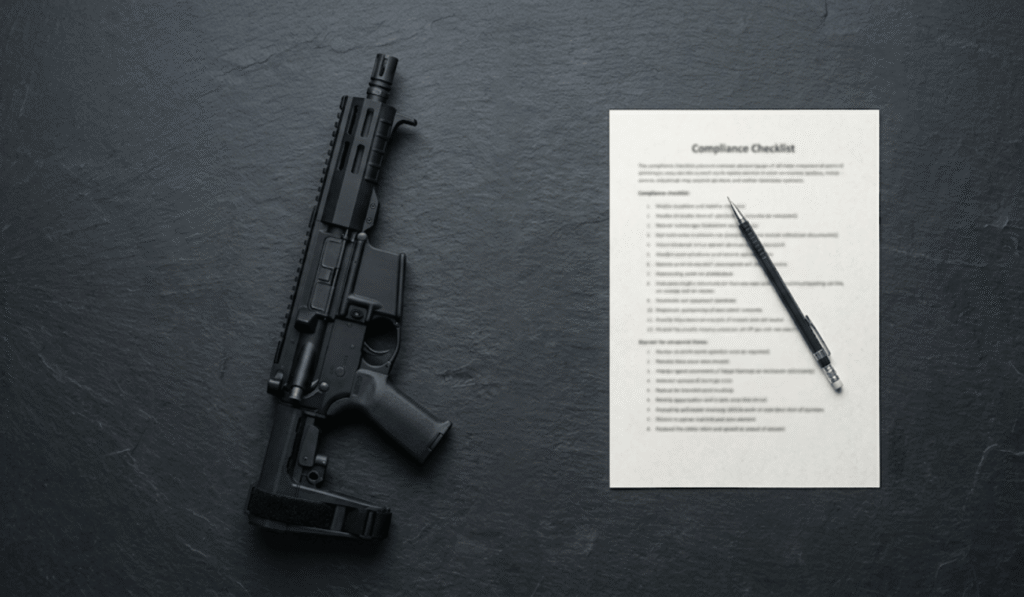
The federal rule is dead. So why are so many braced pistol owners still not sure if they are breaking the law?
That is the right question, and it does not have a simple answer. A rule that can send you to prison should not be this hard to understand, and yet here we are in mid-2026 with millions of gun owners getting a different answer every time they ask.
Here is the straight version: the 2023 ATF pistol brace rule collapsed in court. That matters, and it protects most owners. But the National Firearms Act is not the rule. The rule is dead. The NFA is not. And at least seven states never changed their own laws to match the federal outcome. Pistol brace enforcement questions did not disappear when the rule did.
This guide covers the current pistol brace enforcement picture, what the active dates actually mean, and a three-step action checklist to close any remaining gap in your compliance posture.
What Is the Current ATF Pistol Brace Enforcement Status in 2026?
The 2023 brace rule is vacated and unenforceable, but the ATF’s enforcement authority under the NFA statute survived the court order.
Pistol stabilizing braces were first approved by ATF in 2012 as forearm-support accessories that did not reclassify a pistol as a short-barreled rifle. That approval drove adoption across the market. Estimates placed the number of braced pistols in circulation at roughly 40 million by the time the regulatory picture turned hostile.
In January 2023, ATF published a final rule attempting to classify most braced pistols as unregistered short-barreled rifles under the NFA. Owners had a window to register their firearms for free. Compliance estimates landed between 6 and 8 percent. Lawsuits followed immediately across multiple federal circuits.
The rule did not survive. A federal court vacated it in June 2024 under the Administrative Procedure Act, finding that ATF exceeded its statutory authority. In July 2025, the DOJ agreed to a joint dismissal of its remaining appeal in Mock v. Bondi, making the vacatur permanent.
Here is the full pistol brace enforcement timeline at a glance:
- 2012: ATF approves stabilizing braces; pistol classification confirmed
- January 2023: ATF final rule reclassifies most braced pistols as SBRs; free registration window opens
- June 2024: Federal court vacates the rule nationwide under the APA
- July 2025: DOJ drops appeal; vacatur becomes permanent; Mock v. Bondi resolved
- March 16, 2026: ATF files brief in State of Texas v. ATF confirming it retains NFA case-by-case enforcement authority for configurations appearing designed to be shouldered
- April 29, 2026: ATF 34-rule reform package announced; includes proposed repeal of 2023 brace language from 27 CFR 478.11 and 479.11 (ATF No. 2025R-11P)
- August 4, 2026: Public comment deadline for proposed repeal via Regulations.gov
That March 2026 filing is the part most coverage skips. The rule is gone. ATF’s position is that its authority under the underlying statute was never gone. The practical pistol brace enforcement posture under the current administration is not aggressive, but the agency confirmed that authority explicitly in federal court.

- FIRE AND FLOOD PROTECTION FOR ESSENTIAL PAPERS: UL Classified to withstand high temperatures for up to thirty minutes...
- DESIGNED FOR IMPORTANT DOCUMENT STORAGE: Spacious interior fits hanging file folders and is ideal for organizing...
- KEY LOCK SECURITY YOU CONTROL: Durable key lock helps prevent unauthorized access and keeps the lid securely closed...

Last update on 2026-10-18 / Affiliate links / Images from Amazon Product Advertising API
Disclosure: GunCarrier.com participates in the Amazon Services LLC Associates Program. Links below are affiliate links. If you purchase through them, we may earn a commission at no additional cost to you.
Do I Need to Register My Braced Pistol Under Federal Law?
No registration is required under current federal law for a genuinely brace-configured pistol, but the answer changes if your specific build crosses into SBR territory under the NFA statute.
The vacated rule’s registration requirement no longer applies. You do not need to take any registration action based solely on owning a pistol with a stabilizing brace.
The NFA itself is the exception. A firearm with a barrel under 16 inches and an overall length under 26 inches that is designed to be fired from the shoulder is a short-barreled rifle under the statute. That definition existed before the 2023 rule. It exists now. The courts removed ATF’s specific factoring criteria. They did not remove the statutory definition.
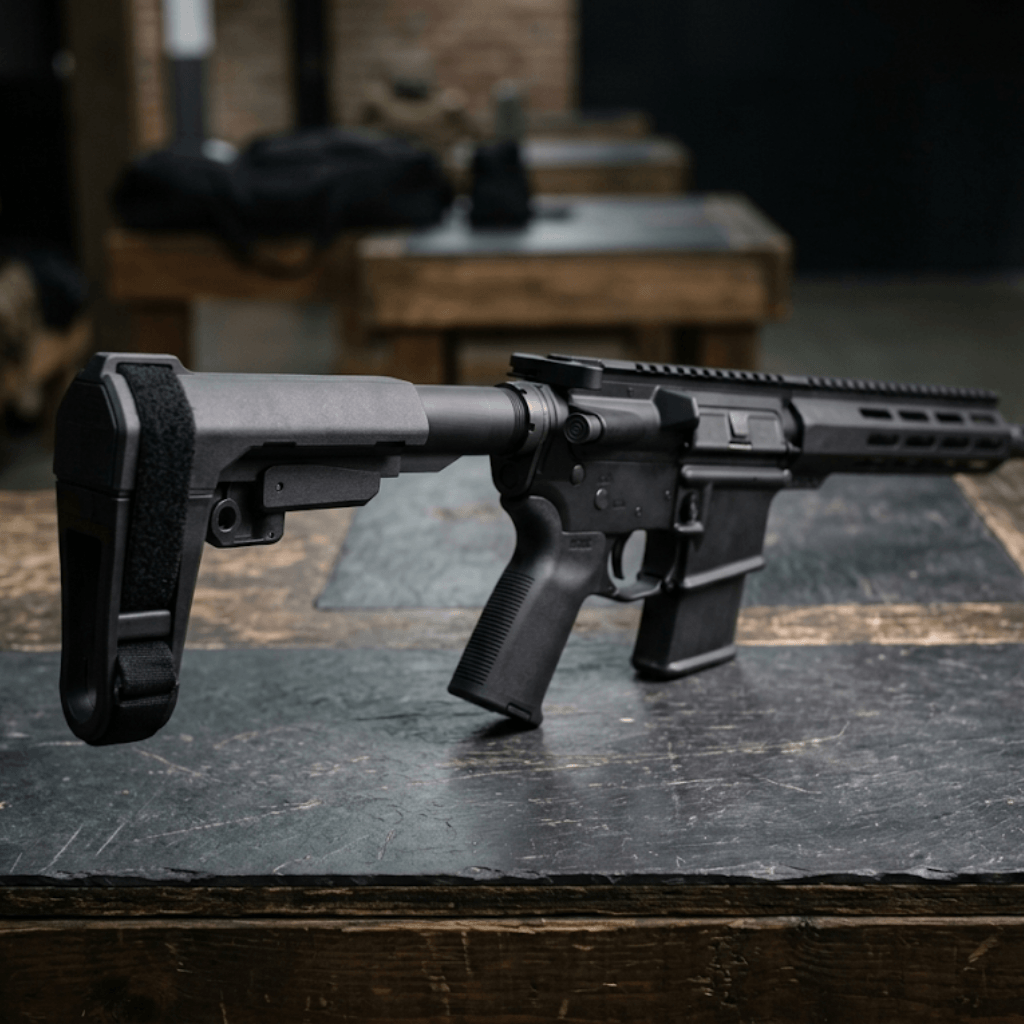
The practical line is brace versus stock. A brace straps to your forearm for one-handed support. A stock rests against the shoulder. If your firearm is genuinely configured as a forearm-braced pistol and functions as one, you are in the clear under current federal posture.
One important administrative note: effective January 1, 2026, the NFA tax stamp fee was reduced to $0 for most NFA items under the One Big Beautiful Bill Act. That change lowered the cost of registering a true SBR going forward. It did not eliminate the registration requirement itself.
If you registered a braced pistol as an SBR during the 2023 amnesty window, your stamp is valid. Do not take any action on that registration based on forum posts or informal guidance. Contact the ATF NFA Branch directly, or consult a qualified firearms attorney, before making any configuration changes to an amnesty-registered firearm.
Which Pistol Brace Configurations Are Still at Risk Under the NFA?
Most braced pistols are federally legal today, but a build that looks and functions like a shouldered short-barreled rifle can still attract case-by-case scrutiny under the NFA.
This is where the current pistol brace enforcement picture gets specific. The ATF’s March 2026 court filing stated that the “designed to be fired from the shoulder” test under the NFA applies independently of the now-dead factoring criteria. The 2023 rule’s point system is gone. The underlying statutory test is not.
The two questions that define your risk level under current enforcement posture:
First, is what is attached to your buffer tube a genuine stabilizing brace, or is it functioning as a stock? Second, if a standard person examined your complete firearm, would they describe it as a pistol or a short-barreled rifle?
If your configuration passes both questions cleanly, you are in a defensible position. If there is ambiguity in either answer, address it before carrying or transporting the firearm. The agency said explicitly that it is not launching mass enforcement actions, but prosecutions for clear-cut configurations have occurred in the past, and ATF’s March 2026 filing signals that door is not closed.
Document your configuration now. Photograph the firearm in its current setup from multiple angles. Measure and record your barrel length and overall length. Log the date. This record establishes your firearm’s status at a specific point in time and is the most practical legal protection available to a responsible owner.

- FIREPROOF: Box is UL Classified to endure 1/2 hour at 1550°F to protect irreplaceable documents and valuables from fire...
- KEYLOCK: Fireproof safe features a flat key lock to prevent the lid from opening in the event of a fire; Includes 2 keys
- COLOR: The fireproof file box for documents has a black exterior finish
Last update on 2026-10-18 / Affiliate links / Images from Amazon Product Advertising API
Which States Still Restrict Pistol Braces After the Federal Vacatur?
Federal vacatur does not override state law, and at least seven states maintain their own restrictions on braced pistols or short-barreled configurations.
You are told the federal rule is dead, but you still face a maze of state laws, shifting agency guidance, and unanswered questions. That frustration is grounded in a real legal reality: each state sets its own restrictions, and the federal outcome has no preemptive effect on them.
As of mid-2026, the following states maintain their own brace or SBR restrictions independent of the vacated federal rule: California, Connecticut, New York, New Jersey, Illinois, Washington, Hawaii, and Maryland. Each state’s specific framework differs. None of them changed their law because the federal rule was vacated.
States with no additional restrictions beyond current federal posture include Texas, Florida, Arizona, and Idaho, among others.
The travel risk is the one most owners underestimate. Carrying a braced pistol across state lines requires a state-by-state compliance check, not a federal one. A firearm that is fully legal in your home state may be illegal in a neighboring state. Run that check before every out-of-state trip, against current primary sources, not last year’s forum thread.
Where you stand under current pistol brace enforcement, by situation:
- Permissive state, genuine pistol configuration: carry daily, document your configuration, and monitor your state’s posture.
- Permissive home state, travel into a restrictive state: verify destination state law before travel. Leave the braced pistol at home if the destination state bans it.
- Restrictive state resident: verify current law through a firearms attorney familiar with your jurisdiction before any carry decisions.
- Amnesty registrant: contact the NFA Branch or a firearms attorney before making any configuration changes.
What Does the August 4, 2026 Comment Deadline Mean for Owners?
The August 4, 2026 deadline is a public comment window for the proposed repeal of the 2023 brace rule language. It is not a compliance action, and missing it does not affect your legal status as an owner.
The ATF 34-rule reform package, announced April 29, 2026, includes a Notice of Proposed Rulemaking (ATF No. 2025R-11P, Docket No. ATF-2026-0335) that would formally remove the 2023 brace language from the regulatory definition of “rifle” in 27 CFR 478.11 and 479.11.
This proposed repeal is a formal administrative step toward codifying what the courts already decided. It cannot change your ownership status, registration requirement, or compliance posture. The courts handled that in June 2024.
If you want to participate in the rulemaking process, submit written comments at Regulations.gov before midnight Eastern Time on August 4, 2026. Identify your submission by RIN 1140-AA98. Public comments from gun owners, industry stakeholders, and legal experts influence the final rule language. If you do not submit a comment, nothing about your pistol brace enforcement exposure changes.

- FIREPROOF: Safe is UL classified for ½ hour at 1550°F, keeping valuables safe while emergency responders address the...
- WATERPROOF: Safe is ETL verified for 72 hours of water submersion offering peace of mind in the event of a flood
- COLOR: The fireproof box for home has a gray and black exterior finish
Last update on 2026-10-18 / Affiliate links / Images from Amazon Product Advertising API
Your 3-Step Pistol Brace Compliance Checklist for 2026
Treating pistol brace enforcement questions with the same seriousness you would apply to any NFA-adjacent issue is the right posture for a responsible owner. Three steps close the gap between knowing the federal rule is dead and actually being prepared if anyone ever asks about your specific firearm.
- Step 1: Verify
Confirm your state’s current brace and SBR restrictions through a primary source or a qualified firearms attorney before carrying or transporting your firearm. A forum post is not a primary source. If you travel regularly, add every destination state to your verification list. - Step 2: Document
Photograph your complete firearm in its current configuration from multiple angles. Measure and record your barrel length and overall length. Log the date. Store this record where you can access it. This documentation establishes your firearm’s configuration at a specific point in time. - Step 3: Carry
Compliance clarity is the prerequisite to carry confidence, not a replacement for it. Resolve the knowledge gap, document your configuration, and carry daily. The path through regulatory uncertainty is verified knowledge. Not avoidance.
This article is for informational purposes only and does not constitute legal advice. Laws change. Verify current federal and state regulations with a qualified firearms attorney before making decisions about your specific firearm. For the proposed repeal, see ATF No. 2025R-11P at federalregister.gov.
Compliance Tools
Keeping your configuration documented is step one in responsible ownership. A fireproof document box stores your photographs, measurements, and any NFA paperwork in one accessible place.
FTC DISCLOSURE: GunCarrier.com is a participant in the Amazon Services LLC Associates Program. This section contains affiliate links. If you purchase through these links, we may earn a commission at no additional cost to you.
Download the Free Pistol Brace Compliance Checklist
A one-page printable PDF covering: federal status confirmation, state-level check questions for home and travel states, barrel length and OAL documentation fields, amnesty registration notes, and five questions to bring to a firearms attorney if your configuration is complex.
Download ——-> Pistol Brace Compliance Checklist
Check this video out from Sawtooth Tactical.
Frequently Asked Questions
-
Is the ATF pistol brace rule still in effect in 2026?
No. The 2023 ATF pistol stabilizing brace rule was vacated by federal courts in June 2024. The DOJ dropped its appeal in July 2025. ATF then published a proposed repeal in May 2026. Braced pistols are treated as standard pistols under current federal law. No registration or compliance action is required under the vacated rule.
-
Do I need to register my braced pistol with the ATF?
Not under the vacated rule. However, if your firearm’s configuration meets the NFA statutory definition of a short-barreled rifle, meaning a barrel under 16 inches and an overall length under 26 inches on a firearm designed to be fired from the shoulder, NFA registration requirements still apply. Configuration determines your obligation, not rule status alone.
-
What is the August 4, 2026 ATF comment deadline?
It is the public comment deadline for the proposed repeal of the 2023 brace rule language from federal regulations (ATF No. 2025R-11P, RIN 1140-AA98). Submitting a comment is optional participation in the rulemaking process. Missing the deadline does not affect your ownership rights or compliance status as a braced pistol owner.
-
Which states still restrict pistol braces in 2026?
California, Connecticut, New York, New Jersey, Illinois, Washington, Hawaii, and Maryland maintain their own restrictions on pistol braces or short-barreled configurations. Federal vacatur does not override state law. If you live in or travel to any of these states, check current state statutes or consult a firearms attorney before carrying a braced pistol.
-
Can ATF still enforce against my braced pistol even though the rule is dead?
Yes, on a case-by-case basis under the underlying NFA statute. ATF confirmed in a March 2026 court filing that it retains authority to evaluate whether specific firearm configurations are designed to be fired from the shoulder. The 2023 factoring criteria are gone, but the NFA statutory test survives. Configurations that clearly function as shouldered SBRs remain at risk.
-
What happened to braced pistols registered as SBRs during the 2023 amnesty?
Those NFA tax stamps remain valid. The rule being vacated does not automatically cancel individual NFA registrations. If you want to revert your firearm from SBR to pistol status, contact the ATF NFA Branch or consult a qualified firearms attorney. Do not rely on informal guidance or forum advice for this process, as it involves NFA administration.
-
Is the NFA $200 tax stamp still required for SBRs in 2026?
The $200 tax was reduced to $0 effective January 1, 2026 for most NFA firearms under the One Big Beautiful Bill Act, excluding machine guns and destructive devices. NFA registration is still required for true SBRs. The fee changed; the registration process did not. Confirm current requirements for your specific configuration with ATF or a qualified firearms attorney.
-
What is Mock v. Bondi and how does it affect pistol brace owners?
Mock v. Bondi was the federal case in which the DOJ agreed to a joint dismissal of its appeal of the 2023 brace rule vacatur in July 2025. The dismissal made the vacatur permanent. Pistol brace owners are no longer at risk under the vacated rule as a direct result of that resolution.
-
How do I document my pistol brace configuration for legal protection?
Photograph your firearm in its current configuration from multiple angles, measure and record your barrel length and overall length, and log the date. Keep this record accessible. If your configuration is questioned, this documentation establishes your firearm’s status at a specific point in time. This step is especially important for owners who made configuration changes during or after the 2023 rule period.
-
Should I travel across state lines with my braced pistol?
Check your destination state’s law before you travel. Federal vacatur does not preempt state restrictions. States including California, New York, and New Jersey treat braced pistols under restrictions that may apply to SBR-equivalent configurations. Run a state-specific compliance check before any out-of-state trip. When in doubt, consult a firearms attorney familiar with both your home state and destination state laws.
Lock in your vote and tell us: Why is this the right call?👇