
Quick Answers
To store a firearm safe properly in a high heat climate, keep the interior between 30% and 50% relative humidity and near 60-70°F. Use a sized dehumidifier rod or desiccant, check it monthly, and keep the safe out of direct sun and unconditioned garages during summer heat.
Related: Home Firearms Safe Reviews 2026: Budget vs. Premium
If your mercury regularly tops 95 degrees, your air conditioner is not the only thing working overtime. Your gun safe is fighting the same battle, quietly, behind a locked door. One longtime forum member put it better than any spec sheet: “It’s the constant temp change that’s not good for either.” Heat is not the enemy by itself. Here is how to store a firearm safely correctly before this summer’s heat does the damage instead.
Why Does Heat Threaten A Stored Firearm In The First Place?
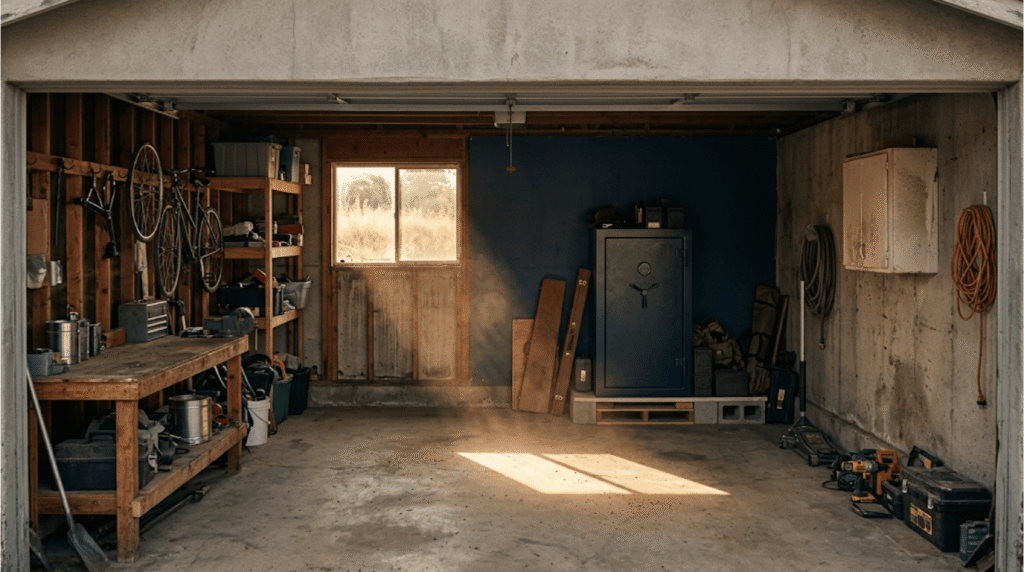
Trapped humidity, not heat on its own, is what corrodes a stored firearm.
Heat rarely rusts a gun by itself. Moisture does that. Heat is the accelerant that makes the process faster. Every time the temperature swings, whether from a hot afternoon cooling into a humid night or an air conditioner cycling on and off, the air inside your safe tries to reach the same moisture level as the air outside it. When warm, humid air meets cooler metal, it condenses, and that thin film of moisture is what starts corrosion.
A safe in a non-climate-controlled space carries a higher risk than one indoors. The problem is not the peak temperature on any single day; it is the repeated cycle of heating and cooling that pulls moisture in and out all summer. Managing that cycle is what it actually takes to store a firearm safely through a hot season.
What Is The Ideal Temperature And Humidity Range For A Firearm Safe?
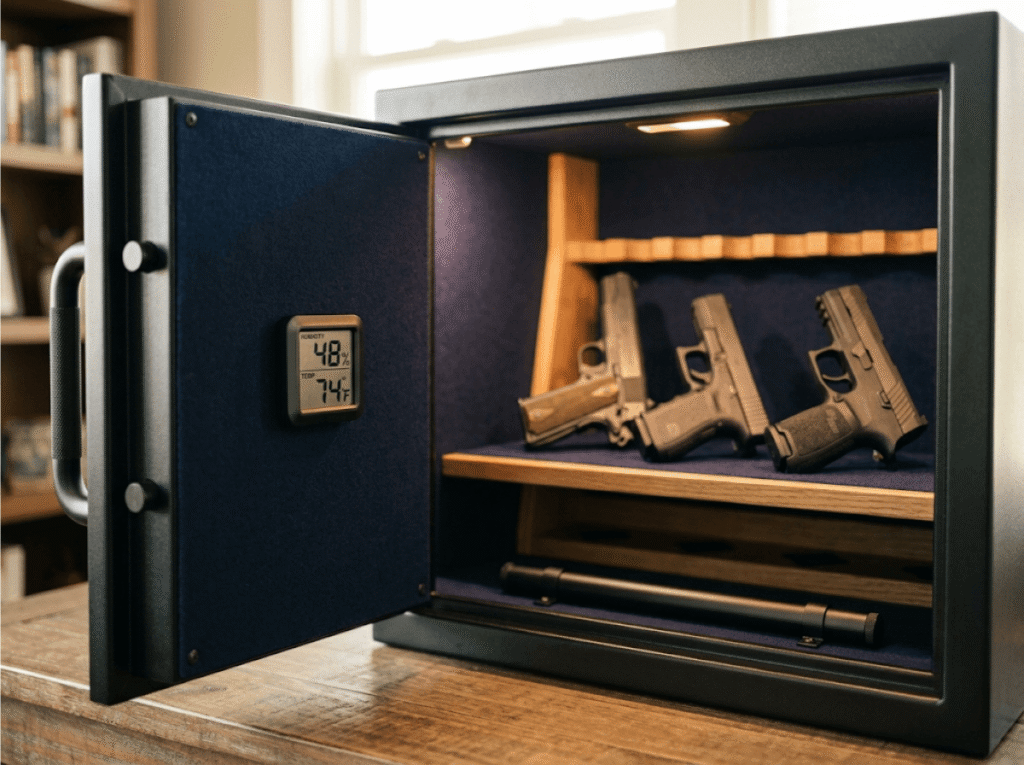
Keep your safe between 30 and 50 percent relative humidity and near 60 to 70 degrees Fahrenheit.
The consensus among firearms curators and safe manufacturers is narrow. The National Rifle Association’s National Firearms Museum recommends a year-round target close to 70°F and 50% relative humidity for stored firearms, and most safe manufacturers publish nearly identical numbers.[^1] Air too humid invites rust and mildew. Air too dry pulls moisture out of wood stocks, leading to cracking.
You cannot estimate this range by feel. A ten-dollar hygrometer placed inside the safe is the only way to know your actual numbers instead of guessing. If you are learning how to store a firearm safe in a demanding climate for the first time, that hygrometer is the first purchase, before any dehumidifier.
Where Should You Place A Firearm Safe In A Hot Climate?
Interior, climate-controlled rooms beat garages, sheds, and exterior closets almost every time.
Placement does more work than most owners give it credit for. An interior closet with regular air conditioning is far easier to manage than a detached garage, shed, or uninsulated closet against an exterior wall. Garages can swing past 100 degrees and still trap humidity overnight, close to the worst combination for stored metal.
If a garage or outbuilding is your only option, do not set the safe directly on bare concrete. Add a vapor barrier underneath it, keep it out of direct sunlight, and treat the space as one that needs active humidity management, not passive storage. Where you store a firearm safe matters almost as much as what you put inside it.
Which Dehumidifier Or Desiccant Actually Works In Extreme Heat?
Continuous dehumidifier rods outperform rechargeable desiccants in genuinely hot, humid climates.
Long-time owners consistently rank three tools the same way. Continuous dehumidifier rods run automatically off household power, making them the strongest option for hot climates. Rechargeable silica gel canisters work well as a backup or in milder climates, but need to be dried out and recharged on a schedule that is easy to let slip. Passive silica gel packs are the weakest option alone, and one forum member who tried them put it plainly: “they made zero difference on my hygrometer” until he switched to a rod.
Size whichever option you choose to the cubic footage of your safe, not the cheapest unit on the shelf. How well you store a firearm safe often comes down to this single, unglamorous purchase.
How Do You Protect Ammunition And Wood Stocks From Heat Damage?
Ammunition does not explode from heat inside a safe; moisture in unsealed rounds is the real risk.
A common fear about learning to store a firearm in a safe in a hot climate is that heat could cause ammunition to detonate. It will not, under any conditions you are likely to encounter. Quality factory ammunition is sealed and built for everyday heat, and true detonation from heat alone needs temperatures near 400 degrees, far beyond any safe or vehicle. The real risk in a hot, humid climate is quieter: moisture reaching unsealed reloads or aging primers over the years, causing misfires.
Wood stocks and grips face a different threat. They expand and contract with humidity swings, and repeated cycles lead to cracking, warping, or loose fittings. A light coat of oil or wax, a couple of times a year, is part of how you store a firearm safely correctly, not an afterthought.
How Often Should You Check A Firearm Safe’s Climate Conditions?
Check your hygrometer monthly in summer and quarterly the rest of the year, without exception.
Consistency beats intensity here. Check your hygrometer and dehumidifier indicator monthly during peak summer heat, and at least quarterly the rest of the year. Pull your firearms out for a quick inspection on the same schedule, rather than waiting until something looks wrong.
One owner who skipped this habit described opening his safe after a nearby water heater flooded his garage during a 105-degree stretch: “I was nervous when I opened the safe.” He got lucky. A fixed monthly habit is what separates owners who store a firearm safely from owners who find out too late.
Not every owner needs the same level of effort here, and experienced owners disagree on where the line sits. One camp argues you should log humidity and temperature regularly, because guessing is how a safe gets discovered rusted a year later. The other argues that a correctly sized dehumidifier and a check twice a year is genuinely adequate for most home safes.
Here is the honest answer: it depends on where your safe lives. Indoors with regular air conditioning, the lighter standard is fine. In a garage, shed, or anywhere summer temperatures regularly climb past 90 degrees, treat the stricter standard as your floor, not your ceiling.
Store A Firearm Safe The Right Way Before Summer Peaks
A hygrometer, a correctly sized dehumidifier, and a fixed monthly check are the entire system.
Your safe’s steel door protects your firearms from people. It does nothing to protect them from the air trapped inside it. The fix is not expensive: a hygrometer to tell you the truth, a dehumidifier sized for the space, and a fixed schedule you actually keep. That is the real answer to how you store a firearm safely through a brutal summer without a nasty surprise in October.
Grab our free Hot Climate Firearm Storage Checklist below and get your safe’s conditions dialed in before the next heat wave hits.
Check this video from Liberty Safe.
Frequently Asked Questions
-
What humidity level is safe for a gun safe in a hot climate?
Aim for 30% to 50% relative humidity inside the safe, with temperature near 60-70°F when possible. This range prevents both rust from excess moisture and stock cracking from air that’s too dry. A hygrometer inside the safe is the only reliable way to confirm you’re actually in range.
-
Can extreme heat alone cause a gun to rust inside a safe?
Heat alone rarely causes rust; trapped moisture does. But heat speeds up chemical reactions and drives daily temperature swings that cause condensation when warm, humid air meets cooler metal. In a hot climate, heat and humidity usually arrive together, which is why both need active management, not just one.
-
Is it safe to store a gun safe in a garage during summer?
It can be, but an uninsulated garage in a hot climate often swings past 100°F and traps humidity, which is a tougher environment than a climate-controlled room. If a garage is your only option, add a sized dehumidifier, a vapor barrier under the safe, and check conditions more often in peak summer months.
-
Will hot weather cause ammunition to explode in a safe?
No. Quality factory ammunition is sealed and built to handle everyday heat, and true detonation from heat alone requires temperatures near 400°F, far beyond what any safe or vehicle reaches. The real risk in hot, humid climates is moisture reaching unsealed reloads or older primers over years of storage, not sudden heat.
-
What’s the best dehumidifier for a gun safe in a humid climate?
Field experience from long-time owners consistently favors continuous dehumidifier rods over rechargeable desiccant beads in genuinely humid climates, since rods run automatically and don’t require recharging cycles. Rechargeable silica gel works fine as a backup or in milder climates, but pair either option with a hygrometer to confirm it’s working.
-
Does a hot climate affect wood gun stocks differently than metal parts?
Yes. Metal parts are mainly threatened by moisture and rust, while wood stocks respond to swings in dryness and humidity by cracking, warping, or loosening at the fittings. A stable humidity range protects both, but wood specifically benefits from an occasional light coat of oil or wax to resist moisture swings.
-
How often should I check my firearm safe in a high heat climate?
Check the hygrometer and dehumidifier indicator monthly during peak summer heat, and at least quarterly the rest of the year. Pull firearms out for a visual inspection and light wipe-down on the same schedule. Consistency matters more than frequency; a fixed monthly habit catches problems long before rust becomes visible damage.
-
Does climate control replace legal safe storage requirements?
No. Humidity and heat control protect the condition of your firearms; legal safe storage laws, where they apply, govern locking and restricting access to unauthorized users, especially minors. A safe can meet every climate best practice and still fail a legal storage requirement if it isn’t properly locked and secured.
-
Can I use rice or a light bulb to dehumidify a gun safe?
Both are common home fixes, but are unreliable for a gun safe. Rice absorbs only a small amount of moisture before it stops working and can attract pests, and a light bulb creates uneven, low-level heat without any real humidity control. A sized dehumidifier rod or silica gel product is more dependable.
-
Is it safe to leave a firearm in a hot car for a short time?
A short errand in a locked vehicle typically won’t damage a firearm from heat alone, since real risk starts near temperatures no closed car reaches. The bigger concerns are theft and, over repeated exposure, humidity buildup inside the case. Avoid extended storage in a vehicle and never leave firearms unattended and unsecured.
Lock in your vote and tell us: Why is this the right call?👇