
What You Need to Know about CCW Habit
Building a daily concealed carry habit comes down to three things working together: a comfortable rig you’ll actually wear, a simple routine that runs on autopilot, and a wardrobe that supports the system instead of fighting it. The carriers who succeed at 365-day carry don’t have more discipline than you. They have a setup that removes friction. This guide shows you how to build that setup and protect the habit for the long term.
Related: Best Budget CCW Pistol Under $500 in 2026: What Actually Works
You bought the gun. You took the class. You worked hard for the first three weeks. Then, on Wednesday afternoon, the holster started digging, and the gun stayed home on Thursday “just this once.”
That’s how most permits quietly drift into part-time carry. It isn’t motivation. It’s friction. As one carry-clothing guide put it bluntly: “Uncomfortable carry leads to inconsistent carry.” That’s the whole problem in seven words.
This is a system guide for closing that gap. Three failure points. Three fixes. A daily concealed carry habit that survives past the honeymoon.
Why Does Daily Carry Stop Sticking After the First 30 Days?
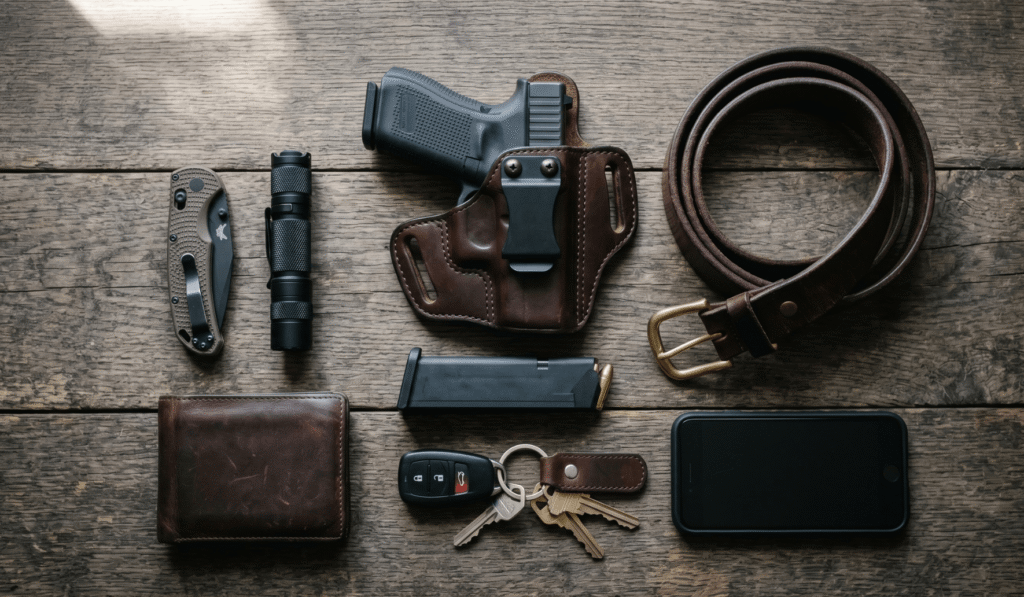
The honest answer most articles skip: by week three, the rig you bought based on five-star reviews starts feeling like a problem you’re paying to solve every morning. Three failure points show up in almost every drop-off story.
- Failure 1: Holster picked on reviews, not on a real four-hour test. A holster that feels fine for ten minutes in your living room is a different object after four hours of seated work, driving, and bending over. Reviews can’t predict how a piece of kydex interacts with your specific hip, your specific belt, and your specific desk chair.
- Failure 2: Wardrobe left unchanged. Most printing problems are clothing problems first and holster problems second. Tapered shirts, performance fabrics, and clingy athletic cuts will print at almost any carry position, regardless of how good your rig is. Carriers who don’t adjust their wardrobe end up adjusting their shirt every five minutes, and the gun “turns into a constant distraction instead of a tool you quietly live with.”
- Failure 3: Binary thinking. Your gym doesn’t allow firearms, so you skip carrying that day. The school pickup is a no-go, so the gun stays home. One restricted location turns into a restricted day, then a restricted week. The 365 carriers think in protocols, not all-or-nothing.
The rule that ties these together: consistency beats optimization. A 70%-perfect rig you wear 28 days a month protects you more than a 100%-perfect rig you wear 12.
How Do I Build a Daily Carry Routine That Actually Sticks?
Stop trying to optimize. Start trying to repeat. The 365 habit is built in three phases, and the order matters.
- Days 1 to 30: One holster. One belt. One position. Pick a setup and run it for 30 days without changing a single variable. The single goal of this phase is consistency. Carry 25 of 30 days. Don’t research new gear. Don’t switch carry positions because someone on a forum said the appendix is faster. You are building an identity, not a kit.
- Days 31 to 90: Add the carry log and the dry-fire reps. Same rig. Now start writing it down. Date carried. Dry-fire reps that week. Any live-fire sessions. The log is gear. It documents the habit, tracks your skill floor, and becomes a defensible record if you ever need one.
- Months 4 to 12 and beyond: Benchmark quarterly. Run a measurable test against your daily rig every three months. Adjust the gear only if the benchmark fails, not because something new caught your eye.
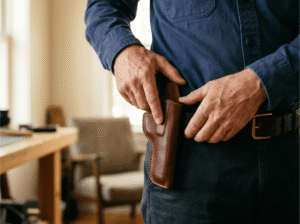
The morning anchor that makes this work: tie the gun to a sequence you already do. Keys, phone, wallet, gun, spare mag, light. Same order every day. Same location. After 30 days, the sequence runs without thought, which is exactly what consistent carry under stress requires later.
What Is the Most Comfortable IWB Holster for All-Day Carry?
The most comfortable IWB holster is the one engineered to distribute weight across your belt instead of pinching it into one spot on your hip. Four criteria matter more than brand.
- Belt-spread weight distribution. Wide-mount holsters (two clips spread across multiple belt loops) carry better for long days than single-clip rigs. The weight goes into the belt, not into your side.
- Sweat barrier and backing. Leather, suede-backed kydex, and hybrid designs reduce skin contact discomfort that compounds across a workday. Bare kydex against bare skin gets old by hour three.
- Adjustable cant and ride height. Your body isn’t symmetrical. A holster that lets you tune cant angle and ride height is a holster that adapts to you instead of the other way around.
- Belt synergy. A premium holster on a department-store belt still rocks and prints. A real gun belt is non-negotiable. As one printing-fix guide put it, a solid holster on a weak belt still moves.
Recommended starter rigs:
- Vedder LightTuck IWB $69.99: primary daily-carry recommendation; light, adjustable, broad gun compatibility.
- Crossbreed SuperTuck Deluxe $74.95: hybrid leather-and-kydex; the long-haul comfort standard.
- Hanks Gunner’s Belt $89: the belt that makes either holster perform as designed.
The metric that separates a day-one holster from a year-three holster: it has to be sustainable seated for four hours without adjustment. Test that before committing to a 30-day trial.
What Do I Wear to Make Concealed Carry Actually Comfortable?
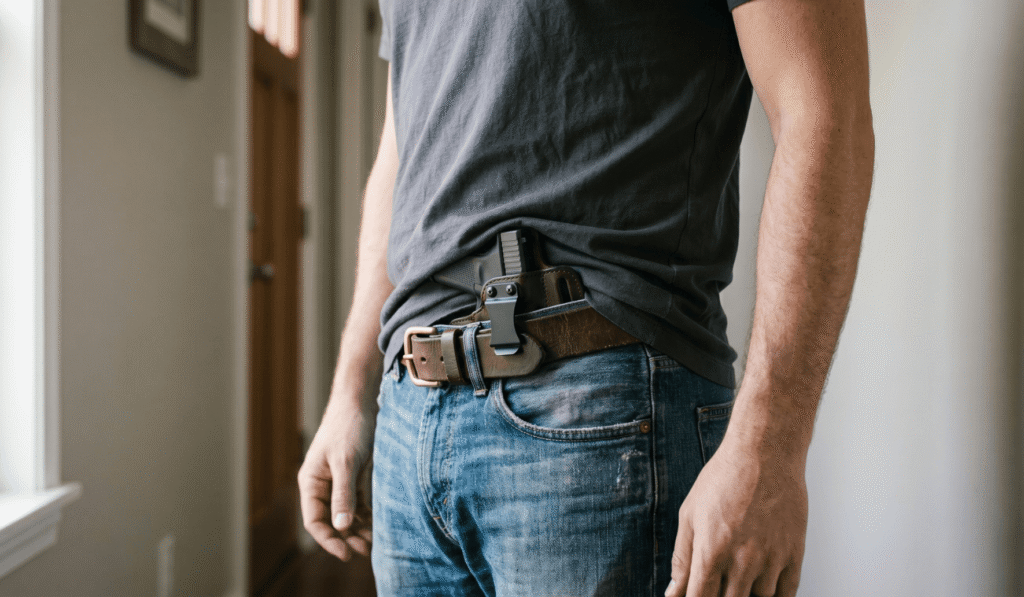
Your wardrobe is part of the carry system, not an afterthought. Adjust it once and stop fighting it daily.
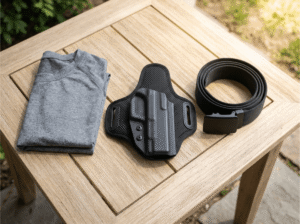
Size up shirts one size in the torso (not the shoulders). Choose mid-weight fabrics that drape rather than cling. Avoid tapered athletic cuts and slim-fit performance polos that conform to the grip shape and print at every position. Patterns hide outline better than solids. And keep one rule in mind: baggy is not a strategy. Loose fabric moves, rides up, and signals “hiding something.” You want clothing that sits naturally and lets a stable, well-positioned holster do the concealing.
The system is gear plus routine plus wardrobe. Most carriers solve one variable, blame the other two, and cycle through equipment forever.
What Do I Do With My Gun When I Can’t Carry?
The carriers who survive five years of daily carry have a defined protocol for restricted locations. The carriers who quit don’t.
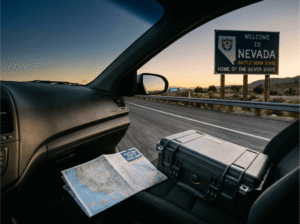
- Vehicle storage: anchored lockbox, bolted into the trunk or under the seat. Never the glove box. Vehicles get broken into; glove boxes are the first place a thief looks.
- Transition timing: secure the gun before you exit the vehicle, not after. Re-holster only when you’re back in the driver’s seat. Same protocol every time.
- Mindset: a one-hour carry-free moment is not a carry-free day. The doctor’s office, the courthouse, the school pickup line, each is a defined gap, not a reason to disarm for the rest of the day.
State laws on vehicle storage, posted property, and prohibited locations vary considerably. Know your state’s specific rules before you build your protocol. This article is general guidance, not legal advice.
How Do Experienced Carriers Maintain the Habit for the Long Haul?
The maintenance layer is what separates year-one carriers from year-five carriers.
Weekly dry-fire reps tied to a recurring trigger, Sunday morning, ten minutes, same time every week. Monthly live-fire session against a fixed standard, not free-form plinking. Quarterly gear audit: holster wear, belt sag, magazine spring fatigue. The carry log captures all of it.
Here’s where the community is genuinely split, and the split is worth naming. Some experienced carriers argue that the average gun owner needs serious, formal, recurring training to justify daily carry. Others argue that consistent basic reps and showing up every day matter more than tactical polish that most carriers will never use.
The honest answer is both, in sequence. Year-one carriers should optimize for consistency. Year-three carriers should optimize for capability. Skipping the consistency phase to chase capability produces well-trained shooters who don’t actually carry. Skipping the capability phase produces consistent carriers with no skill floor when it counts
Key Takeaways
- Comfort is the safety feature. A rig you don’t wear protects nobody.
- Pick one setup and run it 30 days before changing anything.
- Your wardrobe is part of the system. Adjust it once and stop fighting it daily.
- Have a plan for the gun when you can’t carry it. Don’t make every restricted location a reason to disarm for the day.
- Log your carry days and your training reps. The document protects you twice, once as proof of habit, once as proof of skill.

Last update on 2026-10-15 / Affiliate links / Images from Amazon Product Advertising API
Your Next 30 Days: Decide Whether This Sticks
The committed daily carrier and the part-time carrier started the same way. The difference is the system that the daily carrier built in the first month. Pick the holster. Pick the belt. Pick the position. Wear it tomorrow. Log it. Repeat for 30 days without changing a variable.
Ready to build your daily concealed carry habit?
Start with the recommended all-day comfort rig above and join the GunCarrier 30-Day Daily Carry Challenge, a structured email series with weekly gear and mindset checkpoints to lock the habit in.
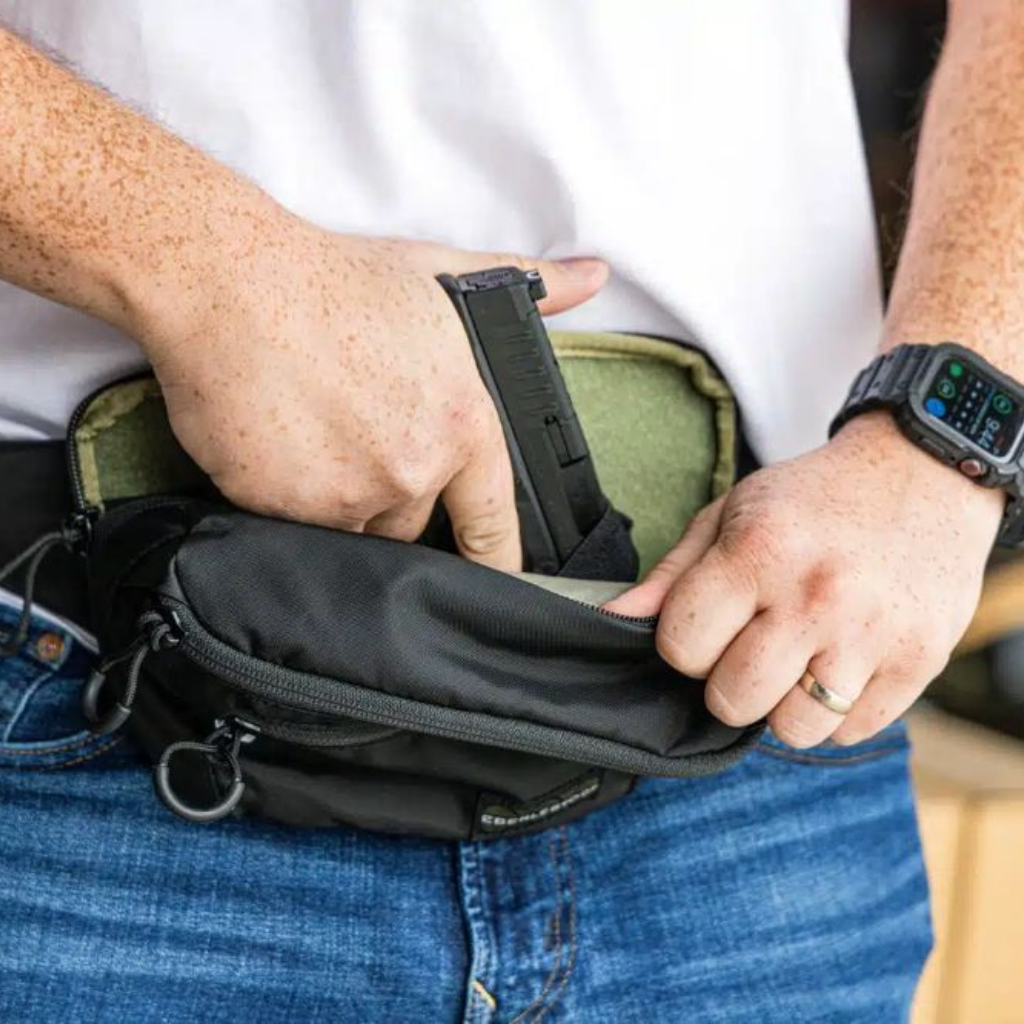
The Ultimate P365 Conceal Carry Setup from Shatterthewicked
Frequently Asked Questions
-
How do I get used to carrying a gun every day?
Start by carrying at home for the first week with no destination involved. Add one outing in week two. By week three, carry on every leave-the-house trip. The body adapts to the rig faster than the mind adapts to the responsibility, and home reps build both at once.
-
What is the most comfortable IWB holster for all-day carry?
The most comfortable holster distributes weight across your belt, uses a sweat-resistant backing against your body, and offers adjustable cant and ride height. Brand matters less than fit. Test seated, standing, and bent over for at least four hours before committing to a 30-day trial.
-
What do I do with my gun when I can’t carry at work?
Use a bolt-anchored vehicle lockbox, never a glove box. Transition the gun to the lockbox before you exit the vehicle, not after. Re-holster only after you’re back in the driver’s seat. Treat the prohibited-location stop as a defined protocol, not an improvised handoff every time.
-
How do experienced CCW holders build a daily carry routine?
They anchor the gun to an existing morning sequence: keys, phone, wallet, gun, spare mag, light. The order never changes. The location never changes. After 30 days the sequence runs without thought, which is exactly what consistent carry under stress requires later. Routine is the multiplier.
-
What should I wear to make concealed carry more comfortable?
Size up shirts one size in the torso, choose patterns and mid-weight fabrics that drape rather than cling, and avoid tapered athletic cuts. A real gun belt is mandatory. Performance fabrics that build static cling will print badly by mid-afternoon. Adjust your wardrobe once and stop fighting it daily.
-
Is it worth carrying a smaller gun if it means I’ll actually carry every day?
A smaller gun you carry consistently outperforms a larger gun left at home. The trade-off matters: smaller often means harder to shoot well. The right answer is the largest gun you’ll genuinely carry every day, in a rig you’ll wear seated for four hours without adjusting.
-
How long does it take for daily carry to feel normal?
For most new carriers, the gun feels obvious for the first 7 to 14 days, present but tolerable through day 21, and largely unnoticed after 30 consistent days. This is a hardware-and-habit adaptation curve. Inconsistent carry resets the clock; carriers who skip days never reach the unnoticed phase.
-
Do I really need to carry it at home?
Home carry serves two purposes: residential break-ins do happen, and the daily reps reinforce the habit. Many committed carriers wear a lighter setup at home rather than the full-size carry rig. The point is consistency. The gun on the nightstand is not the same as the gun on your hip.
Caliber wars aside, why that one? Drop your take.👇