
Quick Summary
Choosing a concealed carry handgun for women requires balancing grip strength, wardrobe compatibility, and training access. While no single gun fits every body type, the Sig Sauer P365 and S&W M&P Shield Plus are the most recommended by carry-focused instructors for their manageable recoil, slim profiles, and adequate capacity. The best gun for you is the one you can draw efficiently from your actual carry position in the clothes you actually wear.
Related: Best Belly Band Holster For Active Lifestyle Women
Key Takeaways:
- Smaller guns are NOT easier to shoot, they increase felt recoil and accelerate flinch response
- Most carry discomfort is a holster problem, not a gun problem. Test three holster designs before switching firearms
- 9mm is the standard: best combination of reduced recoil, capacity, and availability of quality defensive loads
- The drawstroke from concealment is the single highest-value skill 5 minutes of daily dry-fire practice outperforms infrequent range sessions
“Nobody told me how hard it is to find comfortable carry for my body.”
What Makes a Concealed Carry Handgun Right for Women?
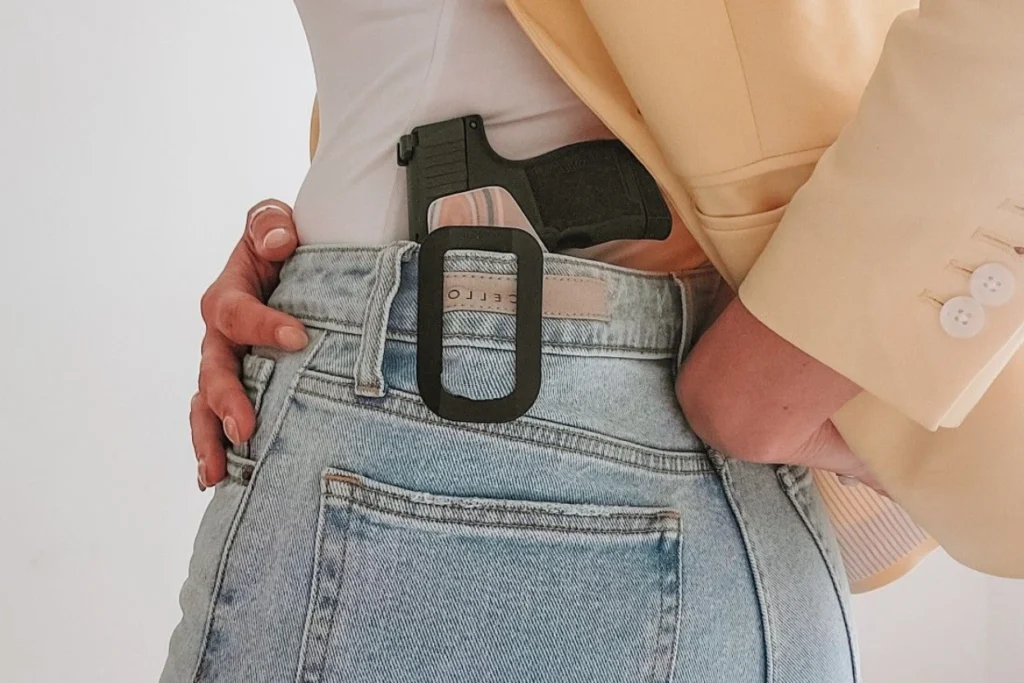
The question isn’t “what gun is marketed to women.” The question is: what gun works for your specific body, your wardrobe, your grip strength, and your training access?
The firearms industry built its products for men and added pink grips as an afterthought. Female carriers face genuine secondary-tier challenges: holsters designed for male hip-to-waist ratios, instruction that assumes male hand size, and gear marketing that either ignores women or condescends.
Getting to the right gun starts with four honest questions:
- Grip strength: Can you rack the slide under stress? Not slowly on a calm range day, under stress, in a hurry, possibly with one hand. Full-size frames with standard recoil springs are harder to rack. Some compact and subcompact pistols are easier; others are harder. This has to be tested, not assumed.
- Wardrobe compatibility: Where will you carry? A standard IWB holster works if you have waistband room. Many women’s pants don’t have that room. Belly bands, bra holsters, and appendix configurations change the gun size equation.
- Frame size vs. concealability: Smaller is not always better. A tiny pistol is harder to shoot accurately under stress. A full-size pistol is harder to conceal. The right answer depends on your specific body shape and carry position, not on what the internet says is “the best compact for women.”
- Training access: The best gun for you is the one you’ll actually train with. Caliber debates matter less than whether you can shoot 200 to 300 rounds in a training session without hand fatigue or a flinch response developing.

- VNSH Belly Band Gun Holster for Women: The VNSH Holster is the most comfortable IWB holster you'll ever wear. Unlike...
- Universal Compatibility: Designed to fit 99% of handguns on the market, our gun holsters for women work without...
- Makes Your Gun Discreet: Designed for modern life, this gun belt for women effortlessly adapts to your lifestyle...
Last update on 2026-10-09 / Affiliate links / Images from Amazon Product Advertising API
What Are the Best Concealed Carry Handguns for Women in 2026?
These five firearms are consistently recommended by carry-focused instructors for female carriers, not because they’re marketed to women, but because they meet the relevant performance, concealability, and shootability criteria. Prices are approximate retail and vary by region and dealer.
| Model | Caliber | Approx. Price | Frame Size | Why It Works for Women’s Carry |
|---|---|---|---|---|
| Sig Sauer P365 | 9mm | $499–$549 | Micro-compact | High-capacity micro-compact; manageable slide rack; widely supported in holster market |
| S&W M&P Shield Plus | 9mm | $449–$499 | Compact | Flat profile; easy to conceal IWB; trigger is consistent and relatively light |
| Glock 43X | 9mm | $449–$499 | Slimline compact | Slim profile; excellent holster ecosystem; predictable striker-fired trigger |
| Springfield Armory Hellcat | 9mm | $499–$529 | Micro-compact | Optics-ready standard; high capacity for its footprint; textured grip aids smaller hands |
| Ruger LCR (.38 Spl +P) | .38 Spl +P | $499–$549 | Compact revolver | No manual safety to manage; reliable; works for belly band carry; simpler manual of arms |
The revolver entry deserves a note. Many instructors recommend revolvers for newer female carriers because the manual of arms is simpler: load, point, press the trigger. There is no slide to rack under stress, no external safety to disengage, and no magazine to seat correctly. For someone who will carry regularly but train minimally, a double-action revolver reduces manual of arms complexity at the cost of round count and a heavier trigger pull. Whether that tradeoff is right depends on your specific situation.
How Does Body Type Affect Holster Choice for Women’s Carry?
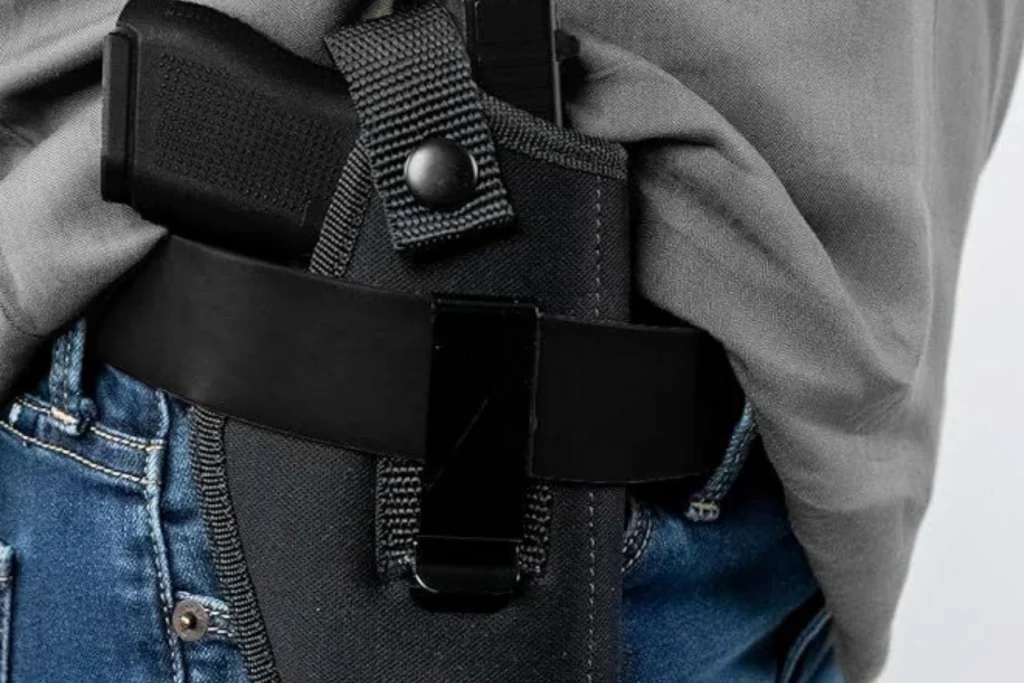
The gun decision and the holster decision cannot be separated. The most common carry failure pattern among female carriers: buy the gun, buy a generic IWB holster that wasn’t designed for their hip geometry, decide carrying is uncomfortable, and stop carrying. That outcome is a holster problem more often than it’s a gun problem.
IWB (Inside-Waistband) Carry
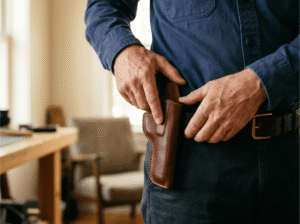
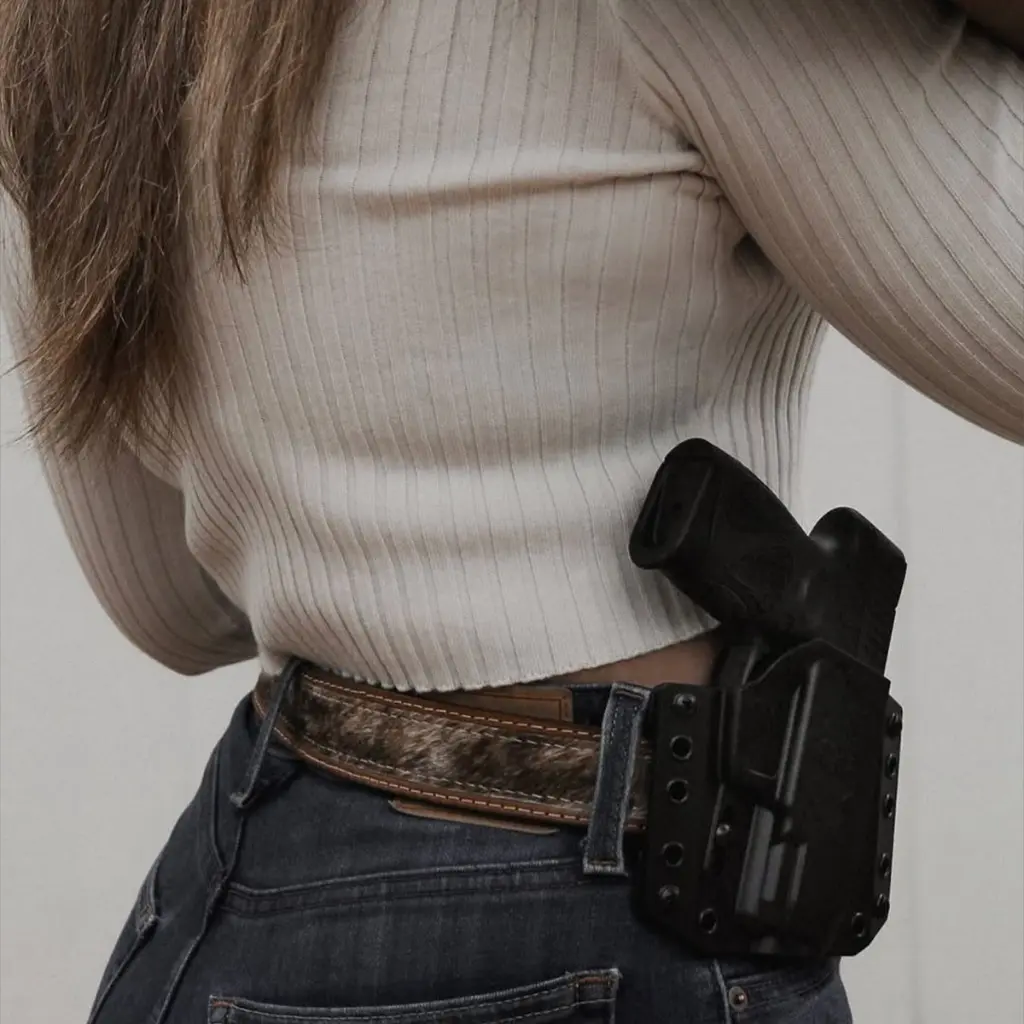
- Works well when clothing has adequate waistband room. Requires pants with a 1 to 2 inch size up from usual to accommodate the firearm without printing. Strong-side IWB at 3 to 4 o’clock is the most common starting position. For women with a defined waist-to-hip ratio, some IWB designs will print or sit uncomfortably; Kydex options with a cant adjustment help.
AIWB (Appendix Inside-Waistband) Carry
- Appendix carry has become significantly more common in the past several years, including among female carriers. It works well for some body types and very poorly for others. Women with more midsection coverage may find appendix carry either uncomfortable or more concealable, depending on their specific anatomy; there’s no universal answer here. Test it with an empty, verified-clear firearm before committing to the position.
Belly Band Carry
- Belly bands are particularly useful for athleisure and workout wear, where no waistband is available for a traditional holster. The Crossbreed Modular Belly Band and the FOMI belt systems are frequently recommended. Primary limitation: slower draw, and the elastic band can shift during physical activity. For everyday carry in athletic clothing, it’s one of the few viable options.
Bra Holsters
- The Flashbang holster and similar designs attach to the bra band and position the firearm below the chest. They do work, but the draw speed is slow, and the draw path requires practice to become consistent. Not suitable as a primary carry method for someone who hasn’t trained the specific draw stroke extensively. Can be appropriate as a backup position.

- Breathable material for maximum comfort
- Right and left handed options
- Perfect fit for all the most popular compact and micro compact firearms
Last update on 2026-10-09 / Affiliate links / Images from Amazon Product Advertising API
Why is 9mm the Best Caliber for Women’s Concealed Carry?
The caliber debate is simpler than most forums make it. Wound ballistics research drawing on multiple years of aggregated real-world data consistently shows that shot placement matters more than caliber choice in most defensive scenarios. No major service caliber; 9mm, .38 Special, .40 S&W, .45 ACP, is reliably deficient in a quality hollow-point defensive loading.
For women’s carry specifically, the practical calculation is this: 9mm offers the best combination of reduced recoil, high magazine capacity, and wide availability of quality defensive loads. Standardized gel testing documents several 9mm hollow-point loads that meet the FBI protocol standard (12 to 18 inches penetration with reliable expansion through four layers of denim). The Federal HST 147gr and Speer Gold Dot 124gr +P are among the most consistently documented performers.
If .38 Special in a revolver is the platform that gets carried and trained with, .38 Special +P loads from Federal and Speer perform adequately in defensive configurations. The “best caliber” is the one chambered in the gun you’ll actually carry, maintain, and train with.
What Are the Most Common Mistakes Women Make When Buying a Carry Handgun?
- Buying what the gun store recommends without testing it. Gun store recommendations are often based on what’s in stock, what has a good margin, or what the salesperson is most familiar with. Before buying, rent the gun at a range and shoot at least 50 rounds. How it feels on round 40 matters more than how it feels on round 5.
- Choosing the smallest possible gun, assuming it’s easiest to conceal. Micro-compact pistols are harder to shoot accurately and develop a flinch response faster due to increased felt recoil. Many women shoot a compact-sized gun significantly better than a subcompact. A gun you shoot well conceals better than a gun you can’t control, because you’ll actually carry it.
- Skipping grip fit evaluation. A gun with a backstrap that doesn’t fit your hand size produces a compromised grip. If the trigger reaches forces your trigger finger to contact the trigger at the first joint rather than the pad, accuracy will suffer under stress. Test the grip fit before committing to a purchase.
- Solving a holster problem by changing guns. “This gun isn’t comfortable to carry” is almost always a holster problem. Before swapping guns, try three different holster designs in different carry positions with the same gun. The gun is rarely the root cause of carry discomfort.
- Relying on pink or female-marketed guns as a quality filter. The color of a gun’s frame has no bearing on its reliability, trigger quality, or suitability for self-defense. Evaluate on mechanics and fit, not aesthetics.
How Much Training Is Enough for Concealed Carry Readiness?
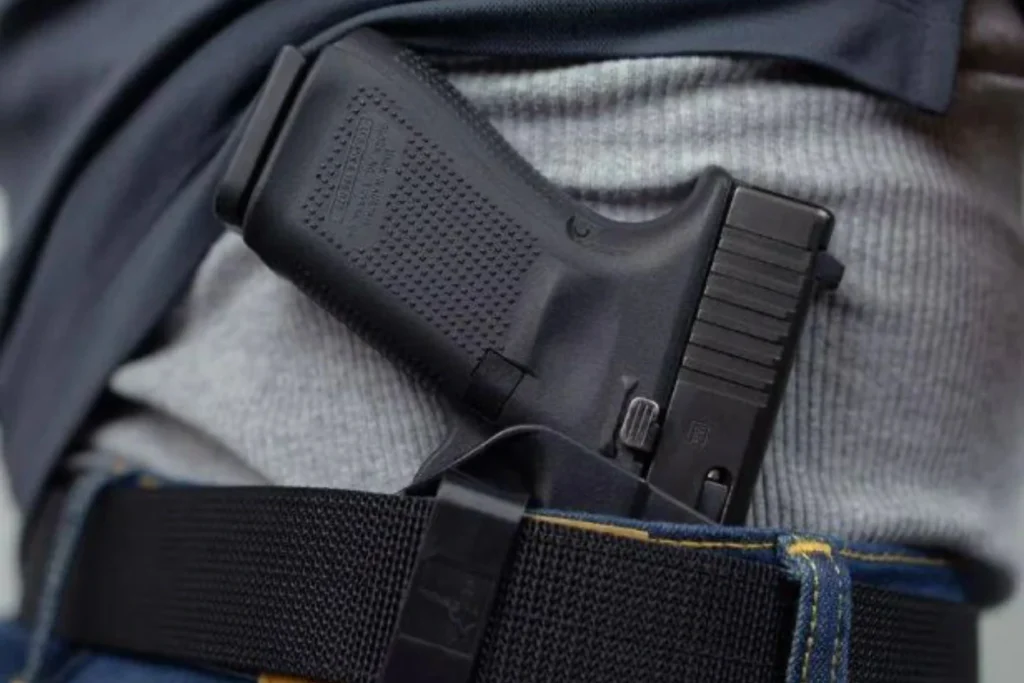
Research from documented student incident data over three decades of instruction shows defensive incidents happen at close range,3 to 7 yards, with limited warning. The practical skill threshold: draw from concealment and place two rounds on a man-sized target at 5 yards in under 3 seconds.
Most people who complete a standard CCW qualification course cannot meet this standard under any stress. The course teaches you enough to get a permit. It doesn’t teach you to be ready.
The starting point that actually builds competency: dry-fire practice 5 minutes per day, focused on a consistent draw stroke from your carry holster. No live ammunition, verified-clear firearm, designated dry-fire area. Training research on ROI consistently shows that drawstroke dry-fire produces faster skill gains than equivalent live-fire time, at a fraction of the cost.
For women building a carry training program from scratch, our concealed carry training guide covers class selection criteria and home dry-fire protocols.

- IMPROVE SHOOTING ACCURACY - 94% of shooters improve after using Mantis X dry fire training system for just 20 mins...
- DATA DRIVEN TRAINING - With the Mantis X10, you can trace the movement of every shot, score and analyze your target...
- SAVE MONEY ON AMMO - Sharpen your shooting skills without breaking the bank on firearm rounds! The Mantis X10 allows you...
Last update on 2026-10-09 / Affiliate links / Images from Amazon Product Advertising API
What Should a Woman Look For in a Carry Handgun?
There is no single best concealed carry handgun for women, because “women” is not a single body type, grip strength, wardrobe, or skill level. What narrows the answer: shoot multiple options before buying, evaluate holster compatibility before committing to a carry position, and choose 9mm for the best combination of performance and shootability.
Among the options in the comparison table above, the Sig P365 and the M&P Shield Plus are the most frequently validated across multiple carry instructors who work specifically with female carriers. Both have broad holster support, manageable recoil, and adequate capacity for defensive use. Neither is the right answer if it doesn’t fit your hand or your carry position.
The single best thing you can do after buying a carry gun: find a qualified instructor, shoot it under pressure, and find out what breaks down in your performance before you need to rely on it. A gun in a drawer full of holsters that didn’t work out isn’t carry gear. It’s expensive inventory.
For a complete breakdown of holster options, see our best concealed carry holsters guide. For caliber selection backed by terminal performance data, see our best 9mm self-defense ammo guide.
Check out this video from ClassicFirearms about The Top 5 Concealed Carry Pistols For Women.
Frequently Asked Questions
-
What is the best concealed carry handgun for women in 2026?
The Sig Sauer P365 and S&W M&P Shield Plus are the most consistently validated options across carry-focused instructors who work with female carriers. Both have broad holster support, manageable recoil, and adequate capacity. Neither is the right answer if it doesn’t fit your hand or your specific carry position, test before buying.
-
Is a smaller gun always better for concealed carry?
No. Micro-compact pistols produce more felt recoil, are harder to shoot accurately under stress, and accelerate flinch response. Many women shoot a compact-size gun significantly better than a subcompact. A gun you can control and shoot well conceals better in practice, because it’s the gun you’ll actually carry consistently.
-
Is a revolver better for women’s carry?
Revolvers offer a simpler manual of arms, no slide to rack, no external safety, no magazine to seat. That makes them appealing for minimal-training carriers. The tradeoffs are a heavier trigger pull and lower round count. For anyone committing to regular dry-fire and range practice, a 9mm semi-automatic is the stronger long-term choice.
-
What is the best caliber for a woman’s CCW?
9mm is the standard: best combination of reduced recoil, high magazine capacity, and availability of quality hollow-point loads that meet FBI protocol penetration standards. .38 Special +P is a solid alternative in a revolver. The best caliber is ultimately the one chambered in the gun you will carry, maintain, and train with consistently.
-
Can you carry a gun in leggings or athleisure?
Yes. Belly band holsters and systems like the FOMI are built for waistbands without belt loops and work well with athletic wear. Draw speed is slower than an IWB setup, that tradeoff needs to be understood and trained for. Practice your drawstroke specifically from whatever carry position you use in athletic clothing.
-
How do I know if a holster fits my body type?
Test it with an empty, verified-clear firearm across three carry sessions before committing. Signs of a poor fit: the gun shifts during movement, printing is visible through normal clothing, or the draw path is inconsistent. Most carry discomfort is a holster geometry problem, not a gun problem. Try at least three holster designs before switching firearms.
-
Do I need to size up my pants to carry concealed?
For IWB carry, yes, typically 1 to 2 inches over your normal waist size to accommodate the firearm and holster without uncomfortable pressure or visible printing. AIWB and belly band options can reduce the need for this depending on body type. Wardrobe compatibility should be evaluated alongside your holster choice, not as an afterthought.
-
How do I build grip strength for racking the slide?
Consistent dry-fire practice is the most accessible method, cycling the slide repeatedly builds the specific hand and wrist strength required. Grip strengtheners help as a supplement. Some pistols also have reduced-power recoil spring options. Testing multiple guns before buying remains the most reliable filter: if you can’t rack it reliably in the store, you won’t rack it reliably under stress.
-
How much does a good women’s carry setup cost?
Budget $450 to $550 for a quality carry pistol, $60 to $120 for a quality holster, and $100 to $200 for an initial training course, a realistic starting total of $650 to $900. Factor in ammunition for 200 to 300 rounds of initial practice. Cutting corners on the holster is where most new carriers lose money and quit carrying.
Would you trust your life to this choice? Tell us why it earned your vote.👇