
Fast Facts
Related: Firearm Safe Storage for Home: Choosing the Right Gun Safe in 2026
“I didn’t realize there was a new law.”
That line came from a gun owner in a Rhode Island forum thread the summer their own state updated its storage requirements. It was not an unusual response. It is the most common reaction responsible gun owners have when they discover a child access prevention law after the fact rather than before.
In 2026, two of the most consequential storage law updates in recent memory took effect simultaneously in California and Illinois. At the same time, three states now put real money back in your pocket for buying a qualifying gun safe, with a fourth adding eligibility in 2027. This guide covers what your state requires, which states pay you to comply, and how to pick a product that satisfies both the law and your home defense requirement. The legal question and the tax question have the same answer: deal with it before anything happens.
Do Any States Offer a Tax Credit for Buying a Gun Safe?
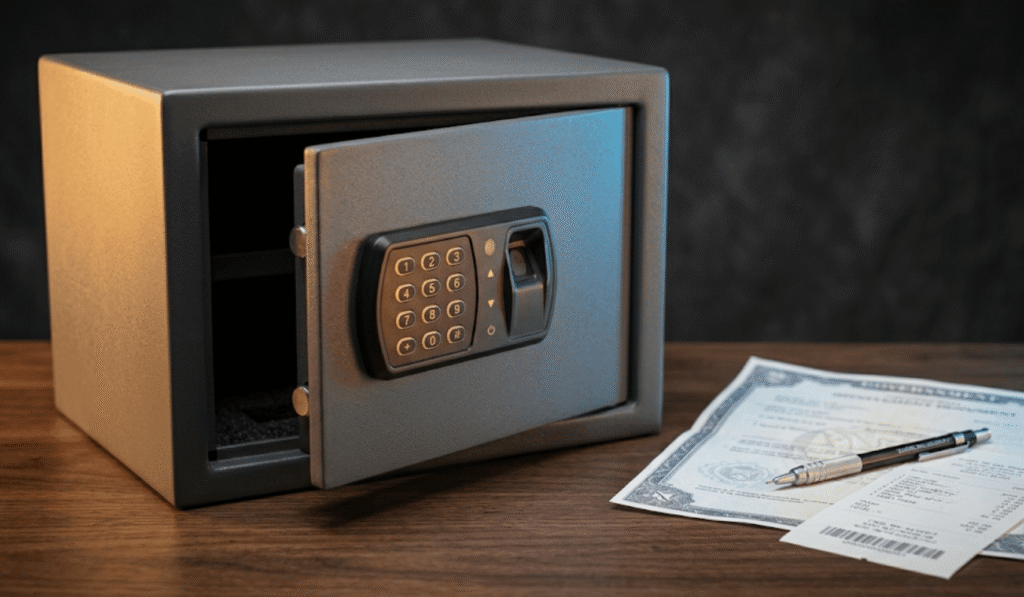
Three states currently operate a gun safe tax credit by state program offering up to $300, and a fourth adds eligibility in 2027.
Here is what is currently on the books:
| State | Credit Amount | Active Period | Per-Taxpayer Max | Key Requirement | Application |
| Virginia | Up to $300 | TY2024 to TY2027 | $300/year ($600 married, filing separately) | Any commercial retailer; UL or ATF/DOJ standard; receipt required; no firearm on same receipt | Form FSD, tax.virginia.gov; first-come/first-served; $5M annual cap |
| California | Up to $300 | TY2025 to TY2029 | $300 per return (one per joint return) | UL-listed steel safe; specifically manufactured for firearm storage; combo or key lock | Claim on FTB state return; one credit per taxpayer for life of bill |
| Georgia | Up to $300 | Jan 2026 to Dec 2030 | $300 lifetime max | Qualifying firearm safe storage device per HB2; preapproval required | Georgia Dept. of Revenue; first-come/first-served; $5M annual cap; keep receipts 3 years |
| Colorado | Up to $200 | TY2027 to TY2028 only | $200/year | Federally licensed dealer only; device must lock by key or combination | First-come/first-served; $500K annual cap; 5-year carryforward; not claimable on 2026 return |
| Federal | None | No program active | N/A | H.R.1272 and H.R.4487 introduced but not enacted | Monitor congress.gov; no federal credit applies to any current tax year |
- Virginia offers up to $300 per taxpayer per year as a nonrefundable state income tax credit, active through tax year 2027. Married couples filing separately can each submit an individual application, bringing the household maximum to $600 annually. As of tax year 2025, purchases from any commercial retailer qualify, not just federally licensed dealers. The credit carries forward up to five years if it exceeds your liability against a $5 million annual cap. Do not include a firearm on the same receipt as the safety device, this disqualifies the claim entirely.
- California offers up to $300 per tax return under AB 2861, active for tax years 2025 through 2029. Only one credit per joint return. The product must be a UL-listed steel safe specifically manufactured to store firearms, with a combination or key lock. A general lockbox or a trigger lock does not qualify under this statute.
- Georgia enacted the Safe Storage Tax Credit Act effective January 1, 2026, running through December 2030. The credit is up to $300 per taxpayer with a $300 lifetime maximum. Preapproval from the Georgia Department of Revenue is required, processed first-come, first-served against a $5 million annual cap. Keep your receipts for three years.
- Colorado passed HB25-1128 creating a credit of up to $200 per year, but the credit applies to tax years 2027 and 2028 only, not 2026. Purchases must be from a federally licensed dealer. The statewide cap is $500,000 annually, substantially lower than other states, which means early applications matter. If you buy a safe in 2026 expecting a Colorado gun safe tax credit by state benefit on your 2026 return, you will not find one. Plan the purchase for a qualifying tax year.
At the federal level, two bills are active: H.R.1272 (Secure Storage Information Act) and H.R.4487 (Gun Safety Incentive Act, introduced July 2025), which would provide a 10 percent credit up to $500. Neither has passed committee as of June 2026. No federal gun safe tax credit by state equivalent exists under current law. Monitor congress.gov for status updates.

Last update on 2026-10-18 / Affiliate links / Images from Amazon Product Advertising API
FTC Disclosure: GunCarrier.com earns a commission on purchases made through links in this section. Liberty Safe, Browning Safes, and SnapSafe all carry models meeting steel and locking specifications for state credit eligibility. Verify current product specifications and active CPSC recall status at cpsc.gov before purchasing.
What Are Child Access Prevention Laws and Do They Apply in Your State?
As of 2026, 35 states and the District of Columbia have some form of child access prevention law, and two major states strengthened their requirements effective January 1, 2026.
Child access prevention laws are state statutes that impose criminal or civil penalties on adults when a minor gains access to an unsecured firearm. There is no federal version. What exists is a patchwork of state laws with different triggering conditions, age thresholds, storage definitions, and penalty structures. [Internal link: 2026 state firearm laws article]
The strongest laws create liability any time a minor could access an unsecured firearm, regardless of whether an incident occurs. Weaker versions create liability only after a child is harmed. The trend in 2026 points in one direction: broader applicability, higher penalties, and mandatory locked-container requirements in states that previously relied on harm-after-the-fact liability.
Two significant updates took effect January 1, 2026:
- California Senate Bill 53 requires all gun owners to store firearms securely in their residences whenever the firearm is not being carried on their person or in their direct control. This is the broadest residential storage mandate currently in effect in any state.
- Illinois Public Act 104-0031 requires firearm owners to secure guns in a locked container any time a minor, at-risk person, or prohibited individual could gain access. The law covers both homes and vehicles. Penalties can reach $10,000.
| State | Law Type | Trigger | Max Penalty | Notes |
| California | Mandatory storage | Firearm not on person or in direct control in residence | Misdemeanor to felony depending on outcome | SB 53 effective Jan 1, 2026; UL-listed device required |
| Illinois | Mandatory storage | Minor, at-risk person, or prohibited person could gain access (home + vehicle) | Up to $10,000 | Public Act 104-0031 effective Jan 1, 2026 |
| Massachusetts | Mandatory storage | Minor under 18 could access | Felony if child obtains and fires; misdemeanor otherwise | Among the strictest in the country |
| Connecticut | Mandatory storage | Minor under 16 could access | Class D felony if minor obtains and fires; Class A misdemeanor for negligent storage | Dealers must provide lock with every sale |
| New York | Mandatory storage | Minor under 16 present, or prohibited person in home | Misdemeanor to felony | NYC has additional local requirements |
| Colorado | Mandatory storage | Minor under 18 could access | Class 2 misdemeanor | Separate from the tax credit program |
| New Jersey | Mandatory storage | Minor under 16 could access | Crime of the fourth degree | |
| Virginia | CAP law | Minor under 14 accesses and handles without supervision | Class 1 misdemeanor; Class 6 felony if injury or death results | State also offers tax credit |
| Maryland | CAP law | Minor under 16 accesses | Misdemeanor | |
| Minnesota | CAP law | Minor under 18 accesses | Misdemeanor | |
| Texas | CAP law | Child under 17 accesses and discharges; injury/death results | Class A misdemeanor to state jail felony | Liability only after discharge causes harm |
| Florida | CAP law | Minor under 16 accesses; injury or death results | Misdemeanor to felony | |
| All other states | Civil liability only or no statute | Varies | Civil damages | Absence of criminal statute does not eliminate civil exposure |
States with mandatory storage or CAP laws as of 2026 include those listed above, plus Hawaii, Maine, Oregon, Rhode Island, Washington, New Mexico, Michigan, New Hampshire, Wisconsin, and North Carolina, among others. This table is not exhaustive and is intended as a reference starting point only. Verify your current state statute at giffords.org/lawcenter before drawing legal conclusions. This article is informational and does not constitute legal advice.
One point that surprises many gun owners: civil liability for negligent storage exists in all 50 states regardless of whether your state has a criminal storage statute. The absence of a law does not close the courthouse. If an unsecured firearm causes harm, civil negligence claims apply under the standard of care a responsible gun owner in your jurisdiction would be expected to meet.
Verify your current state statute at giffords.org/lawcenter before drawing legal conclusions. This article is informational and does not constitute legal advice.
What Does “Locked Container” Actually Mean Under Your State’s Law?
Not all products marketed as gun safes satisfy every state’s statutory definition of “locked container,” and purchasing the wrong product can leave you legally exposed even after a receipt.
This is where responsible gun owners often get caught. The marketing label says “gun safe.” The statute has a specific technical definition. Those two things are not always the same product.
- Virginia requires a device that reasonably limits access and cannot be easily cut, ripped, or opened. The standard is drawn from the ATF and DOJ interpretation of 18 U.S.C. 921(a)(34). Zip ties, rope, bags, gun socks, and racks do not qualify. A product that can be opened with scissors or defeated by tipping it over fails the standard.
- California requires a UL-listed safe specifically manufactured to store firearms, constructed of steel or a material of equal strength, with a combination or key lock listed by Underwriters’ Laboratories.
- Illinois uses “locked container” language from Public Act 104-0031. Verify your product against the statutory language at ILGA.gov before treating any product as compliant.
- Trigger locks satisfy storage requirements in some lower-penalty states. In California and Illinois, a trigger lock alone does not satisfy the mandatory storage statute. If you are in a mandatory-storage state and relying on a trigger lock as your only measure, check your state’s specific statutory language before making that assumption.
A practical check before any purchase: Does the product require a key, combination, or biometric credential to open? Does it have an active CPSC recall? Four biometric gun safe recall actions occurred in 2024. One involved 61,000 units and was linked to a child fatality. Another covered 60,000 units with 71 documented incidents of unauthorized access. A third documented a six-year-old opening the safe with his own thumbprint without prior enrollment. Check cpsc.gov before purchasing any biometric model.

- Quick Dependable Access - prevent firearm accidents, theft, and misuse with this Hornady Rapid Safe Keypad Vault RFID...
- 3 Entry Methods – RFID reader, user programmed access code and mechanical key offer a variety of methods to unlock the...
- Heavy Duty and Tamper Proof – This Hornady safe is made from 14-gauge steel with a thick steel lid for tamper proof...
Last update on 2026-10-18 / Affiliate links / Images from Amazon Product Advertising API
How Do You Balance Safe Storage With Home Defense Access?
Security and accessibility are not opposing requirements. They require a layered system with two separate products, not a single compromise purchase.
This is the question responsible gun owners wrestle with most. A safe that stops a child also slows down an adult at 2 a.m. A bedside vault that opens in two seconds is not the product that protects a house full of firearms against theft or fire. Both problems are real. Neither product solves the other one.
“I want a safe way to store the firearm but also the quickest possible access to it in the event that I would actually need to use it in defense”. That is the exact problem the layered system solves, and it requires a hardware decision, not a single product compromise.
The answer depends on your household.
- Single adult, no minor children in the home: The minimum adequate standard is a 14-to-16-gauge keypad vault meeting your state’s locked-container definition, staged at the location where you need fast access, bolted to the structure. Confirm it passes the from-sleep test: under five seconds, no visual reference. Verify no active CPSC recall on the model.
- Household with minor children: The compliance floor rises. A full steel safe, minimum 12-gauge, bolted to floor or wall, handles long gun and collection storage. A separate staged keypad vault at the bedside handles the primary defensive handgun. These are two different products serving two different requirements. The main safe is not the bedside safe. The bedside safe is not the main safe.
- State with mandatory storage law (California, Illinois, and others): Your state’s statute defines the minimum product specification. California requires a UL-listed safe for all residential storage. Illinois requires a locked container covering vehicles as well as the home. Verify your specific product against the statutory language before purchasing, marketing claims are not statutory compliance.
A handgun holstered on your person at home is faster to access than any stored firearm. That is accurate and not a reason to skip the storage layer. It is the argument for carrying at home, not against securing the firearms you are not carrying.
Which Gun Safes Qualify for the Tax Credit and Home Defense Use?
Verify your current state statute at giffords.org/lawcenter before drawing legal conclusions. This article is informational and does not constitute legal advice.
The product that qualifies for the gun safe tax credit by state in your jurisdiction is not automatically the right product for home defense, but the two requirements can overlap when you start from the specification rather than the price tag.
Use this decision sequence before selecting any product:
- Identify your state’s storage law requirement and statutory product definition.
- Check whether your state has an active tax credit program and what product specifications it requires.
- Run the household audit: Who is in your home? What are you protecting against?
- Check cpsc.gov for any active recall on the specific model you are considering.
Budget tier ($150 to $250): Quick-access keypad vault. 16-gauge steel minimum. Key backup recommended as a redundancy against battery failure. Boltable to nightstand or wall. Adequate for single-adult households in states without mandatory locked-container laws. Verify it meets your state’s statutory definition before treating it as legally compliant.
Mid-range tier ($250 to $500): Rated steel safe, 14-gauge or heavier. Keypad plus key backup. Anchor-bolt capable. Most models in this tier will qualify for the gun safe tax credit by state program in Virginia, Georgia, and California if the UL or steel specification is met. Confirm the product spec against your state’s program requirements before purchase.
Premium tier ($500 and up): Fire-rated full-capacity safe. 12-gauge or heavier. Bolt to floor required. Optimal for fire protection, multi-gun households, and long-term collection storage. The right choice when minor children are in the home and the main safe is the collection storage layer.

- SnapSafe Drop Box Keypad Vault – Keep guns and valuables close at hand for ready access! The fast action drop down box...
- For Guns – Ready to drop into action, enjoy quick access to your handgun! The compact size easily mounts under a...
- Quick Access – Programmable 4 to 6 digit keypad code balances security for your handgun with quick access. Switch...
Last update on 2026-10-18 / Affiliate links / Images from Amazon Product Advertising API
How Do You Claim the Gun Safe Tax Credit in Your State?
All three currently active gun safe tax credits by state programs require a purchase receipt and a separate application. The credit does not apply automatically when you file your taxes.
- Virginia: Purchase from any commercial retailer during the tax year being claimed. Keep the receipt. Submit Form FSD electronically at tax.virginia.gov or by mail. Credits are issued first-come, first-served against a $5 million annual cap. Excess credit carries forward up to five tax years. The program runs through tax year 2027.
- California: Purchase a UL-listed steel safe specifically manufactured for firearm storage. One credit per joint return. Claim on your California state income tax return filed with the Franchise Tax Board. Active for tax years 2025 through 2029. You cannot claim the credit again in a subsequent year if you already claimed it; California allows one credit per taxpayer for the life of the bill.
- Georgia: Apply for preapproval from the Georgia Department of Revenue before or promptly after purchase. Credits are first-come, first-served against a $5 million annual cap. Keep receipts for three years. Maximum $300 lifetime per taxpayer. If the annual cap is exhausted before your application is processed, you cannot carry the unapproved application to the next year, you must reapply. The program expires December 31, 2030.
- Colorado (effective TY2027, not TY2026): Purchase must occur in tax year 2027 or 2028 from a federally licensed dealer. The credit carries forward up to five years. The statewide cap is $500,000 annually, substantially lower than other states. Early applications will exhaust the cap in high-participation years. A 2026 purchase does not generate a 2026 Colorado credit under any circumstance.
For all states: verify eligibility with your state’s department of revenue before purchasing. The gun safe tax credit by state landscape is evolving, and product definitions may be updated by guidance between this publication date and your purchase. Laws change; confirm at the primary source.
Ready to Comply, Collect, and Carry Right?
Three moves that matter:
- Know your state’s storage requirement now, not after an incident. Whether your state has a criminal statute or not, civil liability applies in all 50 states. Documented compliance — receipt, product spec, and application on file — is the only answer that holds up under scrutiny.
- Check the active tax credits before you buy. Virginia, California, and Georgia each put up to $300 back in your pocket for a qualifying purchase this year. Colorado adds that option in 2027. That is real money toward a purchase you should be making regardless. Keep the receipt separate from any firearm purchase.
- Build the layered system, not a single compromise product. The fast-access vault and the rated safe are different products serving different requirements. Budget for both. The staged bedside vault is not optional when minor children are in the home. The full safe is not optional for long-term storage and fire protection.
Download the State Gun Safe Tax Credit Checklist 2026 below. It covers Virginia, California, Georgia, and Colorado in one printable reference with credit amounts, statutory product definitions, application links, receipt retention requirements, and the CPSC recall check step.
Check out this video from SafeandVaultStore‘s – What’s the Best Gun Safe to Buy in 2026?
Frequently Asked Questions
-
Do I get a tax credit for buying a gun safe in 2026?
It depends on your state. Virginia, California, and Georgia each offer up to $300 in state income tax credits for qualifying purchases in 2026. Colorado adds a credit of up to $200 for tax years 2027 and 2028. No federal gun safe credit currently exists. Verify eligibility and product specifications with your state’s department of revenue before purchasing.
-
What are child access prevention laws and do they apply to me?
Child access prevention laws impose criminal or civil liability when a minor accesses an unsecured firearm. As of 2026, 35 states and D.C. have some form of these laws. California and Illinois both strengthened their requirements effective January 1, 2026. Even states without a criminal statute create civil liability exposure. Check giffords.org/lawcenter for your state’s current statute.
-
Does California require gun owners to store firearms in a safe?
Yes, as of January 1, 2026. California Senate Bill 53 requires all gun owners to store firearms securely in their residences whenever the firearm is not carried on their person or in their direct control. The required product must be UL-listed. California also offers up to $300 in state tax credits for a qualifying gun safe purchase under AB 2861 for tax years 2025 through 2029.
-
How do I claim Virginia’s gun safe tax credit?
Purchase a qualifying firearm safety device from any commercial retailer during the tax year being claimed, keep the receipt, and submit Form FSD to the Virginia Department of Taxation electronically or by mail. The credit is nonrefundable, up to $300 per taxpayer per year, and carries forward up to five years if it exceeds your tax liability. Do not include a firearm on the same receipt. The program runs through tax year 2027.
-
What gun safes qualify for the state tax credits?
Requirements vary by state. California requires a UL-listed steel safe specifically manufactured for firearm storage. Virginia requires a device that limits access and cannot be easily forced, cut, or opened; bags, gun socks, racks, and zip ties do not qualify. Georgia requires a qualifying firearm safe storage device as defined in HB2. Always confirm your specific product meets the statutory definition before purchasing.
-
Does Illinois have a mandatory gun storage law in 2026?
Yes. Illinois Public Act 104-0031 requires firearm owners to secure guns in a locked container any time a minor, at-risk person, or prohibited individual could gain access. The requirement covers homes and vehicles. Penalties can reach $10,000. Illinois does not currently offer a state tax credit for gun safe purchases. Verify current requirements at giffords.org/lawcenter or ILGA.gov.
-
What is the difference between a gun safe and a quick-access vault for home defense?
A rated gun safe, typically 12-gauge or heavier steel, fire-rated, and bolted to structure, provides long-term protection against fire and determined theft. A quick-access vault is a staged bedside unit designed for fast retrieval under stress. Most households with minor children need both: the safe for collection and long gun storage, the vault for the primary defensive handgun. Neither product alone satisfies both requirements.
-
Can I keep a gun unsecured at home if my state has no storage law?
You may avoid criminal liability in some states without a mandatory statute. Civil liability is a separate matter. If a child or unauthorized person accesses an unsecured firearm and causes harm, civil negligence claims apply in all 50 states regardless of whether a criminal storage law exists. The absence of a statute is not a legal shield.
-
What is the best gun safe under $500 for CCW permit holders?
For a CCW holder, the priority is a layered approach: a 14-gauge or heavier keypad vault for the bedside defensive handgun, plus a mid-range steel cabinet for additional firearms. Confirm your selected model has no active CPSC recall. Four biometric safe recalls were documented in 2024, including a 61,000-unit recall linked to a child fatality. Mid-range Liberty Safe, Hornady Rapid Safe, and SnapSafe models meet basic specifications in this price range; verify product-specific eligibility for your state’s credit before purchasing.
-
Will Congress pass a federal gun safe tax credit?
Not yet. Two bills are pending in the 119th Congress: H.R.1272 (Secure Storage Information Act) and H.R.4487 (Gun Safety Incentive Act, introduced July 2025), which would create a 10 percent credit up to $500. Neither has passed committee as of June 2026. No federal gun safe credit applies to 2026 tax returns under current law. Monitor congress.gov for current bill status.
-
Does Virginia’s gun safe tax credit apply to purchases from online retailers?
Yes. As of tax year 2025, Virginia allows purchases from any commercial retailer, not just federally licensed dealers. Keep your receipt and file Form FSD separately from any firearm purchase receipt. The $5 million annual cap is allocated first-come, first-served, so submitting early in the tax year improves your chances of approval before the cap is exhausted.
-
Can I claim both a state tax credit and a federal deduction for a gun safe?
No federal deduction or credit currently exists for gun safe purchases. Two bills pending in the 119th Congress would create federal credits, but neither has passed committee as of June 2026. State credits are entirely separate from federal tax treatment. Claiming a Virginia, California, or Georgia state credit does not affect your federal return under current law.
-
What happens if Georgia’s $5 million annual cap is exhausted before I apply?
Your application will not be approved for that tax year. Georgia processes credits first-come, first-served. If the cap is exhausted, you cannot carry the unapproved application forward, you would need to reapply in the next program year. Submit your preapproval application promptly after purchase to protect your position in the allocation queue.
What’s your ‘why’ for this setup? Tell us how it fits your defense strategy.