
This article is informational and not legal advice. Concealed carry law, including federal reciprocity legislation, changes regularly. Consult a licensed attorney in your jurisdiction before relying on any summary of state or federal firearms law.
Key Takeaways
Related: Multi-State Concealed Carry Reciprocity: July 2026 Update
A permit holder driving from Ohio to Illinois this weekend has no simple answer to a simple question: is my carry permit any good once I cross that line? Federal CCW reciprocity is supposed to fix that. It isn’t law yet, and the people pushing hardest for it can’t agree on how to get there. Here is the real framework, not the hope.
Is Federal CCW Reciprocity Law Yet in 2026?

No. Federal CCW reciprocity has not passed Congress. The lead bill, H.R. 38, cleared the House Judiciary Committee on an 18-to-9 vote and was placed on the Union Calendar in October 2025, positioning it for a floor vote that has not happened as of this writing. Its Senate companion, S. 65, has been introduced but has not moved through committee.
Until both chambers pass matching legislation and the President signs it, there is no federal CCW reciprocity standard. What governs your next trip is the same patchwork as always: state-issued permits, state-by-state agreements, and state-specific restrictions that change independently of Washington. Treat any headline claiming otherwise as premature until you confirm it against the bill’s actual status.
What Would H.R. 38 Actually Change?
If federal CCW reciprocity becomes law through H.R. 38, the mechanism is straightforward. A person legally eligible to carry concealed in their home state could carry concealed in any other state that allows concealed carry for its own residents.
- What It Would Allow
That protection extends to permit holders and to residents of constitutional carry states, since eligibility, not a physical permit, is the standard. The bill also amends the Gun-Free School Zones Act to extend that recognition into school zones, and it creates a private right of action for someone whose right to carry is unlawfully interfered with. - What It Would Not Change
What federal CCW reciprocity would not do is erase every state rule. Private property owners still set their own policy. States keep authority over sensitive locations and firearm-type rules unrelated to carry itself. A federal reciprocity law changes who has to honor your permit. It does not turn every state into a blank slate.

Last update on 2026-10-18 / Affiliate links / Images from Amazon Product Advertising API
Why Are Gun Rights Groups Split Over the Fix?
This is the part most reciprocity coverage skips. The disagreement here is not gun owners against gun control. It’s a real split inside the movement pushing for federal CCW reciprocity, over which bill deserves support.
- The Permit-Based Camp
H.R. 38 keeps the existing permit system intact and adds cross-state recognition on top of it. It carries more than 189 cosponsors and committee momentum. The NRA and Gun Owners of America both back H.R. 38 as their top priority on this issue; GOA’s November 2025 letter to House Speaker Mike Johnson defended the bill against law enforcement objections and called it central to restoring Second Amendment protection across state lines. - The Permitless Camp
A rival bill, H.R. 645, the National Constitutional Carry Act, takes a different route: a national permitless carry standard, built on the constitutional carry model already used in most states. The National Association for Gun Rights and the American Firearms Association back H.R. 645 instead, arguing that any system still tied to a government-issued permit falls short of the underlying right.
Forum sentiment reflects the same fatigue on both sides. One longtime poster put the skepticism bluntly: “Anyone who thinks national reciprocity has a chance of passing is delusional.” Another, in a thread running more than a year, kept the door open: “Maybe 2025 is the year we will see this happen.” Both are describing the same underlying problem. Neither is wrong to feel that way.
What Does the Senate Companion Bill Mean for Passage Odds?
S. 65 is the Senate version of H.R. 38, and its existence signals real Senate interest, but interest is not the same as advancing. A federal CCW reciprocity bill needs a full House floor vote, then Senate committee action, then a Senate floor vote, then a presidential signature, in that order. H.R. 38 has cleared exactly one of those four steps. S. 65 has cleared none of them.
This is not a new pattern. A version of this legislation passed the House once before, in 2017, and stalled in the Senate. That history is a reason to keep your compliance plan separate from your optimism about this Congress.
How Should You Handle Multi-State Carry Right Now?
The honest answer depends on how you actually travel, not on a single rule that applies to everyone.
- If Your Route Is Routine
If your carry pattern is routine, meaning you regularly cross into the same one or two neighboring states, verify each state’s current law once, document what you found and when, and only recheck if you hear of a specific legislative change. A stable pattern supports a stable, documented default. - If Your Route Is Irregular
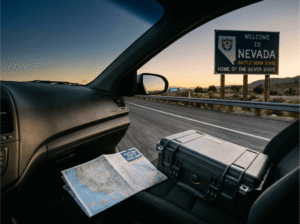
If your carry pattern is irregular, meaning you travel widely or cross into states you don’t carry in often, skip the shortcut. Verify the specific, current law for every state on that trip, every time. Reciprocity maps and bill status both move faster than memory.
Either way, the discipline is the same: your compliance is not something a bill in Congress can do for you today. It has to come from your own verification habit.

- Crushproof Durability – Built from carbon fiber reinforced DS3TeK polypropylene, this TSA approved gun case is...
- Secure Dual-Latch Locking System – Features double latches with reinforced locking lugs for maximum security. This...
- Fits Most Pistols & Revolvers – Measuring 12” x 8” x 3.5”, this hard pistol case fits compact and full-size...
Last update on 2026-10-18 / Affiliate links / Images from Amazon Product Advertising API
What Happens If H.R. 38 Passes?
If federal CCW reciprocity passes in something close to its current form, expect it to preempt most state and local laws that specifically restrict concealed carry by an out-of-state permit holder. Existing state-to-state reciprocity agreements would likely become secondary to that single federal floor.
What it would not likely touch: private property rights, genuinely sensitive locations, and state authority over firearm types unrelated to carry itself. Read the actual final text before assuming what “reciprocity” covers, since bills change in conference and on the floor. The federal CCW reciprocity that eventually passes, if it passes, may differ from the version sitting in committee today.
Your Compliance Doesn’t Wait on Congress
Federal CCW reciprocity would solve a real problem, but it hasn’t solved it yet. No advocacy group’s confidence, on either side of the H.R. 38 versus H.R. 645 divide, changes what the law requires of you this week. Build your own habit: check the specific state, every specific trip, before you assume federal CCW reciprocity carries you across a line it hasn’t crossed yet.
Bookmark the bill’s status page and keep a dated record of the states you’ve verified. For the fuller state-by-state breakdown, see our multi-state concealed carry reciprocity map and our H.R. 38 basics guide. Before your next trip, run through our Pre-Trip Reciprocity Checklist for a state-by-state verification routine.
This article is informational and not legal advice. Concealed carry law, including federal reciprocity legislation, changes regularly. Consult a licensed attorney in your jurisdiction before relying on any summary of state or federal firearms law.
Check out Constitutional Concealed Carry Reciprocity Act H R 38 from Armed Attorneys.
Frequently Asked Questions
-
Is federal CCW reciprocity the law right now?
No. As of mid-2026, H.R. 38 has cleared the House Judiciary Committee but has not received a full House floor vote, and its Senate companion, S. 65, has not moved. Until both chambers pass a bill and the President signs it, no federal reciprocity law exists. State-by-state permit rules still govern every crossing.
-
What would H.R. 38 actually change if it passes?
H.R. 38 would let anyone legally allowed to carry concealed in their home state carry concealed in any other state that allows concealed carry, subject to that state’s specific place restrictions. It would also amend federal law so permit holders could carry in school zones nationwide and would create a legal remedy for people denied that right.
-
Why are gun rights groups divided over the reciprocity bills?
The NRA and Gun Owners of America back H.R. 38, which keeps the permit system and adds cross-state recognition. The National Association for Gun Rights and the American Firearms Association back a rival bill, H.R. 645, which sets a national permitless carry standard instead. The disagreement is over method, not the underlying goal of interstate carry rights.
-
What is H.R. 645 and how is it different from H.R. 38?
H.R. 645, the National Constitutional Carry Act, would extend permitless carry recognition nationwide rather than requiring a state-issued permit for reciprocity. H.R. 38 keeps the permit system intact and adds cross-state recognition. Both aim at the same travel problem but take structurally different legal approaches, which is why the two bills compete for floor time.
-
Does the Senate bill, S. 65, change anything on its own?
Not yet. S. 65 is the Senate companion to H.R. 38 and has been introduced, but it has not advanced through committee. Both chambers must pass matching legislation and the President must sign it before any federal reciprocity law takes effect. Right now, S. 65 is a marker of Senate intent, not active law.
-
How should I handle carrying across state lines while this bill is pending?
Treat it exactly as you would if the bill did not exist, because legally it does not yet. Verify the specific carry law, magazine limits, and restricted locations for every state you will cross before you travel. Do not plan a trip around reciprocity you expect to happen; plan around the law that is actually in effect today.
-
Would H.R. 38 override strict state gun laws if it passes?
It would preempt most state and local laws that specifically restrict concealed carry by an out-of-state permit holder, but it would not eliminate state authority over private property, sensitive locations, or firearm type restrictions unrelated to carry. Read any final version carefully, since preemption scope is one of the most negotiated parts of the bill.
-
What happens to existing state-to-state reciprocity agreements if H.R. 38 passes?
Existing bilateral and unilateral reciprocity agreements would likely become secondary to the federal standard, since H.R. 38 creates one national floor for permit recognition rather than relying on individual state agreements. States could still set additional requirements for their own residents, but they could not selectively refuse otherwise-qualified out-of-state carriers.
-
When might federal CCW reciprocity actually become law?
There is no fixed timeline. H.R. 38 has been introduced in multiple past Congresses without passing the Senate, and this version still needs a full House vote, Senate committee action, a Senate floor vote, and a presidential signature. Advocacy groups on multiple sides describe the current Congress as a realistic window, not a guarantee.
-
Do I need to do anything differently if I only carry in constitutional carry states?
Constitutional carry in your home state does not automatically transfer to states with different rules, whether or not H.R. 38 passes. Some states recognize permitless carriers from other constitutional carry states today; others do not. Verify each destination state’s specific policy toward non-resident permitless carriers before you travel, regardless of federal bill status.
-
Does H.R. 38 override state magazine limits?
No. H.R. 38 preempts state laws that specifically restrict an out-of-state permit holder’s ability to carry concealed. It does not touch magazine capacity limits, firearm type restrictions, or other equipment rules, which are separate from the act of carrying and would remain fully enforceable in every state.
-
Would federal reciprocity apply on federal property?
No. Federal buildings, post offices, and national park visitor facilities are governed by their own federal restrictions, which are separate from state concealed carry law. Federal CCW reciprocity addresses recognition between states. It would not open locations that federal law already restricts, regardless of your permit or home state status.
Lock in your vote and tell us: Why is this the right call?