
Quick Look
The 2023 ATF pistol stabilizing brace rule has been vacated by federal courts and the DOJ dropped its appeal in July 2025. Braced pistols are federally classified as pistols again. No federal registration is required. A formal repeal is in the rulemaking process, with public comments open through August 4, 2026. State laws still apply independently.
This article is for informational and educational purposes only and does not constitute legal advice. Consult a qualified firearms attorney for guidance specific to your jurisdiction and situation.
Related: ATF Pistol Brace Rule 2026: Where It Stands and What Owners Should Do
“A rule that can send you to prison should not be this hard to understand.”
That quote comes from a real gun owner navigating the pistol brace question online in 2026. It captures the problem exactly. For three years, the ATF pistol stabilizing brace rule generated more confusion, misinformation, and conflicting guidance than almost any other federal firearms regulation in recent memory.
The legal picture has resolved. The 2023 rule is dead at the federal level. What remains is the work of understanding what that actually means for you, in your state, with your specific firearm.
The 2023 ATF pistol stabilizing brace rule is vacated, unenforceable at the federal level, and on track for formal repeal before the end of 2026.
This guide gives you the plain-English status report.
What Was the 2023 ATF Pistol Stabilizing Brace Rule, and Why Does It Still Confuse Owners?
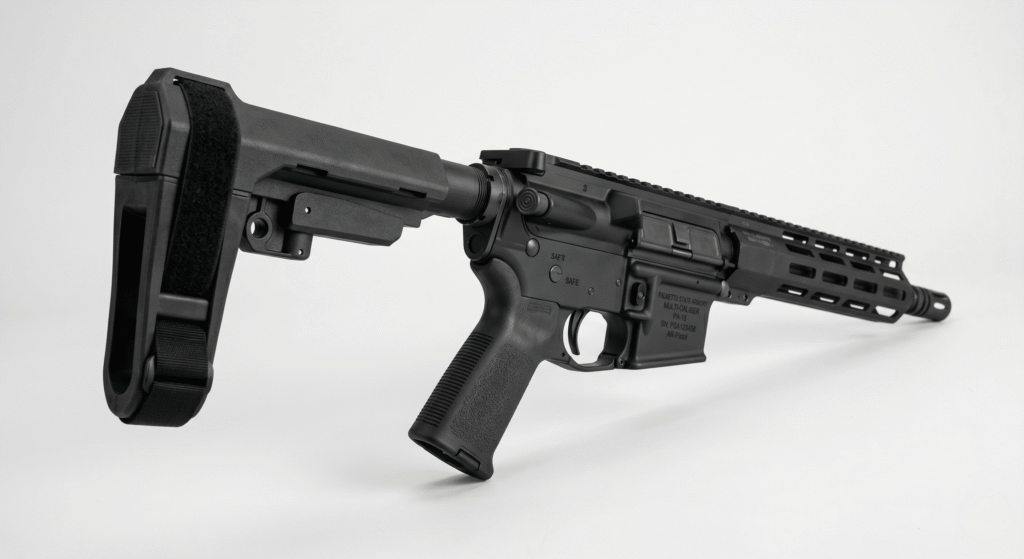
The 2023 ATF pistol stabilizing brace rule attempted to reclassify most braced pistols as short-barreled rifles overnight, and courts found it was unlawful before it ever had consistent nationwide enforcement.
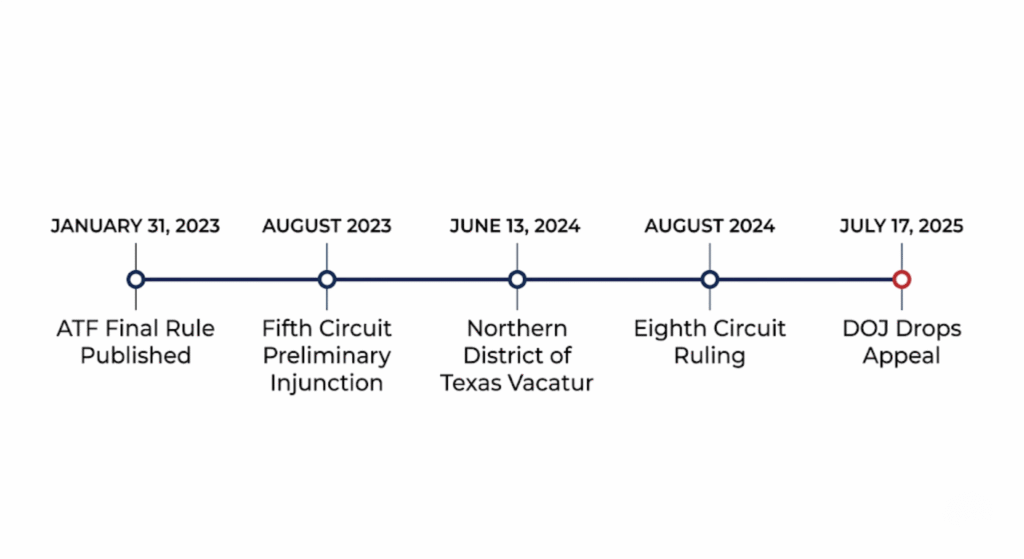
ATF published Final Rule 2021R-08F on January 31, 2023. The rule declared that most pistols equipped with a stabilizing brace would be reclassified as short-barreled rifles (SBRs) under the National Firearms Act. Owning an unregistered SBR is a federal felony carrying up to 10 years in prison and a $250,000 fine.
To comply, owners had 120 days through May 31, 2023, to choose one of four paths: register the firearm as an SBR at no cost during the amnesty window, remove the brace, install a barrel of 16 inches or longer, or destroy the firearm.
The confusion that followed was not accidental. Courts in different jurisdictions issued injunctions protecting different groups of plaintiffs at different stages. If you were a member of a plaintiff organization, you may have been protected. If you were not, the picture was murkier. That patchwork history is why so many owners still ask whether the entire rule was vacated or only part of it. The answer today is all of it.
How Did Federal Courts Strike Down the ATF Pistol Stabilizing Brace Rule?
Two separate federal circuit courts independently found the ATF pistol stabilizing brace rule arbitrary and capricious before the DOJ chose to drop its appeal entirely in July 2025.
Here is the legal timeline in plain English.
In August 2023, the Fifth Circuit found the rule was likely unlawful at the preliminary injunction stage in Mock v. Garland. The court concluded that ATF had issued a vague, subjective test in the final rule that deviated from what was originally proposed during public comment, violating the Administrative Procedure Act (APA).
On June 13, 2024, Federal District Judge Reed O’Connor in the Northern District of Texas vacated the rule entirely. The court found it violated the APA because it was arbitrary and capricious and was not a logical outgrowth of the proposed rule. That ruling had a nationwide effect.
In August 2024, the Eighth Circuit reached a similar conclusion in FRAC v. Garland, finding the rule made it “nigh impossible for a regular citizen to determine what constitutes a braced pistol.” That decision reinforced the Fifth Circuit result from a second independent jurisdiction.
The Supreme Court’s June 2024 ruling in Garland v. Cargill, which addressed bump stocks, added further weight. The Court held 6-3 that ATF cannot reclassify weapons categories without an act of Congress, establishing a principle that directly supported the pistol brace outcomes in both circuits.
On July 17, 2025, the DOJ under the Trump administration agreed to a joint dismissal of the government’s appeal in the case, then renamed Mock v. Bondi. That agreement made the vacatur permanent and removed the last realistic path to reviving the 2023 rule.
An estimated 40 million stabilizing braces were in circulation at the peak of the rule’s enforcement period. The rule attempted to convert that number of owners into potential felons without a Congressional act. It did not survive judicial review.

- FIRE AND FLOOD PROTECTION FOR ESSENTIAL PAPERS: UL Classified to withstand high temperatures for up to thirty minutes...
- DESIGNED FOR IMPORTANT DOCUMENT STORAGE: Spacious interior fits hanging file folders and is ideal for organizing...
- KEY LOCK SECURITY YOU CONTROL: Durable key lock helps prevent unauthorized access and keeps the lid securely closed...

Last update on 2026-10-08 / Affiliate links / Images from Amazon Product Advertising API
What Does the ATF Pistol Stabilizing Brace Vacatur Mean for Owners in 2026?
Owning a standard-braced pistol configuration today requires no NFA registration at the federal level, but the underlying NFA still applies to any build that genuinely crosses into SBR territory, regardless of what brace is attached.
The practical status for most owners is straightforward. Braced pistols are back to their pre-2023 federal classification as pistols. You are not required to register, pay a tax stamp, or take any compliance action at the federal level because of the 2023 rule.
Two points require precision, and both matter for responsible owners.
First, the underlying National Firearms Act has not changed. A firearm with a barrel under 16 inches and an overall length under 26 inches that uses a shoulder stock is still an SBR under the NFA, regardless of what happened to the brace rule. The vacatur removed the specific 2023 reclassification criteria. It did not repeal the NFA itself.
Second, ATF stated in 2026 court filings that it retains case-by-case authority under the underlying NFA for configurations that appear clearly designed to be fired from the shoulder. A group of 13 U.S. Senators sent a letter in April 2026 pushing back on that position. The practical takeaway is that a firearm configured and used as a genuine pistol carries no compliance concern under current federal law. A rifle-like build designed to function as a shoulder-fired weapon is a different situation requiring separate analysis.

- 【Large Accordion File Organizer】- Expandable from 2 inch to 20.5 inch, Yoassi expanding file folder can hold up to...
- 【Improved Size For Legal / Letter Papers】- Most alphabetical file folders can not fit legal papers, so we extended...
- 【Thickened Pockets & Shell】- Traditional accordian folders are prone to ripped during high frequency use. Yoassi...
Last update on 2026-10-08 / Affiliate links / Images from Amazon Product Advertising API
What Is the ATF 34-Rule Package, and How Does It Affect the Pistol Stabilizing Brace Repeal?
The August 4, 2026 comment deadline is the only active date in the ATF pistol stabilizing brace picture right now, and it is an opportunity to participate in rulemaking, not a compliance requirement for owners.
On April 29, 2026, ATF and DOJ released a 34-rule reform package, describing it as the largest federal firearms regulatory rewrite in a generation. The package includes a Notice of Proposed Rulemaking (ATF No. 2025R-11P, Docket No. ATF-2026-0335) to formally remove the 2023 pistol brace language from the regulatory definition of “rifle” in 27 CFR 478.11 and 479.11.
That proposed repeal has a public comment window open through August 4, 2026, via Regulations.gov. If you want to participate, submit written comments before midnight Eastern Time on that date. The comment process is open to any member of the public.
The distinction matters. The ATF pistol stabilizing brace rule is already vacated and unenforceable because of the court order. The proposed repeal is the administrative process of removing the language from the Code of Federal Regulations permanently. The rule cannot be enforced while that process runs. But until the repeal is finalized, the 2023 language technically still exists in the CFR on paper. The formal rulemaking closes that gap.
ATF’s own filing in the proposed repeal states plainly that the 2023 rule “has rarely been in effect” due to the multiple court orders against it, and that the agency is removing language that “exceeds statutory authority” and “failed judicial review.”
Does Your State’s Law Still Affect ATF Pistol Stabilizing Brace Ownership?
The federal rule is gone, but if you live in a state with its own assault weapon or feature restrictions, state law governs you regardless of what happened in federal court.
Federal vacatur does not override state law. States operate their own independent regulatory frameworks for firearms features, configurations, and accessories. A braced pistol that is federally legal may still run into state-level restrictions based on how that state defines prohibited features, assault weapons, or short-barreled firearms.
States with restrictions that may affect braced pistol ownership as of mid-2026 include California, Connecticut, New York, New Jersey, Maryland, Massachusetts, Hawaii, Washington, Delaware, and Illinois. This is not a complete list, and state laws change independently of federal outcomes. Check your state’s current gun laws directly before buying, configuring, or transporting a braced firearm.
California added new accessory restrictions effective January 1, 2026. Pistol grips, adjustable stocks, and flash hiders now face additional requirements and shipping rules that apply independently of the federal brace outcome. As one forum member put it: “No one really knows until you check your own jurisdiction.” That is exactly right, and it is the governing principle for anyone living in or traveling through a restrictive state.
A braced AR pistol that is perfectly legal in Tennessee may be difficult or impossible to configure the same way in California, even though the federal rule no longer applies. The state answer is the one that governs you in your state, full stop.
This article is reference material to help you ask better questions, not legal advice for your specific state and configuration. A qualified firearms attorney familiar with your state’s current statutes is the right resource for a definitive answer.

- Letter Size: This colorful file organizer folder measures 12.8" x 9.4" x 0.4", perfect for letter and A4 size.
- Fashionable and Light: Our expandable folder will not leave you disappointed. With snap closure and incredibly light, it...
- Sturdy and Durable: This document folder is made of high-quality durable plastic that will protect your documents from...
Last update on 2026-10-08 / Affiliate links / Images from Amazon Product Advertising API
If You Registered During the 2023 Amnesty, What Is Your Status Now?
Amnesty registrants are in a distinct legal position because a vacated rule does not erase a registration that was processed and approved.
During the 120-day amnesty window that closed May 31, 2023, some owners filed ATF Form 1 to register their brace pistol as an SBR at no cost. Those approved registrations resulted in a Form 1 on file with the ATF, stamped as tax exempt.
The vacatur of the 2023 rule does not automatically cancel an approved Form 1. According to ATF’s own guidance page on pending forbearance applicants, those who filed under the amnesty may still desire to have the NFA Division process their application and effect registration in the National Firearms Registry. If your Form 1 was approved, your firearm is currently in the NFA registry as a registered SBR. You cannot simply treat it as a pistol again without formal steps to address the registration on file.
One forum member with an approved Form 1 summarized the situation accurately: “Until the ATF notifies everyone that the approved Form 1s from the amnesty are null, it is a registered NFA item.” That is the correct read of the current situation.
The process for removing a voluntarily registered item from the NFA registry following the vacatur is still being clarified as of mid-2026. Do not reconfigure, transfer, or make decisions about an amnesty-registered firearm based on the vacatur alone. Consult a qualified firearms attorney who is current on the post-vacatur paperwork process before taking any action.
Where the ATF Pistol Stabilizing Brace Rule Stands in 2026 and What Responsible Owners Do Next

The regulatory chapter that created years of confusion for millions of responsible gun owners is effectively closed at the federal level. The 2023 ATF pistol stabilizing brace rule was vacated by two federal circuit courts, the DOJ dropped its appeal, and the formal repeal process is underway with a comment deadline of August 4, 2026.
What replaces the confusion is clarity, but only for owners who understand three things in sequence: your federal status, your state status, and your own paperwork status if you registered during the amnesty window.
Compliance is not about fear. It is about preparation. Knowing where you stand before you buy, sell, or transport a braced firearm is the baseline for a responsible owner. The rule that created years of uncertainty is gone. What comes next is straightforward for most owners and requires a phone call to a firearms attorney for those in the amnesty registrant category.
Download the free Pistol Brace Compliance Checklist to confirm your status at the federal and state levels. It covers the key questions to work through in order, the documents to keep on hand, and the questions to bring to a firearms attorney if your situation involves an amnesty registration.
This article is for informational purposes only and does not constitute legal advice. Laws change. Verify current federal and state regulations with a qualified firearms attorney before making decisions about your specific firearm.
Frequently Asked Questions
-
Is the ATF pistol stabilizing brace rule still in effect in 2026?
No. The 2023 ATF pistol stabilizing brace rule has been vacated by federal courts. A federal judge ruled it void in June 2024, the DOJ dropped its appeal in July 2025, and ATF published a proposed repeal in May 2026. Braced pistols are classified as standard pistols again at the federal level. No registration or compliance action is required under the vacated rule.
-
Do I need to register my braced pistol as an SBR in 2026?
No NFA registration is required for a standard-braced pistol under current federal law. The rule requiring registration has been vacated. The underlying NFA still applies to any firearm that genuinely crosses the threshold of a short-barreled rifle by barrel length and overall length, independent of the brace rule. If your build is a genuine pistol configuration, you have no federal registration obligation at this time.
-
What is the August 4, 2026 deadline about?
That is the public comment deadline for ATF’s proposed rulemaking to formally remove the 2023 pistol brace language from the Code of Federal Regulations. It is not a compliance deadline for owners. Submit comments at Regulations.gov under docket number ATF-2026-0335. The rule is already unenforceable due to court vacatur. The rulemaking is the formal administrative cleanup step that removes the language from the books permanently.
-
I registered my pistol as an SBR during the 2023 amnesty. What happens now?
Your approved Form 1 remains on file with the ATF as a registered NFA item. The vacatur of the underlying rule does not automatically cancel that registration. You currently own a registered SBR under federal records. Consult a qualified firearms attorney before making decisions about reconfiguration, transfer, or de-registration. The process for removing amnesty registrations from the NFA registry is still being clarified.
-
Does the federal vacatur protect me in California, New York, or Connecticut?
No. State laws operate independently of the federal rule. More than a dozen states maintain their own restrictions on AR-pistol configurations, feature sets, and related accessories that are not affected by the federal court outcome. Check your state’s current statute directly and consult a local firearms attorney for state-specific guidance before you buy, configure, or transport a braced firearm across or within those state lines.
-
What is the ATF 34-Rule package and does it affect pistol braces?
The ATF 34-Rule package, announced April 29, 2026, is the largest federal firearms regulatory reform in a generation. It includes a proposed rule (ATF No. 2025R-11P) to formally repeal the 2023 pistol brace language from federal regulations in 27 CFR 478.11 and 479.11. That repeal is in the proposed-rule tier, meaning the public comment period must close and ATF must issue a final rule before the language is permanently removed from the books.
-
Can the ATF still take action against my braced pistol configuration?
The 2023 rule is vacated and unenforceable. ATF stated in 2026 filings that it retains case-by-case authority under the underlying NFA for configurations that appear clearly designed to be fired from the shoulder. Builds configured and used as genuine pistols carry no compliance concern under current federal law. If your build would have qualified as an SBR under original NFA criteria before the brace rule existed, that analysis still applies independently of the brace question.
-
What did Mock v. Bondi decide?
Mock v. Bondi is the Fifth Circuit case that produced the final legal outcome for the 2023 ATF pistol stabilizing brace rule. The Northern District of Texas vacated the rule on June 13, 2024. On July 17, 2025, the DOJ agreed to dismiss its appeal via joint stipulation. That dismissal made the vacatur permanent and removed the last realistic path to federal enforcement of the 2023 rule.
-
What cases reinforced the vacatur of the ATF pistol stabilizing brace rule?
The Eighth Circuit’s August 2024 ruling in FRAC v. Garland independently found the rule arbitrary and capricious. The Supreme Court’s June 2024 decision in Garland v. Cargill (602 U.S. 406) reinforced the principle that ATF cannot reclassify weapons categories without Congressional action. Both decisions strengthened the legal foundation supporting the pistol brace vacatur.
-
What should a responsible owner do right now?
Confirm your firearm’s status under the underlying NFA criteria independent of the brace rule. Verify your specific state law using your state’s current statute or a local firearms attorney. If you registered during the 2023 amnesty, consult a firearms attorney about your Form 1 status before taking any action. Watch the August 4, 2026 comment window at Regulations.gov if you want to participate in the formal repeal. Use the Pistol Brace Compliance Checklist to work through each question in order.
Make the case: Why did you vote that way?👇