
Quick Look
Before spending $150 on a premium carry setup, it helps to know what the carbon fiber label on a holster actually means. Most of the time, it does not mean what the price tag implies. This guide breaks down the real material differences, how retention levels work for civilian carry, and what to test before committing to any holster at any price point.
Related: Best New Appendix Carry Holster Designs of Spring 2026
What Does “Carbon Fiber Holster” Actually Mean?
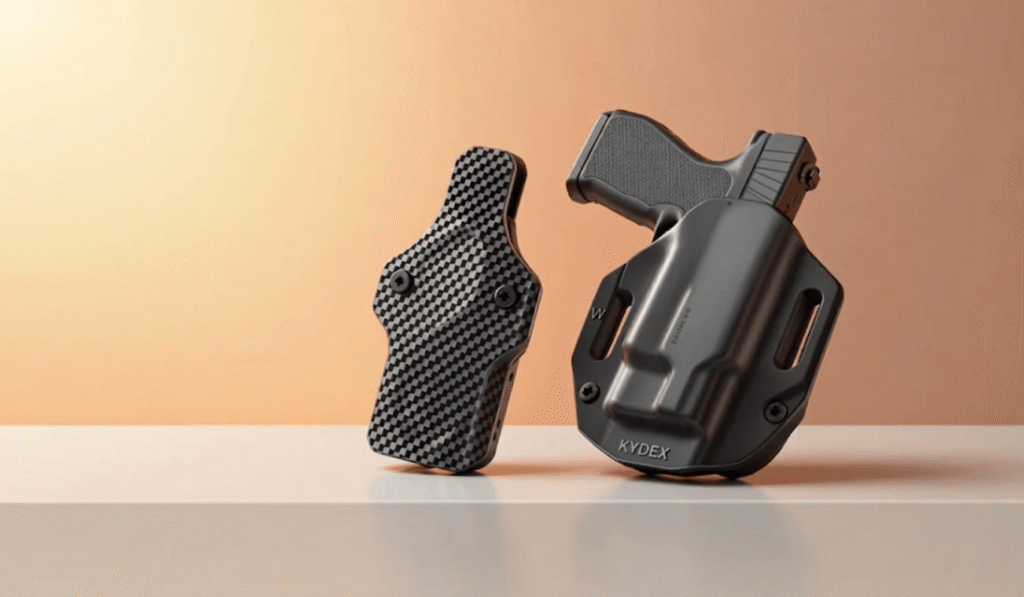
Most holsters marketed as carbon fiber are Kydex thermoplastic with a carbon fiber texture overlay applied to the surface, not true carbon composite material.
Here is the structural distinction. True carbon fiber is carbon-strand fabric locked in rigid epoxy resin, the same construction used in aircraft components and high-performance motorsport equipment. Kydex is an acrylic thermoplastic that is heated and formed around a specific firearm to hold its shape under pressure. When you see a carbon fiber holster priced between $40 and $100, the shell is almost certainly Kydex with a carbon-pattern finish applied to the surface.
According to Kydex LLC’s published material specifications, the base thermoplastic performs identically whether the surface carries a flat finish or a carbon-fiber texture. The overlay changes appearance and adds minor surface hardness. It does not change the shell’s structural performance in any carry-relevant category.
What the carbon texture overlay does deliver: modest UV resistance, a harder contact surface than flat Kydex, and visual appeal. What it does not deliver: meaningful weight savings, better retention, or improved all-day comfort compared to equivalent Kydex construction at a lower price.
True carbon composite holsters, made from actual carbon-strand fabric in epoxy, exist in the $150 to $300 range. They offer one genuine performance advantage, covered in the durability section below. But they represent a small fraction of what the market labels as a carbon fiber holster.
Confirm the actual material before purchasing. Ask the manufacturer directly or read the product specification, not the product name.
How Do Retention Levels Work for Concealed Carry?
For civilian concealed carry, Level 1 passive retention is the correct choice for most carriers because a concealed firearm is already its own security layer.
Holster retention levels were systematized in the early 1970s and apply across the full carry spectrum. The structure is straightforward.
- Level 1 uses passive friction. The shell is thermoformed to a specific firearm model. The gun seats with an audible click and releases on a single deliberate upward draw stroke. No buttons, thumb breaks, or locking hoods. One motion in, one motion out.
- Level 2 adds one active mechanism, such as a thumb break or rotating hood, requiring a deliberate disengagement step before the firearm releases. Level 3 adds a second active mechanism.
For civilian inside-the-waistband appendix carry, Level 1 is the appropriate standard. When you carry concealed, nobody around you sees where the firearm is. The concealment itself provides the primary security. Adding active retention mechanisms slows your draw without solving a problem that concealment already addresses.
Open carriers and uniformed officers face a different situation. Their firearm is visible, which makes it a potential target for a disarm attempt. Level 2 or 3 is appropriate in those contexts.
The retention variable that matters most for concealed carry is fit. A gun-specific shell precisely thermoformed to your exact firearm model, with an adjustable retention screw tuned to your draw preference, provides more functional security than a universal shell in any material. Adjust the screw until the gun stays put through a full day of sitting, driving, and movement, and releases cleanly on a deliberate draw stroke. That is adequate retention for civilian carry regardless of shell material.

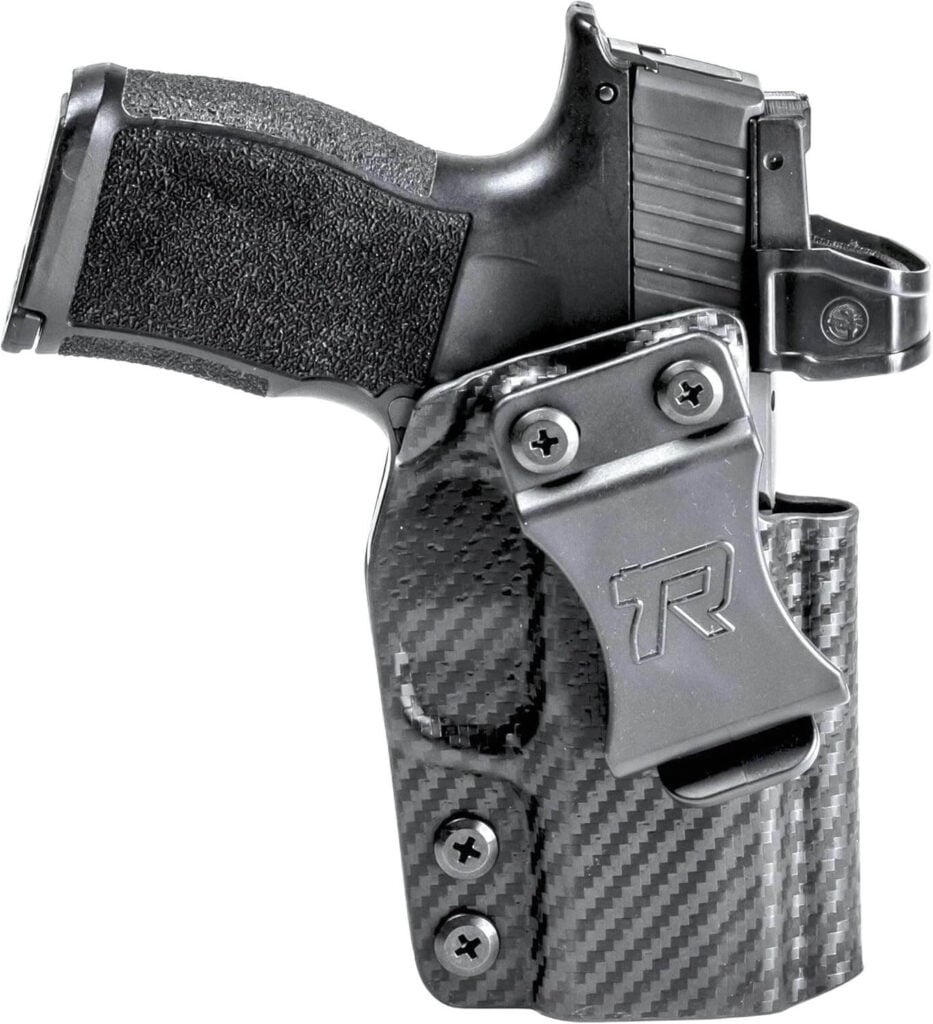
- ULTRA COMFORTABLE ALL DAY CARRY at just 3 ounces. INSIDE THE WAISTBAND HOLSTER fits: FN 509 Compact - Our IWB concealed...
- IWB HOLSTER Compatible with your FN 509 Compact FEATURES: Comfortable Enough to Forget You Have It On at only 3 ounces...
- ADJUSTABLE ‘POSI-CLICK’ RETENTION & CANT: When you holster your IWB Holster Compatible with your FN 509 Compact...
Last update on 2026-10-09 / Affiliate links / Images from Amazon Product Advertising API
Are Carbon Fiber Holsters More Durable Than Standard Kydex?
In the force conditions that holsters actually experience, premium Kydex and carbon overlay Kydex perform comparably in durability. True carbon composite outperforms in heat tolerance but costs two to four times as much.
Consider what holsters actually encounter in daily carry: abrasion from thousands of draw-and-reholster cycles, sweat exposure, UV from the sun, drop impact, and vehicle heat. In all of those categories, quality Kydex performs well. It flexes under impact rather than cracking. It resists moisture. Surface wear accumulates over time at high-traffic draw points, but shell integrity holds for a decade or more with regular use.
The one category where a true carbon composite offers a meaningful advantage is heat tolerance. Kydex begins softening at approximately 140 degrees Fahrenheit, a temperature reachable inside a vehicle on a hot summer day in most regions. A Kydex holster left in a hot car can deform and compromise retention permanently.
The carbon overlay finish does not change this threshold. A carbon-textured Kydex shell has the same heat tolerance as a flat Kydex shell because the base material is identical.
If vehicle storage is part of your carry reality, the correct solution is a dedicated vehicle safe or lockbox rated for high temperatures, not a holster material upgrade. A quality vehicle safe addresses the heat problem more reliably than any shell material at a comparable or lower cost.
How Do You Improve Appendix Carry Comfort Without Buying a New Holster?
Appendix carry comfort is a system variable with four adjustable inputs: shell thickness, cant angle, foam or wedge backing, and belt stiffness.
Appendix inside-the-waistband carry has become the dominant carry position for reasons grounded in performance. It produces the fastest drawstroke from concealment, positions the firearm where it is most naturally defended against a disarm attempt, and allows the most consistent grip acquisition. Those outcomes are documented across training contexts with tens of thousands of repetitions behind them.
The comfort problem, especially in summer, is real. The hard plastic shell of any Kydex holster creates contact pressure against the lower abdomen that builds over a full day. Shell material is the lowest-leverage variable for addressing this. The four inputs that actually move the needle are:
- Shell thickness. A slimmer shell reduces bulk and improves concealment under light summer clothing. Both carbon overlay and standard Kydex options exist in slim configurations.
- Cant angle. A forward cant of 10 to 15 degrees rotates the grip away from the body and reduces printing under a t-shirt. Neutral cant works for some body types. Test in your actual carry clothing before committing to a purchase.
- Foam or wedge backing. A foam wedge attached to the muzzle side of the holster angles the grip away from the body and redistributes contact pressure across a wider surface area. Third-party wedge options typically run $15 to $30. This addition often solves the comfort problem that people try to address with a $150 material upgrade.
Belt stiffness. A dedicated gun belt distributes the weight of the holster and firearm across the waistband. A standard dress belt allows the rig to sag and rotate, creating the hot spots and position shifting that make appendix carry feel unstable by midday.
For female carriers: the holster industry’s default geometry assumes male torso proportions. Cant angle, ride height, and clip placement all interact with female anatomy differently than the default design accounts for. A carbon overlay finish does nothing to address that. Test any holster in your actual carry position and your actual clothing before purchasing.
No products found.
What Is the Best Carbon Fiber Holster for Your Carry Style?
The best holster is the one that passes the five-day carry test, delivers a consistent drawstroke, and stays on your body in every situation you actually move through.
Before evaluating a material or brand, apply the three questions:
Does the gun stay put when you run, sit in a car, and drive for an hour? Can you draw cleanly with a standard grip without a second-hand adjustment? Can you wear this holster all day without repositioning or avoidance behavior?
If a holster fails any of those three questions, no material upgrade solves it. If it passes all three, the material question has already been answered by the field result.
Here is where the selection approach splits, and it is worth naming directly. An evidence-first approach says: measure before you buy, test against a defined draw-time standard of 1.5 to 2.0 seconds from concealment, and verify material claims before paying a premium. An adequacy-first approach says: carry consistently in any holster that passes the five-day test, because a holster worn every day in any material outperforms a premium holster left at home. After all, it is uncomfortable. Both approaches are correct. Which one applies to you depends on your carry experience level.
If you have fewer than 90 days of consistent carry history, apply the adequacy standard first. Find a holster from a proven manufacturer that passes the five-day test. Material is irrelevant at this stage.
If you are an experienced carrier with a specific identified problem, such as heat tolerance in vehicle storage, finish wear at high-volume training, or summer comfort gaps, apply the evidence-based test. Identify the problem precisely, verify whether a material upgrade actually addresses it, then decide.

- Universal Compatibility: Compatible with most IWB and AIWB Kydex holsters, providing a versatile solution for your...
- Enhanced Comfort: The angled, flexible design of this foam wedge evenly distributes pressure, reducing hotspots and...
- Improved Concealment: Drawing the top of your gun closer to your body reduces printing, helping you maintain a...
Last update on 2026-10-09 / Affiliate links / Images from Amazon Product Advertising API
Disclosure: GunCarrier earns a commission on purchases made through links on this page at no additional cost to you.
What to Do Before You Buy a Carbon Fiber Holster
Confirm what material you are actually buying before placing an order. Apply the drawstroke-first test before adding any holster to your system. If you carry an appendix in summer, try a foam wedge addition before paying a material premium. If heat storage in a vehicle is a concern, address it with a dedicated vehicle safe before a holster upgrade.
The most important metric is not material, retention level, or brand. It is whether you carry the firearm every day. A $45 Kydex shell, carried consistently in every situation, outperforms a $200 carbon-composite holster left on the nightstand because the cant angle is wrong.
Use the GunCarrier Holster Comparison Chart to compare tested options by material, retention level, carry position, and price tier before your next purchase.
Check out this video from Falco Holsters.
Frequently Asked Questions
-
What is a carbon fiber holster?
Most holsters marketed as carbon fiber use standard Kydex thermoplastic with a carbon fiber texture printed or laminated on the surface. True carbon fiber holsters, constructed from carbon-strand fabric in rigid epoxy resin, exist but are rare and priced between $150 and $300. Confirm the actual construction with the manufacturer before purchasing.
-
Are carbon fiber holsters better than Kydex?
In everyday carry conditions, carbon overlay Kydex performs comparably to standard Kydex in all practical categories. True carbon composite offers better heat tolerance, relevant for firearms stored regularly in hot vehicles. For retention, draw consistency, and daily comfort, shell fit, cant angle, and ride height matter more than material selection.
-
What retention level is best for concealed carry?
Level 1 passive retention is the standard for civilian concealed carry. Your firearm is concealed, so concealment itself provides the primary security layer. A gun-specific shell with an adjustable retention screw and audible posi-click provides sufficient security for IWB carry without the draw-time penalty of active locking mechanisms designed for uniformed duty use.
-
How do I make appendix carry more comfortable?
The four adjustable variables are shell thickness, cant angle, foam or wedge backing, and belt stiffness. A foam wedge between the holster muzzle and your body reduces contact pressure and is often more effective than a material upgrade at a fraction of the cost. Try a third-party holster wedge at $15 to $30 before spending $150 or more on a new shell.
-
Can Kydex holsters warp in a hot car?
Kydex begins softening at approximately 140 degrees Fahrenheit, which is reachable inside a vehicle on a hot day in most regions. Prolonged heat exposure can permanently deform a Kydex shell and compromise retention. A dedicated vehicle safe rated for high temperatures is the correct solution. Carbon overlay Kydex has the same heat threshold as flat Kydex because the base material is identical.
-
Does holster material affect draw speed?
Material does not directly determine draw speed. Draw speed is a product of holster fit, carry position, clothing clearance, and training repetitions. A precisely fitted $45 Kydex shell worn consistently will produce faster and more reliable access than a $200 premium shell worn infrequently. Train the drawstroke before upgrading the gear.
-
What is the difference between Level 1 and Level 2 retention for CCW?
Level 1 uses passive friction through gun-specific molding, releasing on a single deliberate draw stroke. Level 2 adds one active mechanism, such as a thumb break or rotating hood, requiring a deliberate disengagement step before the firearm releases. For civilian concealed carry, Level 1 is the standard. Level 2 is appropriate for open carry or any environment where the firearm is visible and a disarm attempt is a realistic risk.
-
Are carbon fiber holsters a good fit for women?
No carbon fiber finish provides a body-fit advantage for female carriers. The critical variables are cant angle, ride height, and clip placement, all of which must match female torso geometry rather than the industry’s default male-body proportions. Test any holster in your actual carry position and your actual clothing before committing to a purchase, regardless of material or price tier.
-
How long do Kydex holsters last?
A quality gun-specific Kydex holster from a reputable manufacturer can last a decade or more with daily carry. The most common failure points are clip wear, retention screw loosening, and surface finish wear at high-contact draw points. Carbon overlay finish may show surface marks sooner than flat Kydex under heavy training volume, but shell integrity is not affected by surface wear.
-
What brands make reliable appendix carry holsters?
Confirmed options across price tiers: Concealment Express and Vedder LightTuck for budget to mid-range Kydex and carbon overlay options. PHLster and Tier 1 Concealed for precision-fit mid-range direct-to-consumer Kydex. PHLster and Tier 1 Concealed sell direct only and are not available through Amazon. Verify model compatibility at each manufacturer’s site before purchasing.
-
Is a carbon fiber holster TSA or airline compliant?
Neither carbon overlay Kydex nor true carbon composite triggers airline compliance concerns specific to holster material. Compliance issues for air travel with firearms relate to the firearm itself and its declared storage container, not holster construction. Review current TSA-declared firearm rules at TSA.gov and confirm your airline’s policy before any flight with a firearm.
-
Can I adjust the retention on a carbon fiber holster?
Most gun-specific Kydex and carbon overlay Kydex holsters include an adjustable retention screw. Turning it clockwise increases draw resistance by tightening the shell against the trigger guard area. Counterclockwise loosens it. Adjust until the firearm stays put through sitting and movement, but releases cleanly and consistently on a deliberate draw stroke.
-
What is the difference between IWB and OWB for a carbon fiber holster?
IWB positions the holster inside the waistband against the body, prioritizing concealment at the cost of some comfort and accessibility. OWB mounts outside the waistband, prioritizing accessibility and comfort while reducing concealability. Carbon overlay and standard Kydex options exist in both configurations. Carry position drives this decision more than material selection.
Make the case: Why did you vote that way?👇