Knowing how to holster properly is paramount for everyone who owns a gun. The simple process of reholstering must follow a safety procedure, otherwise you can injure the case, yourself, or others.
How to Holster | Tips for Safe and Proper Holstering
Learning how to holster properly isn’t given much attention in gun training, but it should. Re-inserting the gun into a holster is a high-risk activity for many, but it doesn’t have to be. Avoid pain, disability, or worse by doing it the right way every time. Here are some pointers about equipment and behaviors to keep you free of unwanted bodily holes. Not to mention, understanding how to holster properly will keep you looking competent on the range.
1. Maintain a firing grip throughout the holstering process.

The term “firing grip” means the “V” of your thumb and forefinger is as high as reasonably possible on the backstrap. Further, the three non-trigger fingers are wrapped firmly around the grip, and your trigger finger is straight and planted against the frame. Never loosen your grip as you reholster. This is essential discipline not only for safety but also for developing an automatic habit in self-defense or competition.
2. Be sure the holster is clear of obstructions involving the holster itself.
Some holsters have retention straps that tend to dangle over the opening. Some have the trigger finger-operated retention devices that collect snow or small sticks that protrude into the holster. There is nothing inherently wrong with either type, so long as you ensure the opening and interior are clear before inserting your gun. Never use your muzzle to clear an obstruction and never cross your support hand in front of the muzzle to clear the holster!
3. Be sure the holster is clear of potential wardrobe malfunctions.
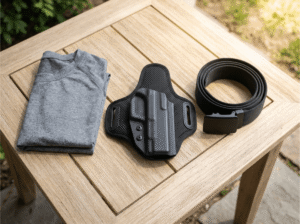
It’s best to tuck your shirt in tightly when wearing a holster outside the waistband. If not, or if you’re wearing a baggy shirt, you risk pushing a fold of clothing or a button into the holster. This can result in an unintentional discharge. Clearing baggy shirts from the holster area is best done by placing your support hand flat against your abdomen just in front of the holster and then pressing against yourself as you draw toward your midline. This will clear the holster opening while preventing the muzzling of your own hand.
Does your carry holster have these 3 essential properties? Follow this link and find out! #GunTips https://t.co/uOVTwDfREQ
— Gun Carrier (@GunCarrierUSA) September 20, 2017
4. Don’t use the muzzle to work the gun into a collapsible holster.
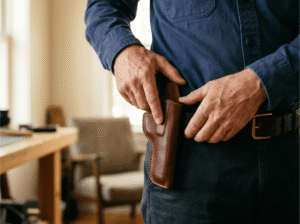
My everyday carry holster is a Sticky brand. It works great for me, but one of its limitations is reholstering. The collapse of a holster upon drawing must be deliberately placed back on the gun — not vice versa. This means I have to remove the holster from my waistband and use my support hand to lower it onto the muzzle from above. This way the muzzle never covers my non-gun hand or other body parts. It’s very little trouble, since this is only necessary when I’m doing a chamber check or after firing.
5. Stand up first, reholster second
It’s a great idea to practice firing from different positions once you’re safe and comfortable shooting from a standing position. It’s a big risk to reholster when prone, kneeling, sitting, and so on. Keep your muzzle in a safe direction with the gun in a firing grip in one or both hands as you rise. If you want to be pro-active in your training, visually scan your environment as you come up to a standing position, then go to the holster.
6. Take your time.
Some lasting advice I got from my first pistol class at Gunsite Academy is “draw quickly, fire slowly, reholster reluctantly.” This was often followed by “there are no awards for speed reholstering.” This simple investment of a couple extra seconds will protect your life and health.
Watch this video about holster angle and placement by PersonalDefenseNet:
Apparently, holstering is not as simple as it appears in the movies. Carrying a loaded gun so close to your body is already a risk in itself. Otherwise, these tips wouldn’t be necessary. A huge percentage of gun owners own a gun for self-defense, thus, proper holstering for the purpose of competing is somewhat a secondary priority. Overall, the proper knowledge of holstering is an essential skill to become a well-rounded gun owner.
What can you say about learning the right way to holster? Share your thoughts in the comments below!
UP NEXT: 3 Must-Have Properties of All Carry Holsters

Follow us on Facebook, Instagram, Twitte